- Animals
- ›Chordates
- ›Vertebrates
- ›Mammals
- ›Therians
- ›Placental Mammals
- ›Ungulates, Carnivorans, and Allies
- ›Even-toed Ungulates and Cetaceans
- ›Cetaceans and Hippopotamuses
- ›Cetaceans
- ›Toothed Whales
- ›Beaked Whales
- ›Beaked Whales
- ›Ziphius
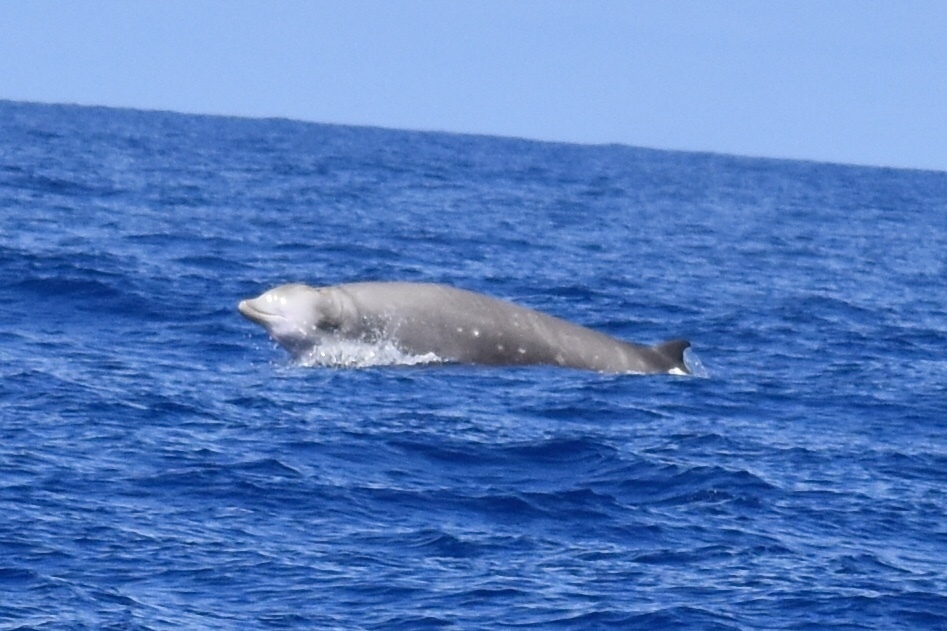
Cuvier's Beaked Whale
Ziphius cavirostris
Cuvier's beaked whale, goose-beaked whale, or ziphius (Ziphius cavirostris) is the most widely distributed of all beaked whales in the family Ziphiidae. It is among the largest beaked whales but smaller than most baleen whales, reaching lengths of about 4.5–8 metres (15–26 ft) and weights of 1,800–3,100 kg (4,000–6,800 lb).
This species is pelagic, inhabiting deep offshore waters far from coastlines, typically deeper than 1,000 metres (3,300 ft). They reside mostly in temperate, tropical, and subtropical areas of the Atlantic, Pacific, and Indian Oceans.
From the article Cuvier's beaked whale on Wikipedia (CC BY-SA), quoted section by section
Description
The body of Cuvier's beaked whale is robust and cigar-shaped, similar to those of other beaked whales. Adult Cuvier beaked whales vary in length from 4.5–8 metres (15–26 ft) and weights of 1,800–3,100 kg (4,000–6,800 lb). Males and females tend to be similar in size; however, females are sometimes found to be bigger. The colour is variable among individuals and between sexes. Adult males are typically a dark grey over most of their body, with the head being slightly lighter grey or even white. Females vary from dark grey to a reddish-brown, and their head lightening is usually less pronounced. Adult males often bear numerous scars along their bodies. These marks can be used to identify individuals. The scars are believed to be from battles between other males, as well as interactions with predators, such as cookiecutter sharks and lampreys. The frequency of scarring is higher in males than in females, and tends to increase with age.
Range & habitat
Cuvier's beaked whale has a cosmopolitan distribution, meaning it resides in many oceans across the world. The species occurs mostly in temperate, tropical, and subtropical waters, but its range extends into cooler temperate regions. It is found primarily in deep offshore waters of the Atlantic, Pacific, and Indian Oceans, as well as the semi-enclosed seas such as the Mediterranean Sea and the Gulf of Mexico, but avoids (or is very rare in) shallow seas like the North and Baltic Seas. Cuvier's beaked whales are strongly associated with deep ocean habitats, usually in waters deeper than 1,000 m (3,300 ft). They are often found near underwater features such as continental slopes, submarine canyons and seamounts where their prey species are abundant. Cuvier's beaked whale is thought to be one of the most widespread and abundant of the beaked whales. Global population size is uncertain but estimates suggest that the worldwide population likely exceeds tens of thousands of individuals. Regional surveys estimated 80,000 are in the Eastern Tropical Pacific, nearly 1,900 are off the west coast of the United States (excluding Alaska), and more than 15,000 are off Hawaii. The population in the Gulf of Mexico is extremely small and appeals have been made to have them made a protected species in this area. …
Wikipedia: “Distribution and habitat”
What it does
Newborn calves are approximately 2–3 m (6 ft 7 in – 9 ft 10 in) long and weigh about 250–300 kg (550–660 lb) at birth. Calves are typically black or dark blue with a lighter underside. Females reach maturity at an average length of 5.8–6.7 m (19–22 ft) and males at 5.0–7.0 m (16.4–23.0 ft), weighing about 2 to 3.5 tonnes. Cuvier's beaked whale can live for up to 60 years. Cuvier's beaked whales reach sexual maturity at 11 years old. Breeding and calving occurs all throughout the year, but often in the spring time. The gestation period lasts around 12 months until females give birth to a single calf at a time. This occurs about every two to three years. Cuvier's are typically found in small groups, from two to seven individuals, or up to 30–40 individuals, which likely plays a role in mating behaviour.
Wikipedia: “Lifespan and reproduction”
At the table
Cuvier's beaked whales primarily feed on deep-sea animals and are specialist hunters of squid. Their diet consists mainly of squid, along with deep-sea fish and some crustaceans. They usually make their dives in small social groups. This behaviour may reduce predation risk. They are thought to forage during deep dives where they use suction feeding to capture prey. This involves opening the mouth, expanding the throat, and using the tongue to create a pressure difference that pulls prey into the mouth. This species possess throat pleats, that allows their throat to expand, which likely helps with suction feeding. Echolocation is used to detect prey in deep, dark waters where sunlight does not reach. The "melon" (the bump on top of its head) contains its organ for echolocation. This allows them to hunt effectively at great depths and may reduce competition with other marine predators for their prey. Most information about their diet comes from the analysis of stomach contents of stranded individuals. Examining Pacific Ocean whales, they found that cephalopods made up 98.0% (by number) and 87.7% (by mass) of Cuvier's beaked whale diet. Among these were at least 37 varieties of squid, of many different sizes. Diet can vary by region, depending on the availability of prey at different ocean depths.
Wikipedia: “Food and foraging”
Listen
Looking for field recordings…
Where it lives
Recorded sightings
—
geo-referenced records in GBIF, from museums, herbaria and field observers.
Drag the globe to turn it. Dots are where records exist, not a range map; darker means more records.
In the stacks
Searching the stacks…
Every page naming Ziphius cavirostris in the Biodiversity Heritage Library →
This page is assembled live from iNaturalist, GBIF, Wikipedia, the Source Library and the Internet Archive. It is not yet part of the hand-edited codex. iNaturalist taxon 41428.