- Animals
- ›Chordates
- ›Vertebrates
- ›Mammals
- ›Therians
- ›Placental Mammals
- ›Ungulates, Carnivorans, and Allies
- ›Even-toed Ungulates and Cetaceans
- ›Cetaceans and Hippopotamuses
- ›Cetaceans
- ›Toothed Whales
- ›Beaked Whales
- ›Beaked Whales
- ›Mesoplodon
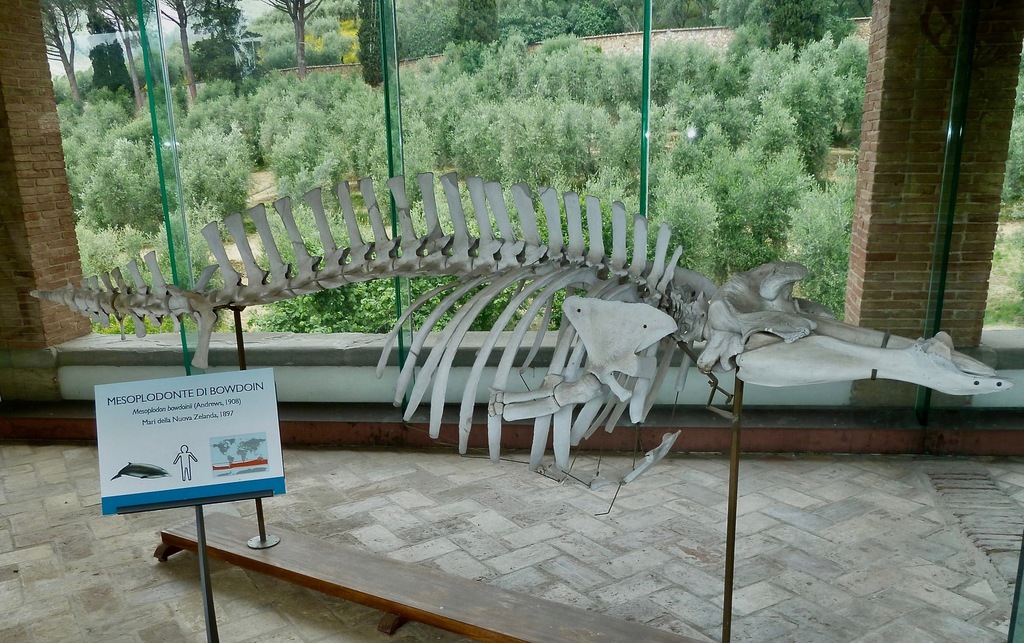
Splay-toothed Beaked Whale
Mesoplodon bowdoini
Andrews' beaked whale (Mesoplodon bowdoini), sometimes known as the deep-crest beaked whale or splay-toothed whale, is one of the least known members of a poorly known genus. The species has never been observed in the wild, and is known only from specimens washed up on beaches.
From the article Andrews' beaked whale on Wikipedia (CC BY-SA), quoted section by section
Description
Andrews' beaked whale is a medium-sized beaked whale, with males typically reaching lengths of 3.4 m (11.2 ft) to 4.4 m (14.4 ft) and females 3.7 m (12.1 ft) to 4.9 m (16.1 ft). Calves are around 2.2 m (7.2 ft). Weight is uncomfirmed, however mesoplodonts of similar sizes are recorded at 1-1.5 t. It has a robust, spindle-shaped body, low melon, and short, thick beak with a pair of large, flattened tusks that only erupt from the arched lower jaw in adult males. The teeth of females remain unerupted in the less-arched jawline.
Adult males are dark brown or black with a contrasting pale lower jaw and rostrum tip, while females are bluish-gray to slate grey in the dorsal surface, fading to pale sides and underside and also share the pale to whitish lower jaw and rostrum tip. Both sexes may have a small, light or pale patch in front of the eye. Subadult males look very similar to females, especially before their tusks develop. Calves are dark dorsally and light ventrally with a notably dark eye patch.The flippers are small and narrow and are set relatively low on the body. Slight depressions known as "flipper pockets" are located behind the flippers and allow the whales to better streamline themselves while diving. The dorsal fin is small, triangular and positioned far back on the body. The flukes are broad relative to the body and typically lack a prominent median notch.
Range & habitat
Andrews' beaked whales live in the Southern Hemisphere, and the precise range is uncertain. Some 48 stranded specimens have been recorded in Australia and New Zealand, Macquarie Island, the Falkland Islands, and Tristan da Cunha. That range may imply a circumpolar distribution. However, there are no confirmed sightings to confirm this.
Wikipedia: “Population and distribution”
What it does
Like other Mesoplodon species, Andrews' beaked whales may form pods of 1-5 individuals. Males are notable in having extensive, linear pale to white scarring throughout the body which contrasts against the dark skin. These are presumed to be the result of use of tusks in male-male combat, perhaps for access to females. The calving season may be during summer and autumn off New Zealand. Otherwise, any behavior is completely unknown.
Wikipedia: “Social behavior”
At the table
Andrews' beaked whales are likely deep-diving, echolocating suction-feeders. Like other beaked whales, this species possess a pair of V-shaped throat grooves that are thought to facilitate suction feeding by creating negative pressure within the mouth as the tongue retracts and the throat grooves expand, powerfully drawing prey inward like a biological vacuum. While the exact diet of this species is unknown, it likely preys on deep-sea squid such as Histioteuthis, Taonius pavo, and Chiroteuthis, as well as fish.
Wikipedia: “Food and foraging”
Listen
Looking for field recordings…
Where it lives
Recorded sightings
—
geo-referenced records in GBIF, from museums, herbaria and field observers.
Drag the globe to turn it. Dots are where records exist, not a range map; darker means more records.
In the stacks
Searching the stacks…
Every page naming Mesoplodon bowdoini in the Biodiversity Heritage Library →
This page is assembled live from iNaturalist, GBIF, Wikipedia, the Source Library and the Internet Archive. It is not yet part of the hand-edited codex. iNaturalist taxon 41404.