- Animals
- ›Chordates
- ›Vertebrates
- ›Mammals
- ›Therians
- ›Placental Mammals
- ›Ungulates, Carnivorans, and Allies
- ›Bats
- ›Yangochiroptera
- ›Sheath-tailed and Slit-faced Bats
- ›Sheath-tailed Bats
- ›Tomb and Pouched Bats
- ›Saccolaimus
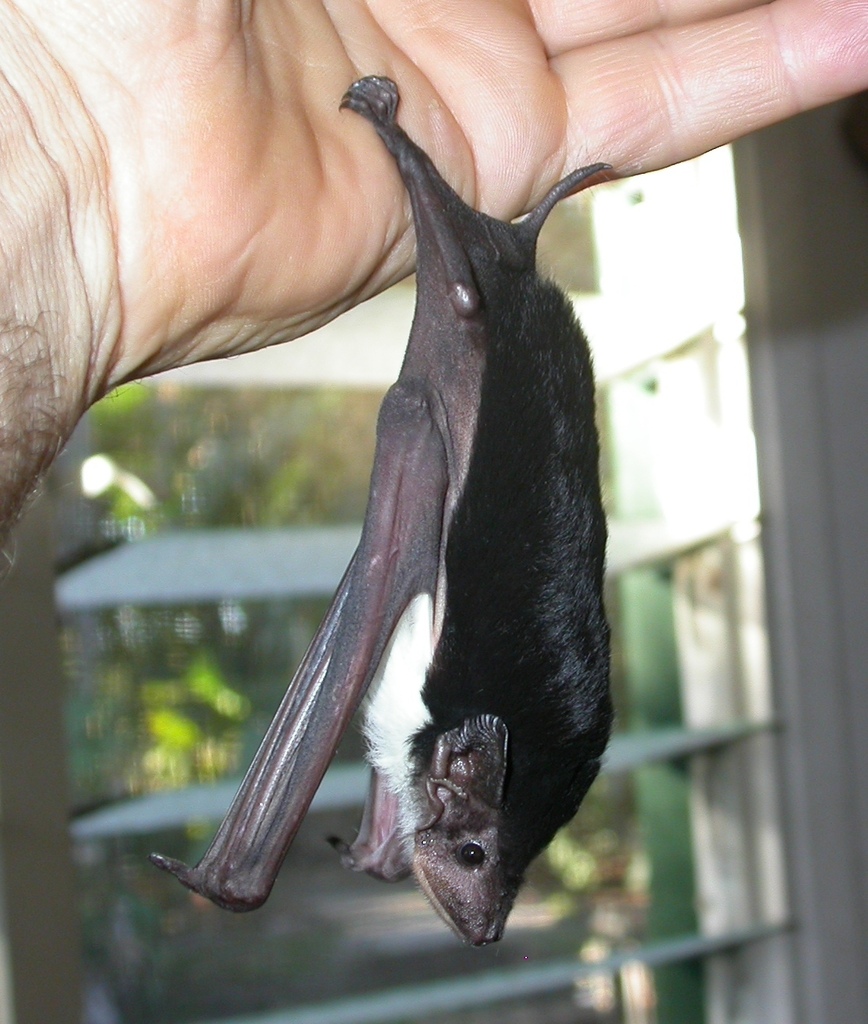
Yellow-bellied Pouched Bat
Saccolaimus flaviventris
The yellow-bellied sheath-tailed bat (Saccolaimus flaviventris), also known as the yellow-bellied sheathtail or yellow-bellied pouched bat, is a microbat species of the family Emballonuridae found extensively in Australia and less commonly in parts of Papua New Guinea.
Although found throughout most parts of Australia, very little is known about its ecology due to the small size, nocturnal activity, and general elusiveness of most microbat species, making them difficult to study. They are sometimes mistaken for the endangered and less widely distributed bare-rumped sheathtail bat where the two species occur sympatrically, as well as other similar Emballonuridae species, but upon inspection are quite distinct and easily identified.
From the article Yellow-bellied sheath-tailed bat on Wikipedia (CC BY-SA), quoted section by section
Description
The yellow-bellied sheath-tailed bat is quite large with a mean body weight of 44 g that ranges from 28 to 60 g, and a mean head-body length of 81.8 mm that ranges from 72.3-91.9 mm. It has distinct fur colouration, with the dorsal back being a shiny jet black and the ventral underside a contrasting creamy white. Males of the species have a distinctive gular throat pouch that is believed to play a role in territorial marking. The throat pouch is absent in females, which instead have naked folds of skin around their throats. Unlike many other sheathtails, this species does not have a wing pouch in either sex. Other distinguishing features of the yellow-bellied sheath-tailed bat are a flattened head and sharply pointed muzzle, a mean forearm length of 74–77 mm, and a mean outer canine width of 6.4 mm.
Range & habitat
The yellow-bellied sheath-tailed bat appears to be wide-ranging, occurring across most parts of eastern and northern Australia, though in what densities remains uncertain due to the difficulties associated with capture and detection of the species. Much of the distribution understanding of this species has developed as a result of incidental sightings, such as one record from central western Queensland that was taken from a mummified bat found on a barbed-wire fence. Though most common throughout the tropical regions of their range, yellow-bellied sheath-tailed bats are known to occur regularly in semi-arid environments including the Mallee region of north-western Victoria, Gundabooka National Park in northwestern New South Wales, and central-western Queensland. This species likely migrates into its southerly range during summer, with seasonal records placing bats in most parts of Victoria, southwestern New South Wales, and the adjacent regions of South Australia. Though less common, two specimens of yellow-bellied sheath-tailed bats have been found in Papua New Guinea, one in the National Capital District and the other in Central Province. This species occupies most wooded habitats, including both wet and dry sclerophyll forest, mallee and Acacia shrubland, desert, and open woodland. …
Wikipedia: “Distribution and habitat”
What it does
Yellow-bellied sheath-tailed bats are canopy feeders, meaning that they are capable of fast flight, but inefficient at rapid maneuvering. They generally feed at heights of 20–25 m, unless feeding in open spaces or at forest edges, where they forage lower. Studies of stomach contents have found Orthoptera (grasshopper), Coleoptera (beetle), and Hemiptera (true bug) species, with beetles making up the bulk of the diet.
Wikipedia: “Diet and foraging”
Listen
Looking for field recordings…
Where it lives
Recorded sightings
—
geo-referenced records in GBIF, from museums, herbaria and field observers.
Drag the globe to turn it. Dots are where records exist, not a range map; darker means more records.
In the stacks
Searching the stacks…
Every page naming Saccolaimus flaviventris in the Biodiversity Heritage Library →
This page is assembled live from iNaturalist, GBIF, Wikipedia, the Source Library and the Internet Archive. It is not yet part of the hand-edited codex. iNaturalist taxon 41342.