- Animals
- ›Chordates
- ›Vertebrates
- ›Mammals
- ›Therians
- ›Placental Mammals
- ›Ungulates, Carnivorans, and Allies
- ›Bats
- ›Yangochiroptera
- ›Noctilionoid Bats
- ›Thumbless and Smoky Bats
- ›Furipterus
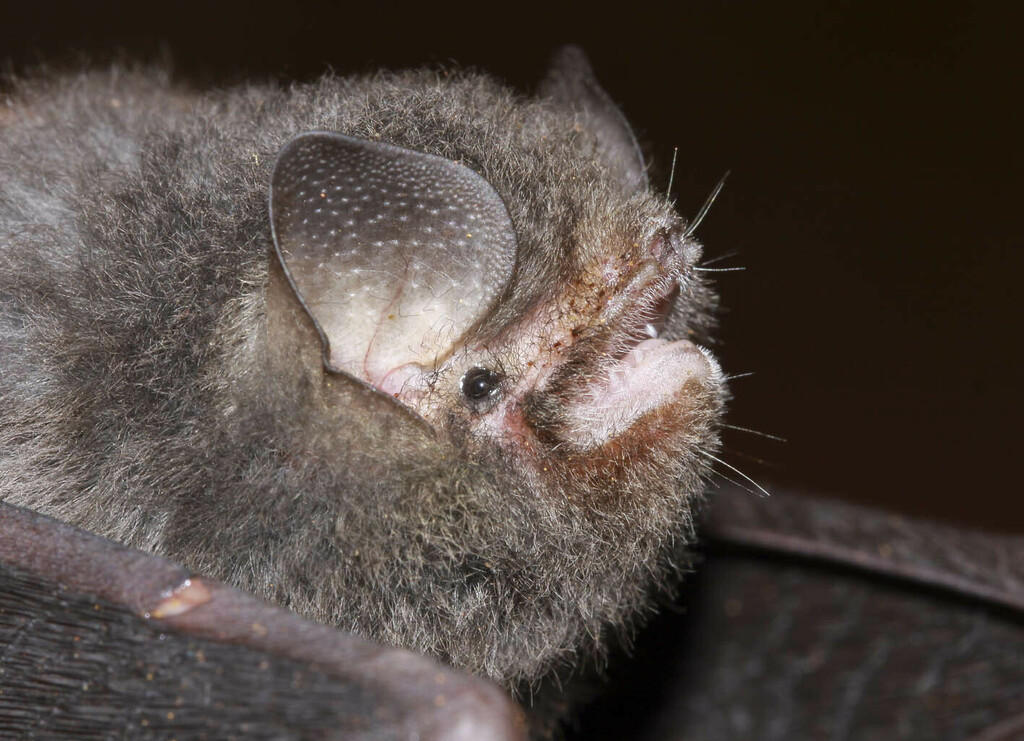
Thumbless Bat
Furipterus horrens
The thumbless bat (Furipterus horrens) is a species of bat in the family Furipteridae, in the monotypic genus Furipterus. It is found in Costa Rica, Brazil, Venezuela; Colombia; Ecuador; Suriname; French Guiana; Guyana; Panama; Trinidad, and Peru. They have a small thumb which is included in the membrane of the wing, causing the 'thumbless' appearance.
From the article Thumbless bat on Wikipedia (CC BY-SA), quoted section by section
Range & habitat
The thumbless bat is found in Central and South America. Its range includes Costa Rica, Panama, southern Brazil and Bolivia. as well as Venezuela, Colombia, Ecuador, Suriname, French Guiana, Guyana, Panama, Trinidad, and Peru. In Brazil, it was recorded in twelve different regions covering the Amazon, Caatinga, Cerrado and Atlantic Forest biomes.
Wikipedia: “Geographic range”
What it does
Its populations are rare and very local, but widespread. Male and female bats may live separately during some parts of the year. There were found more than 60 males occupying one hollow. Thumbless bats are aerial and insectivorous. The thumbless bat is found in caves. Additionally, it is associated with moist environments. Thumbless bats were detected significantly more frequently over large lakes(Emmons and Feer 1997). The moist habitat plays a key role for aerial insectivorous bats. However, thumbless bat's activity is significantly higher in forest compared to the lakes. They roots in small clusters in colonies for up to 60 individuals in caves. The nests are located in deep cracks between rocks.
== References ==
Wikipedia: “Population and behavior”
Listen
Looking for field recordings…
Where it lives
Recorded sightings
—
geo-referenced records in GBIF, from museums, herbaria and field observers.
Drag the globe to turn it. Dots are where records exist, not a range map; darker means more records.
In the stacks
Searching the stacks…
Every page naming Furipterus horrens in the Biodiversity Heritage Library →
This page is assembled live from iNaturalist, GBIF, Wikipedia, the Source Library and the Internet Archive. It is not yet part of the hand-edited codex. iNaturalist taxon 41333.