- Animals
- ›Chordates
- ›Vertebrates
- ›Mammals
- ›Therians
- ›Placental Mammals
- ›Ungulates, Carnivorans, and Allies
- ›Bats
- ›Yinpterochiroptera
- ›Rhinolophoid Bats
- ›False Vampire Bats
- ›Macroderma
Ghost Bat
Macroderma gigas
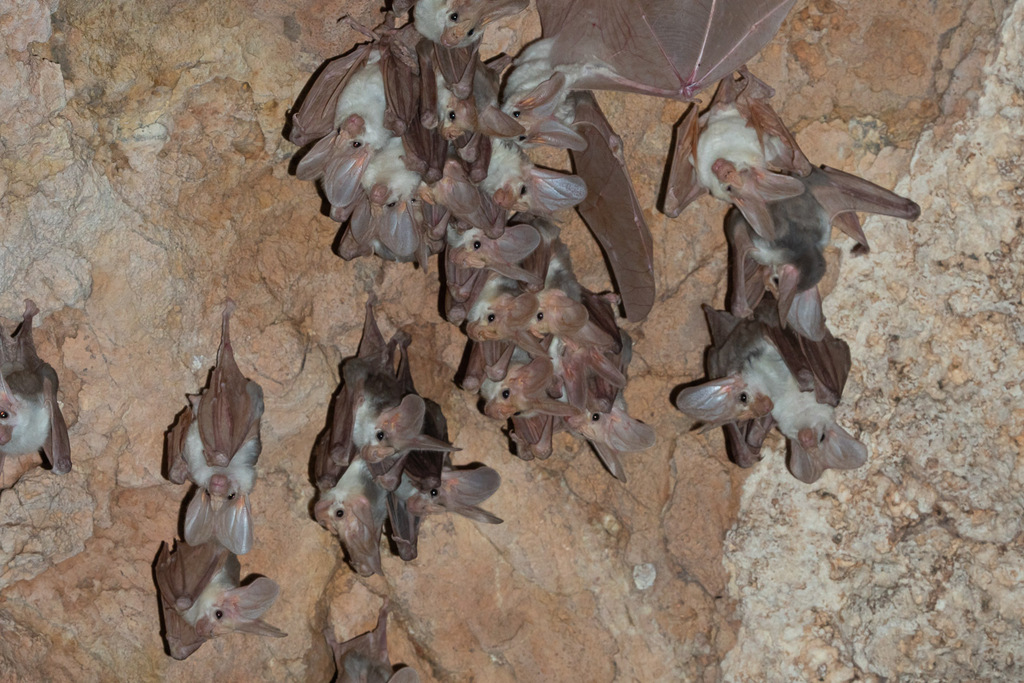
The ghost bat (Macroderma gigas) is a species of bat found in northern Australia. It is the only Australian bat that preys on large vertebrates – birds, reptiles and other mammals – which they detect using acute sight and hearing, combined with echolocation, while waiting in ambush at a perch. The wing membrane and bare skin is pale in colour, their fur is light or dark grey over the back and paler at the front. The species has a prominent and simple nose-leaf, with large elongated ears that are joined at the lower half, sharp teeth for attacking prey and large dark eyes.
The first description of the species was published in 1880, since when its recorded range has significantly contracted.
From the article Ghost bat on Wikipedia (CC BY-SA), quoted section by section
Description
A larger species of microchiropterans (microbats) and the largest in Australia, the size is comparable to the megabat species (flying fox, fruitbat). The fur colour is grey, ranging in tone from mid, sometimes dark, to very pale grey at the back and whitish at the ventral side and head. The colour of populations is a geographic cline, becoming darker toward the coastal regions. A ring at the eye is dark and colour of the wing membranes and other bare skin is pale and brownish. The interfemoral membrane extends the wing surface between the length of the legs. The great length of the ear, from notch at head to tip, is 44 to 56 millimetres and they are fluted in form; the inner margins of the ears are fused for half their length. The length of the prominent ears is twice that of the head, a seam at the inner margins stiffens these to keep them upright while in flight. Other measurements of the species are a 96 to 112 mm (3.8 to 4.4 in) range for the forearm length, 98 to 120 mm (3.9 to 4.7 in) for the combined length of the head and body, and a weight range of 75 to 145 g (2.6 to 5.1 oz).
The eyes are comparatively large and well developed for nocturnal vision, a feature shared with the long-eared genera Nyctophilus. The nose-leaf is also large and prominent, and simple in form. …
Range & habitat
The ghost bat is endemic to Australia. Three population centres are identified, the Northern Pilbara and Kimberley in Western Australia, the Top End of the continent and in Queensland. The distribution of colonies is non-contiguous, and they usually occur in small isolated pockets within each region. Analysis of fossil remains shows that distribution patterns within Australia changed, in waves of both expansion and contraction, and the probable cause was ecological changes resulting from the increasing aridity of the continent's climate. Remains of the species have been found with other mammals at the Devils Lair archaeological site in Southwest Australia, including other predators such as Thylacinus cynocephalus and Sarcophilus harrisii that inhabited the region after the first peoples had arrived. Little is known of the genetics of the ghost bat, although the colonies shows a high degree of genetic distinctiveness at a local and regional level. The southernmost record is Austin's 1854 note at Mt Kenneth. A limestone cave site favoured by M. gigas is in the region of the Mitchell and Palmer rivers at Cape York. They are occur around Shoalwater Bay at the east coast. The species is well represented at Litchfield National Park, which provides important caves and habitat for a number of bat species in the northern regions near Darwin. The largest recorded breeding colony of M. …
Wikipedia: “Distribution and habitat”
What it does
Although Macroderma gigas is inactive during daylight hours, they do not hibernate. The colony size reduces in the austral winter, increasing when they gather to breed or females form maternity groups. They leave the roost several hours after sunset, alone, in pairs, or as small groups. Hunting occurs via a 'sit and wait' technique while suspended from a tree or as low surveys over vegetation. The large ears allow the bat to hear prey moving on the ground. Field observations at Pine Creek using nightscope equipment reported seeing M. gigas suspended from a tree and dropping to catch large locusts detected moving through grass at ten to twenty metres distance. They are also able to detect the echolocation signals of the microbats on which they prey. The bat has good vision for a microchiropteran, and echolocation is also utilised to directly locate approaching prey. They are able to visually locate birds roosting in trees, and budgerigars (Melopsittacus undulatus) are detected by their silhouettes against the evening light. The budgie is a favoured food of the bat, which they detect by the flock's chatter while retiring for the night, and these are taken to a perch to be consumed head first, with the feet and wing parts eventually being discarded. Prey may be taken at or to the ground, where it is enveloped with the wings and killed with bites to the neck. …
Wikipedia: “Behaviour and diet”
Listen
Looking for field recordings…
Where it lives
Recorded sightings
—
geo-referenced records in GBIF, from museums, herbaria and field observers.
Drag the globe to turn it. Dots are where records exist, not a range map; darker means more records.
In the stacks
Searching the stacks…
Every page naming Macroderma gigas in the Biodiversity Heritage Library →
This page is assembled live from iNaturalist, GBIF, Wikipedia, the Source Library and the Internet Archive. It is not yet part of the hand-edited codex. iNaturalist taxon 41326.