- Animals
- ›Chordates
- ›Vertebrates
- ›Mammals
- ›Therians
- ›Placental Mammals
- ›Ungulates, Carnivorans, and Allies
- ›Bats
- ›Yangochiroptera
- ›Vespertilionoid Bats
- ›Free-tailed Bats
- ›Molossinae
- ›Tadarida
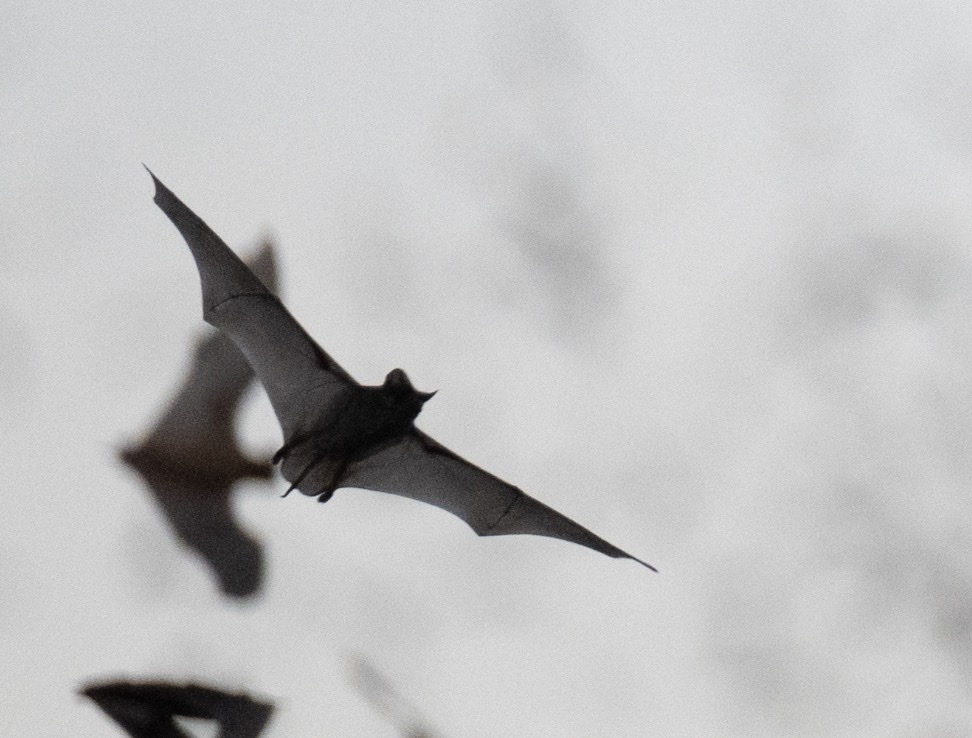
Mexican Free-tailed Bat
Tadarida brasiliensis
The Mexican free-tailed bat or Brazilian free-tailed bat (Tadarida brasiliensis) is a medium-sized bat native to North, Central, and South America and the Caribbean, so named because its tail can be almost half its total length and is not attached to its uropatagium. It has been claimed to have the fastest horizontal speed of any animal, reaching level flight speed of up to 99 mph (160 km/h). It also flies the highest among bats, at altitudes around 3,300 m (10,800 ft).
It is regarded as one of the most abundant mammals in North America. Its proclivity towards roosting in huge numbers at relatively few locations makes it vulnerable to habitat destruction in spite of its abundance. For instance, up to 1.5 million bats reside under just one bridge in Austin. The Texas Legislature recognized the Mexican free-tailed bat as the "Official Flying Mammal" of the State of Texas in 1995.
From the article Mexican free-tailed bat on Wikipedia (CC BY-SA), quoted section by section
Range & habitat
The Mexican free-tailed bat ranges from the southern half of the continental United States through most of Mexico, and through most of Central America into South America. Their range in South America is less understood where they live in the eastern Brazilian highlands and coast, the northeastern Andes, the coast of Peru and northern Chile, and the center of Argentina. They are absent in much of the Amazon rainforest. They are also found in the Caribbean, and are native to all of the Greater Antilles and 11 of the Lesser Antilles. The largest known colony is found at Bracken Cave, north of San Antonio, Texas, with nearly 20 million bats; the bats from this colony congregate in huge numbers at altitudes between 180 and 1,000 m (590 and 3,280 ft), and even as high as 3,000 m (9,800 ft).
Habitat. Mexican free-tailed bats roost primarily in caves. However, they also roost in buildings of any type as long as they have access to openings and dark recesses in ceilings or walls. The bats can make roosting sites of buildings regardless of "age, height, architecture, construction materials, occupancy by humans and compass orientation". Caves, though, need to have enough wall and ceiling space to fit millions of bats. …
Wikipedia: “Range and ecology”
What it does
Mexican free-tailed bats are nocturnal foragers and begin feeding after dusk. They travel 50 km in a quick, direct flight pattern to feed. This species flies the highest among bats, at altitudes around 3,300 m (10,800 ft). Bats appear to be most active in late morning and afternoon between June and September. Free-tailed bats are more active in warm weather. The species has been measured at a ground speed of 160 km/h (99 mph), measured by an aircraft tracking device. The measurement methodology did not simultaneously record wind speed and ground speed, so the observations could have been affected by strong local gusts, and the bat's maximum air speed remains uncertain.
Guano and ammonia. Among bats that roost in great, concentrated numbers, T. brasiliensis roosts produce large quantities of urine and guano; from 22 to 99 metric tons per cave and over 18,700 metric tons are produced annually. The concentrated waste generates high levels of toxic ammonia in the air of a cave. T. brasiliensis individuals have genetic adaptation for withstanding or countering these high levels of ammonia. The bats' content of CO2 and protein in respiratory mucus and CO2 dissolved in blood plasma increase with increasing levels of dissolved ammonia, providing the bats with a buffer against pH change. …
Wikipedia: “Behavior”
Listen
Looking for field recordings…
Where it lives
Recorded sightings
—
geo-referenced records in GBIF, from museums, herbaria and field observers.
Drag the globe to turn it. Dots are where records exist, not a range map; darker means more records.
In the stacks
Searching the stacks…
Every page naming Tadarida brasiliensis in the Biodiversity Heritage Library →
This page is assembled live from iNaturalist, GBIF, Wikipedia, the Source Library and the Internet Archive. It is not yet part of the hand-edited codex. iNaturalist taxon 41301.