- Plants
- ›Vascular Plants
- ›flowering plants
- ›Dicots
- ›proteas, lotuses, planes, and allies
- ›Protea family
- ›Paired Proteas
- ›Embothrieae
- ›Hakeinae
- ›Grevillea
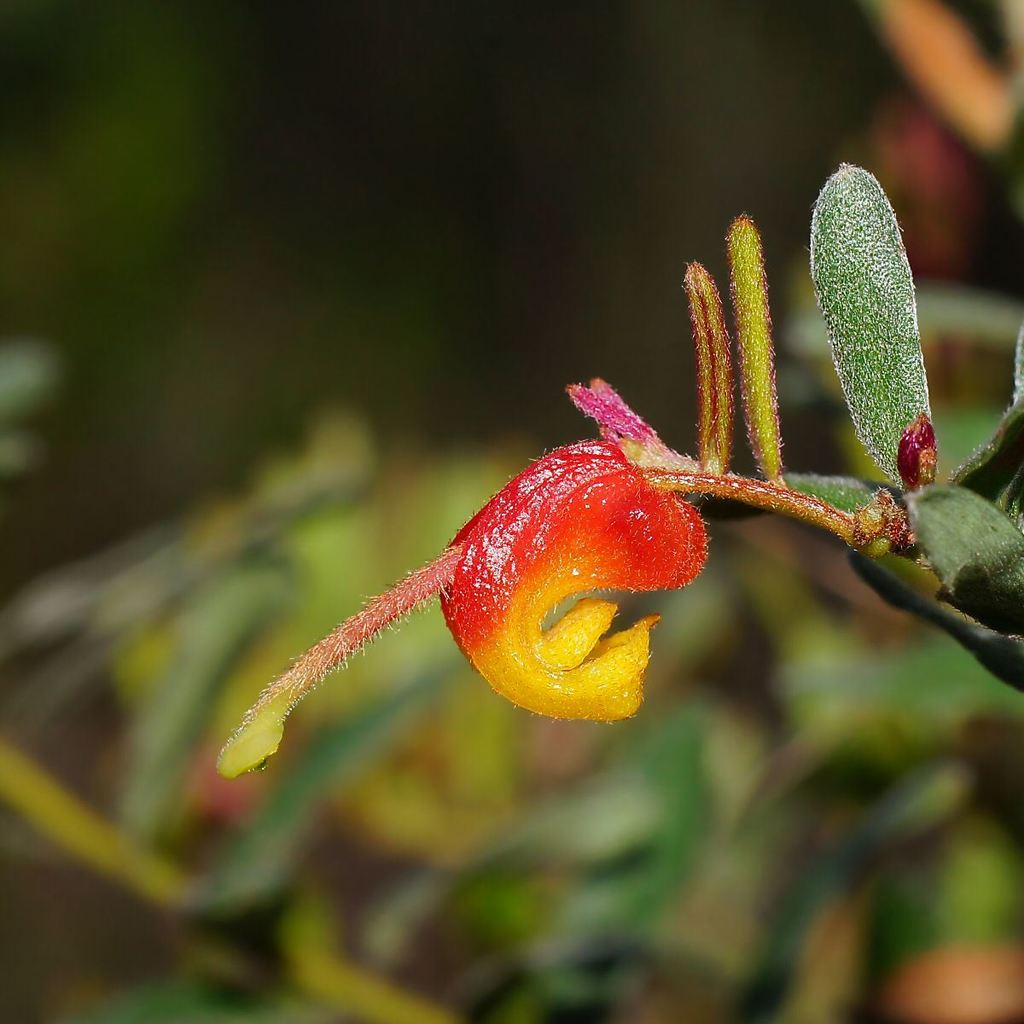
Mountain Grevillea
Grevillea alpina
Grevillea alpina is a species of flowering plant in the family Proteaceae. It has several common names, including mountain grevillea, alpine grevillea, and cat's claws. It is endemic to Australia. It is not limited to alpine environments, and in fact is less common at high elevation than low. The species is variable in appearance, with five general forms described: small-flowered, Grampians, Northern Victorian, Goldfields, and Southern Hills forms. It is found in dry forests and woodlands across Victoria and into southern New South Wales.
Some forms of the plant are low to the ground, and some become a spreading shrub. The flowers come in many colours, from white to green to shades of red and pink, or a pattern of several colours. The curled flowers are 1 to 3 centimetres (0.39 to 1.18 in) in length. It is attractive to nectar-feeding insects and birds.
From the article Grevillea alpina on Wikipedia (CC BY-SA), quoted section by section
Description
There is considerable variation in the form, leaves and flowers of the species. Plants are between 0.3 and 2 metres (0.98 and 6.56 ft) in height. The leaves may be linear, oblong or elliptic and are generally between 0.5 and 2 centimetres (0.20 and 0.79 in) long and 1.5 to 4 millimetres (0.059 to 0.157 in) wide. Both surfaces of leaves may or may not have hairs. The leaf edges may be curved backwards or revolute. Flower colour is one of the most variable characteristics. The main colour of the perianth may be red, orange or pink or more rarely yellow or cream. There is often a transition of colour along the length of the perianth leading to commonly seen red-yellow or red-cream combinations. The main months of flowering are from August to December in the species' native range. The flowers are followed by hairy, leathery, ovoid fruits (follicles) that are between 8.5 and 12 millimetres (0.33 and 0.47 in) long. These split open, releasing winged seeds.
Range & habitat
Grevillea alpina is widespread in Victoria extending from Melbourne northwards into New South Wales through Albury and as far north as Canberra where it is found on Black Mountain. Its westernmost extent is found in the Grampians in Victoria. It occurs in woodland, heathland and mallee. In The Grevillea Book published in 1995, the authors Peter Olde and Neil Marriott identified five informal forms:
The Grampians form, the type form with bright orange and yellow flowers The Southern Hills form, found in locations surrounding Melbourne including Lerderderg Gorge, Kinglake, Mount Slide, Mount Evelyn the Dandenong Ranges and Cardinia. The Goldfields form, occurring in Castlemaine, Bendigo and Whroo Forest. The Northern Victorian form, seen in places including the Strathbogie Ranges and the Warby Ranges. The small-flowered form found in Beechworth, Chiltern, Albury and Canberra. Plants from Tooborac were also classified as this form, but the authors currently believe they may constitute a separate form. Naturally occurring hybrids have been recorded with G. lavandulacea.G. dryophylla and G. obtecta. In New Zealand, hybrids with Grevillea rosmarinifolia have become naturalised.
Wikipedia: “Distribution”
What it does
Honeyeaters are believed to be the major pollinators. Honey bees have been observed feeding on the nectar, but are able to do so without touching the pollen presenter.
Wikipedia: “Ecology”
How it is grown
The species was first introduced to cultivation in England in 1856 and by 1858 was in cultivation at the Royal Botanic Gardens, Melbourne. Though widely grown, it has a reputation for being short lived. This problem, which is accentuated in humid climates with summer rainfall, has been addressed by grafting on various rootstocks. G. alpina grows best in dry environments and does not tolerate excess moisture well. Regular pruning from a young age will encourage denser growth and reduce woodiness. Plants are readily propagated from pre-treated seed, though seed sourced from gardens often leads to hybrid progeny. The species hybridises readily with Grevillea rosmarinifolia, Grevillea juniperina and Grevillea lavandulacea. The use of cuttings is the preferred method of propagation for assuring that particular forms and cultivars are true to type. In 2003, it was reported that the fungal disease Phytophthora palmivora had been detected in plant nurseries in Sicily, leading to root rot and death of potted Grevillea cultivars. Of these plants of Grevillea alpina were the most severely affected.
Cultivars. A large number of hybrid cultivars and selected forms have been introduced to horticulture including:
'Bonnie Prince Charlie' – G. rosmarinifolia × G. alpina (Grampians form) 'Coral' – selected seedling of G. alpina (Cardinia form) 'Edna Walling Softly Softly' – G. alpina × G. …
Wikipedia: “Cultivation”
Where it lives
Recorded sightings
—
geo-referenced records in GBIF, from museums, herbaria and field observers.
Drag the globe to turn it. Dots are where records exist, not a range map; darker means more records.
In the stacks
Searching the stacks…
Every page naming Grevillea alpina in the Biodiversity Heritage Library →
This page is assembled live from iNaturalist, GBIF, Wikipedia, the Source Library and the Internet Archive. It is not yet part of the hand-edited codex. iNaturalist taxon 411301.