- Plants
- ›Vascular Plants
- ›flowering plants
- ›Dicots
- ›pinks, cactuses, and allies
- ›knotweed family
- ›Polygonoideae
- ›Polygoneae
- ›Reynoutriinae
- ›Muehlenbeckia
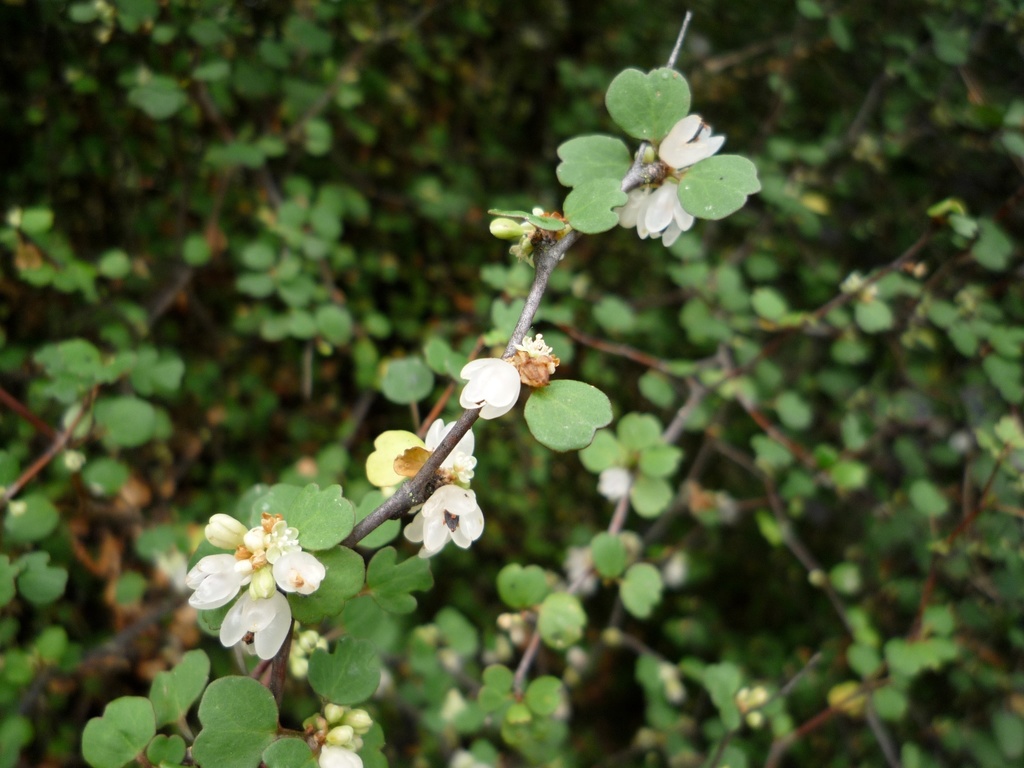
Shrubby tororaro
Muehlenbeckia astonii
Muehlenbeckia astonii, common names shrubby tororaro and wiggy-wig bush, is an endemic New Zealand shrub, a distinctive ornamental plant in the Polygonaceae family. It is found only at the southern tip of the North Island (Palliser Bay) and on the eastern side of the South Island from northern Marlborough to Birdlings Flat at the south-west edge of Banks Peninsula, on the coast and on lowlands, especially terraced riverbeds.
From the article Muehlenbeckia astonii on Wikipedia (CC BY-SA), quoted section by section
Description
Shrubby tororaro has very small leaves (only 2–15 millimetres (0.079–0.591 in) wide) on a 3–10 millimetres (0.12–0.39 in) brown stalk, growing in clusters of two to three (sometimes five), or alternating along the longer branchlets. The leaves are usually dented at the tip and heart-shaped. They are bright green above and pale below. Unlike most New Zealand plants M. astonii is leafless in winter. It grows from a distinct trunk, and has many fine reddish brown to orange flexible branches that zigzag around one another to form a dense, interwoven ball, generally 2–3 metres (6 ft 7 in – 9 ft 10 in) around, and sometimes 4 × 4 metres. Older plants have stems like canes growing from the interior. Plants have been recorded living for over 80 years. Its flowers, appearing December to January, are tiny and grow in clusters of two to four, less than 10 millimetres (0.39 in) in diameter, and are greenish to white or pinkish white. The plant is gynodioecious: individuals have either female flowers or what have been described as 'inconstant male' hermaphrodites. 'Inconstant males' can self-fertilise, but their seeds have less than 5% viability. Isolated female plants produce infertile fruits, or hybridise with other Muehlenbeckia species nearby.
Fruits appear in October to June. …
Range & habitat
This species was probably once widely distributed in the drier lowland and coastal parts of eastern New Zealand, especially on terraced riverbeds, possibly as far south as the Waitaki Valley, South Canterbury. Its former range is hard to determine, as the species was only recognised by botanists decades after most of New Zealand's dry scrublands had been cleared for agriculture. Its deep root system helps it survive in dry conditions, and can grow on open rocky hillsides and stony ground, up to 300 metres (980 ft) altitude. It prefers free-draining, warm, sunny slopes, on moderately- to highly-fertile soil. M. astonii is currently only found in four areas:
Around Palliser Bay at the southern tip of the North Island, from Honeycomb Light south to Sinclair Head. Northeastern Marlborough, currently only from the lower Awatere Valley, the Blind River, Clifford Bay, and Cape Campbell. Some sites in North Canterbury discovered in the 1950s and 1960s: Balmoral, Weka Pass, Waikari Stream, Waiau, and along the Waipara River. Kaitorete Spit at Lake Ellesmere (containing 90% of the world population), and Birdling's Flat and Lake Forsyth at the southwestern edge of Banks Peninsula.
Wikipedia: “Distribution”
How it is grown
M. astonii is usually deciduous, though retains some leaves when grown in northern New Zealand. It prefers dry conditions, and is very drought-tolerant – excessive moisture can lead to root rot. Its unusual form and wiry orange stems make it an interesting garden plant. It tolerates light shade, but grows well as a shelter plant in exposed situations, tolerating salt spray, wind, and frost. It can be planted as an informal hedge, and responds well to being pruned into shape. If planted in rich soil, M. astonii can grow vigorously upwards and may require staking. It can be propagated by winter hardwood cuttings, which strike best in early spring, and grows well from outcrossed seed. The translucent fruits are considered decorative, so most plants sold in nurseries are female. At a time when only 48 M. astonii were known to be growing wild in the Wellington area, the city councils of the Hutt Valley and Wellington began propagating plants from the wild and successfully growing males and females close together in traffic islands, each representing a different wild population, where they could pollinate each other. Traffic island populations were used as a stock to propagate 1500 plants from cuttings, and these were subsequently planted in Turakirae Reserve where the species once occurred.
Wikipedia: “Cultivation”
In human culture
The name "shrubby tororaro" distinguishes it from the similar species tororaro (Muehlenbeckia complexa), a scrambling plant with no trunk. It sometimes goes by the names wiggy-wig bush, zig zag plant, wirebrush, shrubby pōhuehue, or mingimingi (a generic term for many small-leaved shrubs).
Wikipedia: “Etymology”
Where it lives
Recorded sightings
—
geo-referenced records in GBIF, from museums, herbaria and field observers.
Drag the globe to turn it. Dots are where records exist, not a range map; darker means more records.
In the stacks
Searching the stacks…
Every page naming Muehlenbeckia astonii in the Biodiversity Heritage Library →
This page is assembled live from iNaturalist, GBIF, Wikipedia, the Source Library and the Internet Archive. It is not yet part of the hand-edited codex. iNaturalist taxon 410120.