- Plants
- ›Vascular Plants
- ›flowering plants
- ›Dicots
- ›carrots, ivies, and allies
- ›carrot family
- ›Apioideae
- ›Aciphylleae
- ›Aciphylla
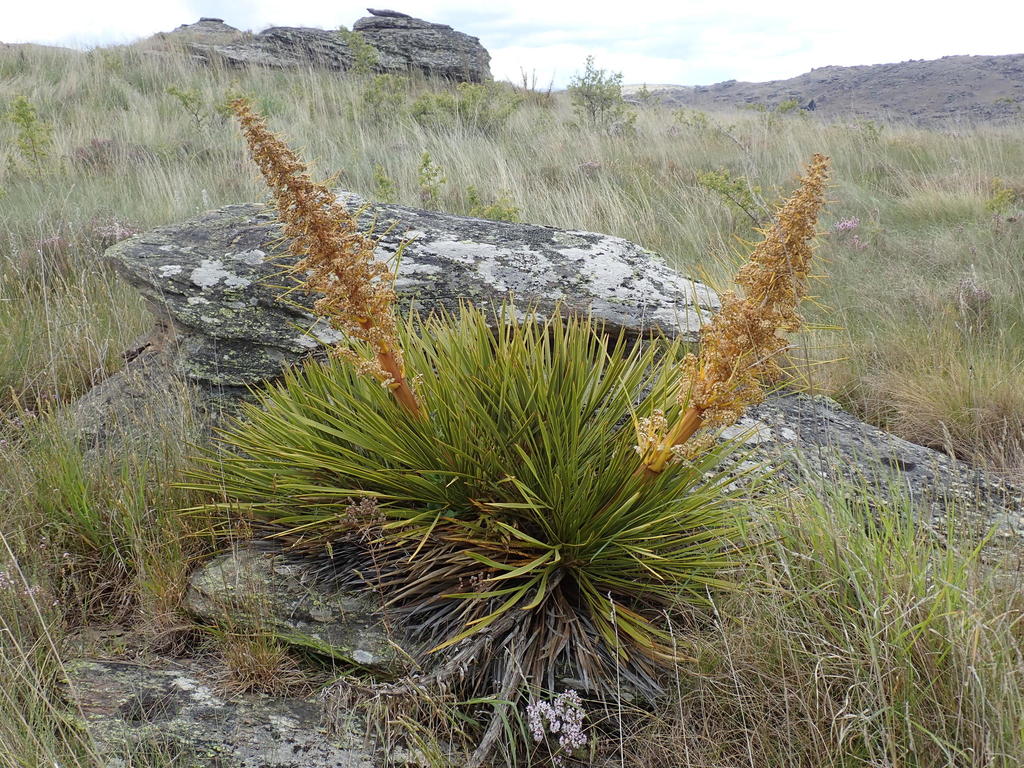
Golden Spaniard
Aciphylla aurea
Aciphylla aurea is a species of Aciphylla, commonly known as golden speargrass or golden Spaniard. Individual plants may be up to 100 cm (39 in) tall, and consist of sharp spiky yellowish-green leaves. A. aurea is found throughout the South Island of New Zealand, usually in mountainous areas but also lower altitude dry well drained grassland sites. It is found at altitudes of 300 to 1,500 m (980 to 4,920 ft).
From the article Aciphylla aurea on Wikipedia (CC BY-SA), quoted section by section
Description
Plants are yellow-green, tufted herbs up to 1.5 m high (when in flower or fruit) with spiky rosettes up to 1 m diameter, and dioecious (with separate male and female plants). Leaves are up to 70 cm long, once- or twice-pinnately compound, petiolate, with thick, wide sheaths and stiff, sharp, tapering stipules up to 27 cm long. Petioles are up to 20 cm long and 16 mm wide and serrulate. Pinnae in 1–2 pairs, about 20 cm long, erect, serrulate. Stems are thick, ribbed, bracted, and tapering, up to 80 cm long with acicular stipules up to 8 cm long. Flowers are cream to yellow in colour, and grouped into compound inflorescences called umbels that have linear bracts. In male plants, the umbels are found along the length of the peduncles, which are longer than the umbel rays. In female plants, the umbels are on peduncles up to 15 cm long and are made up of umbellules on short rays. Seeds usually dark brown (sometimes golden brown), 5–7 mm long. Flowering from November–December. Flowering is irregular and infrequent (every 3–4 years). Fruiting from January–February. Seeds are wind-dispersed. Populations of A. aurea in the northern South Island (Marlborough and Nelson regions) show some characteristics that are different from the rest of the population, including golden brown seeds (rather than dark brown).
Range & habitat
A. aurea is endemic to the South Island of New Zealand, from Nelson and Marlborough near Mount Stokes to northern Southland near Te Anau, mostly on the eastern side of the Southern Alps. It prefers montane to low alpine dry, rocky sites including grassland from 300–1,500 m above sea level. A. aurea can be common in the drier mountains of Marlborough. A. aurea has a high tolerance for extreme weather conditions, tolerating fires and temperatures of -17 degrees Celsius. A. aurea is found in drier climates compared to some of its relatives, which might be due to plant size and tolerance.
Wikipedia: “Distribution and habitat”
At the table
Aciphylla aurea is one of several large species of Aciphylla with a milky exudate that was harvested and used by Māori to make perfume. The phytochemistry of A. aurea has been found to include the non-volatile polyacetylene falcarindiol and the seeds contained steam-distilled volatiles such as heptanal and octanoic acid.
Wikipedia: “Uses”
In human culture
This species was first described in 1956 by the New Zealand botanist Walter Oliver. The type locality of this species is Swampy Hill in Otago and the several syntype specimens, collected by Oliver on 25 November 1950, are held at Te Papa. The species epithet aurea refers to the distinctive golden colour of the plant.
Wikipedia: “Taxonomy and etymology”
Where it lives
Recorded sightings
—
geo-referenced records in GBIF, from museums, herbaria and field observers.
Drag the globe to turn it. Dots are where records exist, not a range map; darker means more records.
In the stacks
Searching the stacks…
Every page naming Aciphylla aurea in the Biodiversity Heritage Library →
This page is assembled live from iNaturalist, GBIF, Wikipedia, the Source Library and the Internet Archive. It is not yet part of the hand-edited codex. iNaturalist taxon 409337.