- Plants
- ›Vascular Plants
- ›flowering plants
- ›Dicots
- ›Roses, Elms, Figs, and Allies
- ›rose family
- ›brambles, roses, strawberries, and allies
- ›agrimonies and burnets
- ›burnet subtribe
- ›Acaena
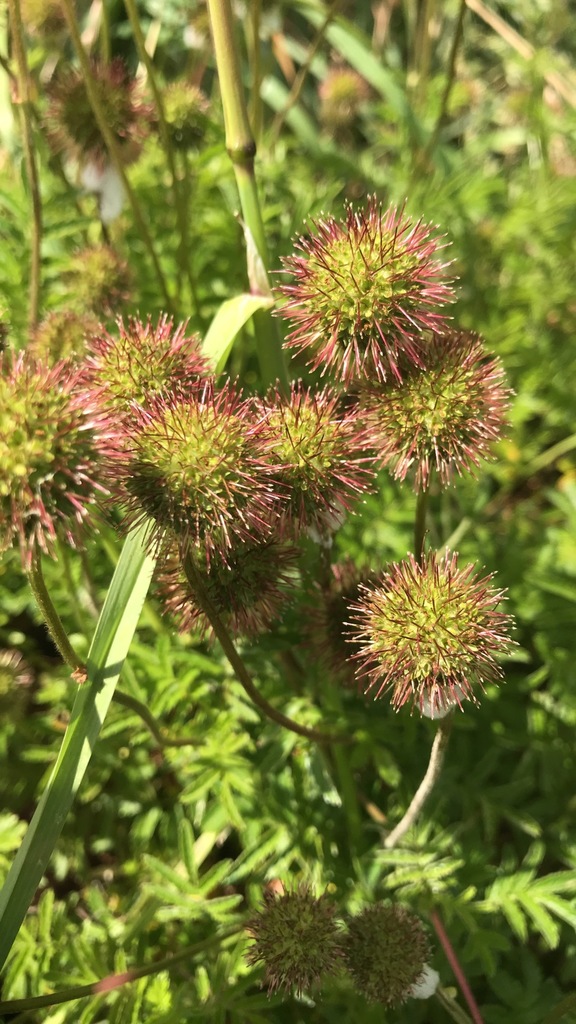
bidgee-widgee
Acaena anserinifolia
Acaena anserinifolia, the bidibidi, hutiwai, or piripiri, is a species of plant, endemic to New Zealand. It has been introduced to the United Kingdom and Ireland. Known for its distinctive hooked seeds which easily attach to clothing and animals, bidibidi can be used to make a tea, used by both Māori and Pākehā settlers in New Zealand, as well as in ointments for wounds and medical purposes.
From the article Acaena anserinifolia on Wikipedia (CC BY-SA), quoted section by section
Description
The bidibidi is a small plant with deeply divaricated opposite leaflets and long stems ending in a globular capitulum. The flowers are pink, red, or white. It can be distinguished from Acaena novae-zelandiae by "the distinctive tuft of brush-like hairs surmounting the leaf teeth apices," and by silvery leaf undersides.
Range & habitat
Acaena anserinifolia is native to the North Island, South Island, Stewart Island, and the Chatham Islands in New Zealand. It has been introduced to Antipodean Islands, Great Britain and Ireland. It is naturalised on the Auckland Islands and Campbell Island. The plant grows in lowland to subalpine areas, and on forest edges. They are sometimes hydrorphytic.
Wikipedia: “Distribution and habitat”
What it does
The species' ability to attach seeds to clothing likely evolved as a way to disburse seeds by attaching to the feathers of flightless birds, including kiwi, weka and moa.
Wikipedia: “Ecology”
At the table
Boiled piripiri leaves are used in traditional rongoā medicinal practices, either as a healing tonic or a lotion applied to skin. Smoke from burning piripiri was a traditional remedy for people who had been poisoned by tutu.
Wikipedia: “Traditional Māori cultural uses”
In human culture
The Māori language name piripiri is used for a variety of Acaena species found in New Zealand. Piri is a word used across various Polynesian languages for sticky plants. Other Māori language names for the plant include huruhuru o Hine-nui-te-pō ("feathers of Hine-nui-te-pō"), pirikahu, hutiwai; many other names include the elements kaiā (thief) and rure (scatter), including kaiā, kaikaiārure and kaikaiā. The English language name biddy-bid is based on a mishearing of the Māori word piripiri, and over time the word biddy developed as a verb in New Zealand English, meaning to remove seeds from clothing. The species epithet, Anserinifolia, is a reference to the leaves, which are like Potentilla anserina.
Wikipedia: “Etymology”
Where it lives
Recorded sightings
—
geo-referenced records in GBIF, from museums, herbaria and field observers.
Drag the globe to turn it. Dots are where records exist, not a range map; darker means more records.
In the stacks
Searching the stacks…
Every page naming Acaena anserinifolia in the Biodiversity Heritage Library →
This page is assembled live from iNaturalist, GBIF, Wikipedia, the Source Library and the Internet Archive. It is not yet part of the hand-edited codex. iNaturalist taxon 409167.