- Plants
- ›Vascular Plants
- ›flowering plants
- ›Dicots
- ›borages
- ›borage family
- ›Cynoglossoideae
- ›Myosotideae
- ›Myosotis
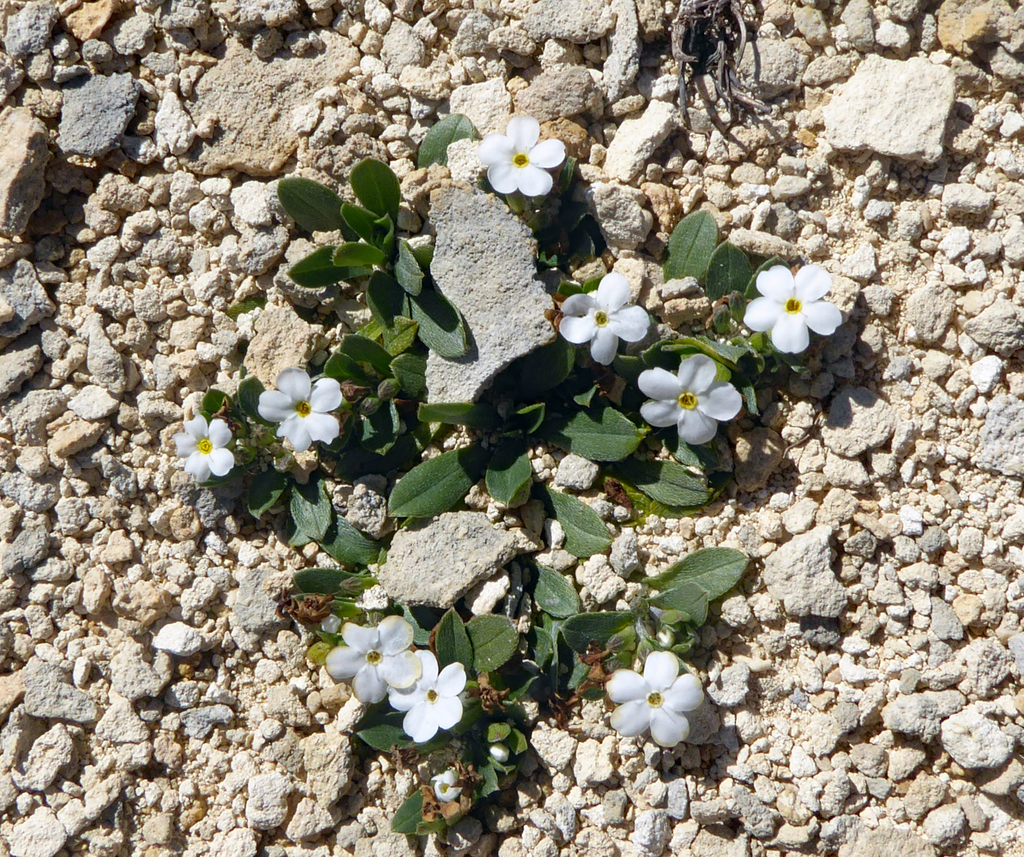
Myosotis colensoi
Myosotis colensoi is a species of flowering plant in the family Boraginaceae, endemic to the South Island of New Zealand. Thomas Kirk described the species in 1896. Plants of this species of forget-me-not are perennial rosettes with bracteate inflorescences and white corollas.
From the article Myosotis colensoi on Wikipedia (CC BY-SA), quoted section by section
Description
Myosotis colensoi plants are single rosettes that grow close together forming loose clumps. The rosette leaves have petioles 2–16 mm long. The rosette leaf blades are 4–15 mm long by 0.6–2 mm wide (length: width ratio 2.2–3.8: 1), oblanceolate to narrowly obovate or rarely narrowly elliptic to elliptic, widest at or above the middle, with an obtuse and often retuse apex. The upper surface of the leaf is densely covered in straight, mostly appressed, antrorse (forward-facing) hairs that are parallel to the mid vein, while on the lower surface the hairs are the same but often only a few isolated hairs are present. Each rosette has 3–13 prostrate, unbranched, bracteate inflorescences that are (14)32–76 mm long. The cauline leaves on the lower part of the inflorescence are similar to but smaller than the rosette leaves, but usually sparsely to densely hairy on the lower surface, and decrease in size and become sessile toward the tip. There can be up to 12 flowers in each inflorescence, each one borne on a short pedicel and with a bract. The calyx is 3–7 mm long at flowering and 4–8 mm long at fruiting, lobed to about a third of its length, and densely covered in short, straight, appressed to patent, antrorse hairs. …
Range & habitat
Myosotis colensoi is endemic to the South Island of New Zealand in Marlborough (Chalk Range) and Canterbury (Castle Hill area), from 610–1050 m ASL. M. colensoi is found on dry, exposed limestone. In Canterbury, it may be found with the Castle Hill buttercup, Ranunculus paucifolius. It is considered to be an obligate calcicole.
Wikipedia: “Distribution and habitat”
In human culture
Myosotis colensoi (Kirk) J.F.Macbr. is in the plant family Boraginaceae and was originally described (as Exarrhena colensoi Kirk) in 1896 by Thomas Kirk. M colensoi is morphologically most similar to M. cheesemanii, from which it can be distinguished by its rosette laminas which are longer (> 6.8 mm) with a larger length : width ratio (2.2–3.1 : 1), shorter petioles, and larger rosettes. The type specimen of Myosotis colensoi is lodged at the Museum of New Zealand Te Papa Tongarewa, Wellington (herbarium WELT). The specific epithet, colensoi, is named after New Zealand missionary and botanist, William Colenso 1811–1899).
Wikipedia: “Taxonomy and etymology”
Where it lives
Recorded sightings
—
geo-referenced records in GBIF, from museums, herbaria and field observers.
Drag the globe to turn it. Dots are where records exist, not a range map; darker means more records.
In the stacks
Searching the stacks…
Every page naming Myosotis colensoi in the Biodiversity Heritage Library →
This page is assembled live from iNaturalist, GBIF, Wikipedia, the Source Library and the Internet Archive. It is not yet part of the hand-edited codex. iNaturalist taxon 407472.