- Plants
- ›Vascular Plants
- ›flowering plants
- ›monocots
- ›grasses, sedges, cattails, and allies
- ›grasses
- ›Oatgrasses, Pampasgrasses, and allies
- ›Oatgrasses, Pampasgrasses, and allies
- ›Rytidosperma
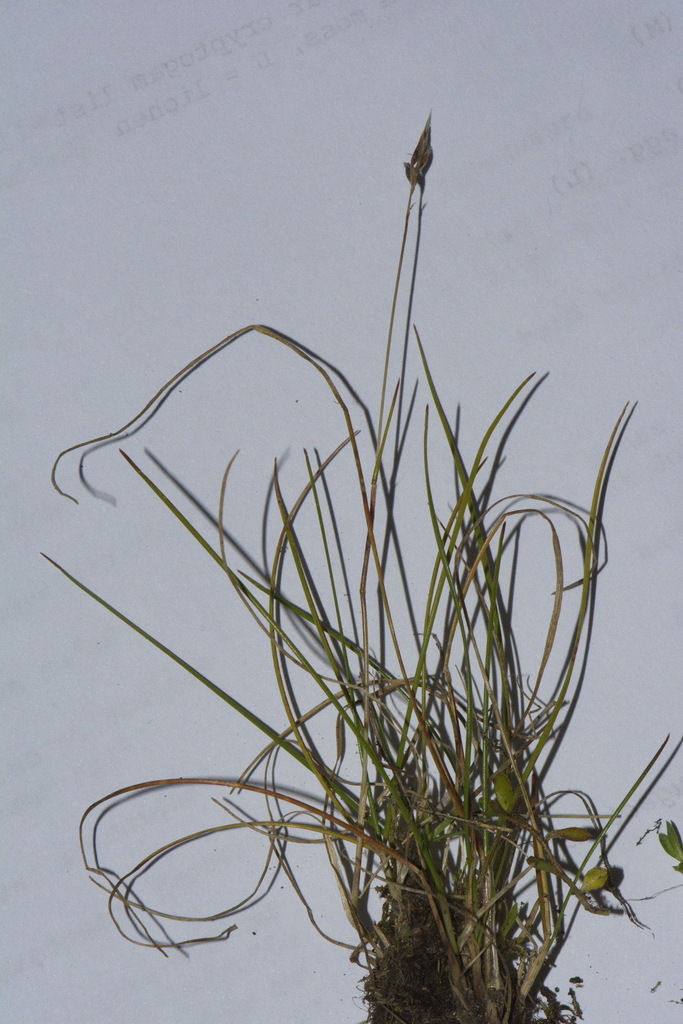
Rytidosperma buchananii
Rytidosperma buchananii also known as black-striped danthonia is a species of true grass in the subfamily Danthonioideae. It is endemic to New Zealand and was described in the Handbook of New Zealand Flora as Danthonia buchanani in 1853 by Joseph Dalton Hooker.
From the article Rytidosperma buchananii on Wikipedia (CC BY-SA), quoted section by section
Description
R. buchananii grows in loose, dull green tussocks with intravaginal branching. Panicle inflorescences grow on 50-(70) cm culms, with panicle branches closely short-scabrid and the culm minutely scabrid below the inflorescence. The panicle is erect, to 10 cm, made up of several spikelets. The spikelets contain (3)-4-5-(6) florets, with awns slightly exserted from purplish glumes. The florets contain three obvious rows of hairs, one on the callus, and two on the lemmas. The lemma is 2-3-(3.5) mm, with the upper and lower rows of hairs usually sparse between dense marginal tufts. The upper row is shorter than the lemma lobes, the lower row overlaps the upper. The palea is 3-4 mm, around the same length as the upper lemma hairs. The callus is c. 0.5 mm, with hairs much overlapping the lower lemma hairs.
Identification. As a Rytidosperma, the easiest way to identify R. buchananii is to select a single floret (which will contain a single awn, two lateral lobes, and usually three rows of hairs - one on the callus and two on the lemma). The arrangement of the hairs, as well as the relative lengths of the awn, lateral lobes, sometimes the callus can help identify to species, using a key such as that found in the New Zealand Flora.
Similar species. R. buchananii is similar to R. thomsonii, in its robust dark coloured spikes. However, R. …
Range & habitat
R. buchananii is endemic to New Zealand. In the North Island, it is found in the central mountains and Ruahine range. In the South Island, it is found throughout, largely in mountainous areas, except in Buller and north Westland. It found at sea level in a few places in the North Island, such as in the Rakaunui Scenic Reserve as well as nearby Awaroa Scenic Reserve, both on the Kawhia Harbour, as well as along the east coast of Wellington Region. Unusually, the cold tolerance of R. buchananii is higher than would be expected from its species distribution. Rather than temperature limiting its distribution, the authors suggest that it could be better explained by competition, time or dispersal limitation. For example, cold tolerance appeared to have emerged in Rytidosperma in the Miocene, around the time that Rytidosperma arrived in New Zealand. Cold tolerance may have provided an adaptive advantage in the context of the Southern Alps building for the first time and been conserved after distributions changed for other reasons.
Wikipedia: “Distribution”
What it does
In grazed tussock grasslands, R. buchananii is a preferred species by sheep, suggesting that it may be vulnerable to herbivory. However, at some sites, grazing may limit competition, allowing R. buchananii to exist at higher numbers. Indeed, the removal of grazing at some sites has resulted in decline. The generalist ergot fungus Claviceps purpurea, which grows black masses of fungal spores on the florets of many grasses, is recorded growing on R. buchananii. A similar smut fungus, Ustilago comburens, is found growing on a variety of Rytidosperma species, including R. buchananii. R. buchananii is also the host of Sphaerodothella danthoniae, a sac fungus that produces black, shiny leaf spots that occasionally coalesce into straight to irregular lines in the leaf surface of Rytidosperma species.
Wikipedia: “Ecology”
In human culture
Rytidosperma - wrinkled seed buchananii: Named after John Buchanan (13 October 1819-1898) who was a New Zealand botanist and scientific artist and fellow of the Linnean Society, and collected the holotype of R. buchananii.
Wikipedia: “Etymology”
Where it lives
Recorded sightings
—
geo-referenced records in GBIF, from museums, herbaria and field observers.
Drag the globe to turn it. Dots are where records exist, not a range map; darker means more records.
In the stacks
Searching the stacks…
Every page naming Rytidosperma buchananii in the Biodiversity Heritage Library →
This page is assembled live from iNaturalist, GBIF, Wikipedia, the Source Library and the Internet Archive. It is not yet part of the hand-edited codex. iNaturalist taxon 405802.