- Plants
- ›Vascular Plants
- ›flowering plants
- ›monocots
- ›grasses, sedges, cattails, and allies
- ›grasses
- ›Oatgrasses, Pampasgrasses, and allies
- ›Oatgrasses, Pampasgrasses, and allies
- ›Rytidosperma
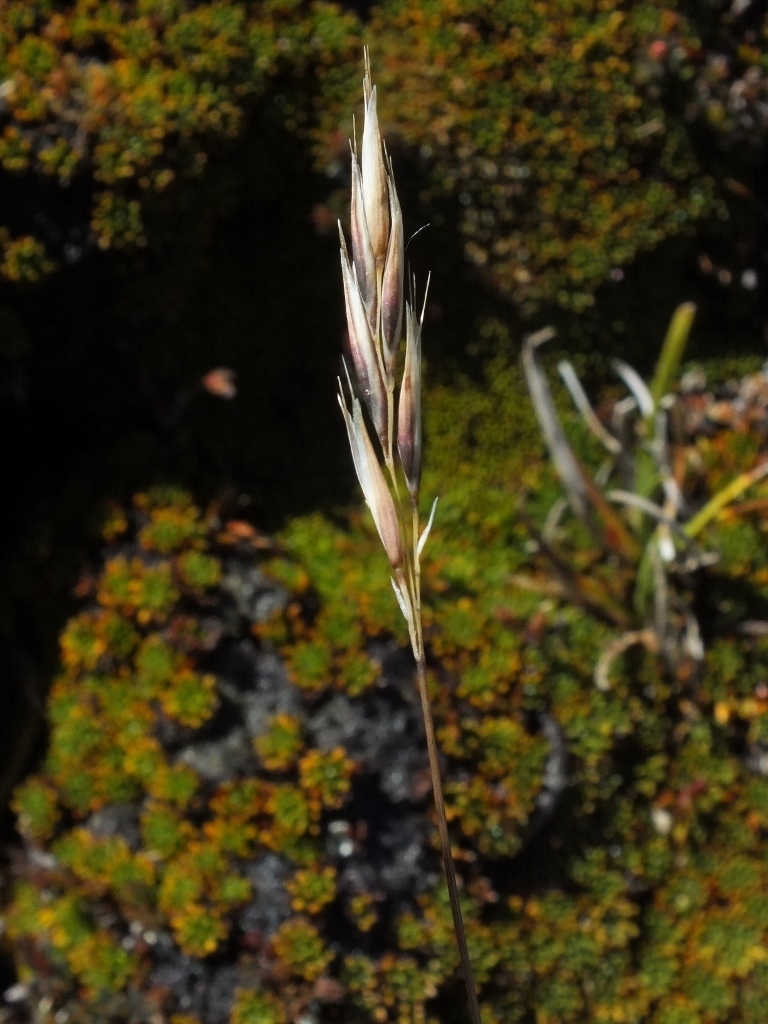
Rytidosperma nigricans
Rytidosperma nigricans is a species of true grass in the subfamily Danthonioideae. It is endemic to New Zealand and was described as Danthonia semiannularis var. nigricans in 1913 by Scottish-New Zealand botanist Donald Petrie.
From the article Rytidosperma nigricans on Wikipedia (CC BY-SA), quoted section by section
Description
R. nigricans grows in small, stiffly erect tufts with culms overtopping leaves up to 30 cm, and tipped with a panicle inflorescence. The panicle contains spikelets with 3-4 florets (or flowers), with awns exserted from the glumes, which are dark purplish or black. The lemma 1.5-2.5 mm, with lobed apexes, and a single awn. They contain two obvious rows of hairs, as well as one on the callus. The upper row is continuous, smaller than or equal to the lemma lobes, while the lower row is short. Between the two rows of lemma hairs, the lemma is predominantly glabrous, occasionally with a few isolated hairs. The callus has a few short scattered marginal hairs that don't (or barely) reach the lower lemma hairs.
R. nigricans has 2 n = 24 chromosomes.
Identification. As a Rytidosperma, the easiest way to identify R. nigricans is to select a single floret (which will contain a single awn, two lateral lobes, and usually three rows of hairs - one on the callus and two on the lemma). The arrangement of the hairs, as well as the relative lengths of the awn, lateral lobes, sometimes the callus can help identify to species, using a key such as that found in the New Zealand Flora.
Similar species. R. nigricans can be distinguished from most other Rytidosperma species by the long upper lemma hairs and very short lower lemma and callus hairs. In New Zealand, R. nigricans is most similar to R. …
Range & habitat
R. nigricans is endemic to New Zealand. In the North Island it is found in the Tararua and Remutaka Ranges. In the South Island it is found from Nelson to Southland mainly along the Main Divide, as well as montane zones to the west and rarely to the east. It is also found on Stewart Island.
Type. The type was collected by Donald Petrie at Mount Hector, in the Tararua Ranges growing at 900-1200 metres (3000-4000 feet) above sea level on the 29th of Janurary 1907.
Wikipedia: “Distribution”
In human culture
Rytidosperma: 'wrinkled seed' from the Greek 'rhytidos' = wrinkled and 'sperma' = seed nigricans: Latin for black. Probably refers to the glumes which are unusually dark purple or black.
Wikipedia: “Etymology”
Where it lives
Recorded sightings
—
geo-referenced records in GBIF, from museums, herbaria and field observers.
Drag the globe to turn it. Dots are where records exist, not a range map; darker means more records.
In the stacks
Searching the stacks…
Every page naming Rytidosperma nigricans in the Biodiversity Heritage Library →
This page is assembled live from iNaturalist, GBIF, Wikipedia, the Source Library and the Internet Archive. It is not yet part of the hand-edited codex. iNaturalist taxon 405778.