- Plants
- ›Vascular Plants
- ›flowering plants
- ›monocots
- ›grasses, sedges, cattails, and allies
- ›grasses
- ›Oatgrasses, Pampasgrasses, and allies
- ›Oatgrasses, Pampasgrasses, and allies
- ›Rytidosperma
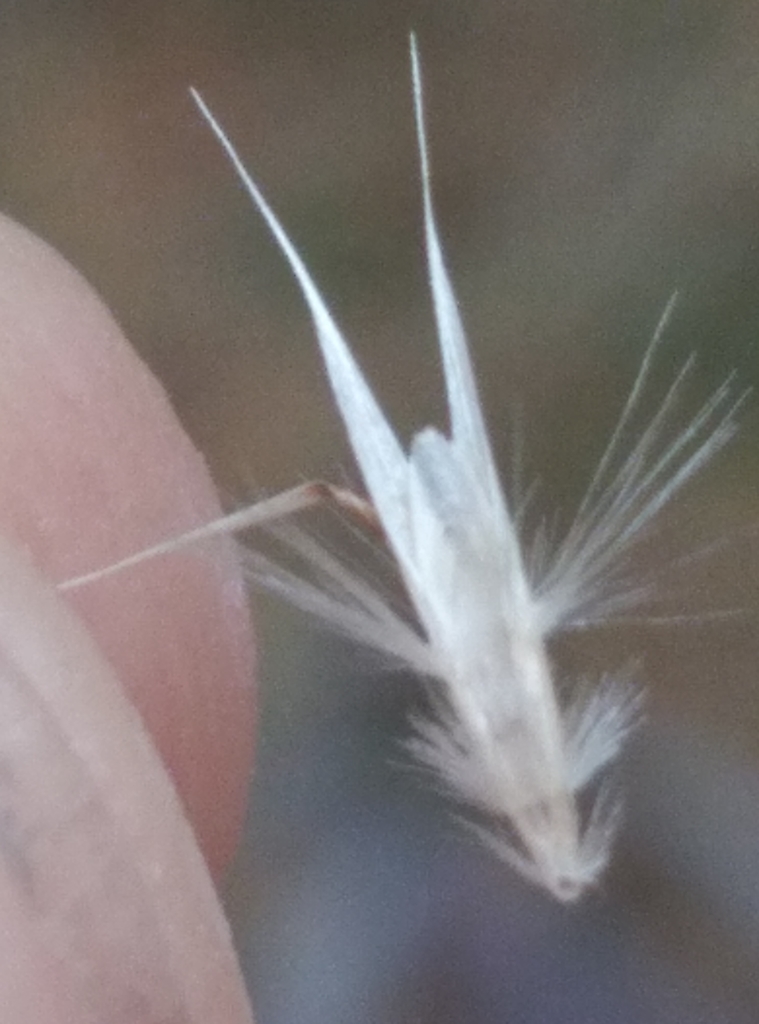
Rytidosperma unarede
Rytidosperma unarede (Māori: Unarede), also known as cliff fairy grass is a vascular plant in the family Poaceae (the grass family). It is indigenous to New Zealand and Lord Howe Island. It was first described as Danthonia unarede by Étienne Raoul in 1844. The specific epithet unarede is likely derived from the Māori name of the plant.
From the article Rytidosperma unarede on Wikipedia (CC BY-SA), quoted section by section
Description
It is an slender perennial tufted grass, growing to about 45 cm in height. The leaf blade grows up to 40 in length and 3.5 mm wide, or is tightly inrolled. The panicle is erect, slightly branched, 5–10 cm long and 1–2.3 cm wide. R. unarede has 2n = 48 chromosomes.
Identification. As a Rytidosperma, the easiest way to identify R. unarede is to select a single floret (which will contain a single awn, two lateral lobes, and usually three rows of hairs - one on the callus and two on the lemma). The arrangement of the hairs, as well as the relative lengths of the awn, lateral lobes, sometimes the callus can help identify to species, using a key such as that found in the New Zealand Flora.
Similar species. R. unarede is most similar to R. biannulare. These two species are differentiated from all other New Zealand Rytidosperma by their long lateral lemma lobes and upper lemma hairs, which exceed the awn column, and by their short lower lemma hairs. However, they are differentiated from one another by R. biannulare having an awn column that is much longer than the palea.
Range & habitat
The grass is native to New Zealand, where it is found on the Kermadec, Three Kings, North, South, Stewart, and Chatham Islands. It is apparently rare to west of Main Divide in the South Island. R. unarede was first discovered on the Kermadec Islands in 1994 by botanist A. E. Wright. It is possible that it is a new arrival which is still localised, given that it is currently found only in one place on the islands. It is also a rare inhabitant of Australia's subtropical Lord Howe Island in the Tasman Sea.
Type specimen. The type specimen of R. unarede was collected near the Akaroa Peninsula by Étienne Raoul in 1843.
Wikipedia: “Distribution”
What it does
The rust fungus Uromyces danthoniae, a species found that grows parasitically on the leaves of several Rytidosperma species in New Zealand and Australia, infects Rytidosperma unarede. It forms dense clusters of orange-brown aecidia on both surfaces of the leaf. It is also a host of Sphaerodothella danthoniae, a sac fungus that produces black, shiny leaf spots that occasionally coalesce into straight to irregular lines in the leaf surface of several species of Rytidosperma.
Wikipedia: “Ecology”
In human culture
Rytidosperma: 'wrinkled seed' from the Greek 'rhytidos' = wrinkled and 'sperma' = seed unarede: derived from the Te Reo Māori name for the grass - according to Raoul, 'Vulgo Unarede' or, the common name is unarede.
Wikipedia: “Etymology”
Where it lives
Recorded sightings
—
geo-referenced records in GBIF, from museums, herbaria and field observers.
Drag the globe to turn it. Dots are where records exist, not a range map; darker means more records.
In the stacks
Searching the stacks…
Every page naming Rytidosperma unarede in the Biodiversity Heritage Library →
This page is assembled live from iNaturalist, GBIF, Wikipedia, the Source Library and the Internet Archive. It is not yet part of the hand-edited codex. iNaturalist taxon 405777.