- Plants
- ›Vascular Plants
- ›flowering plants
- ›Dicots
- ›pinks, cactuses, and allies
- ›knotweed family
- ›Polygonoideae
- ›Docks, Sorrels and Rhubarbs
- ›Rumex
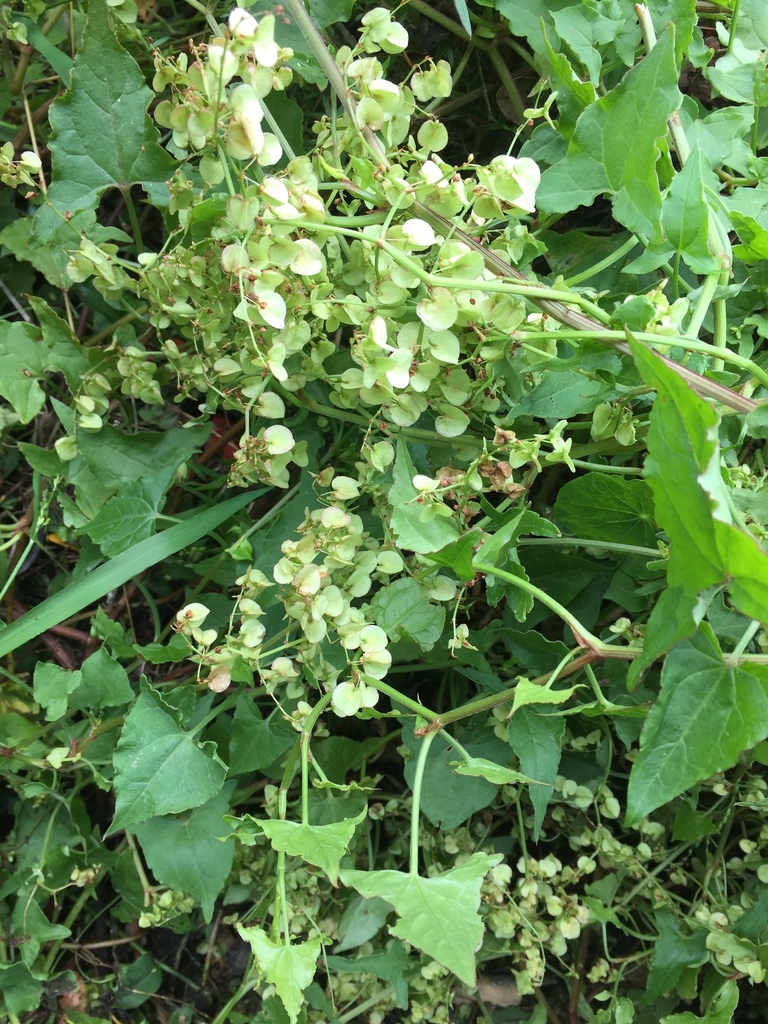
Climbing dock
Rumex sagittatus
Rumex sagittatus, synonym Acetosa sagittata, commonly known as turkey rhubarb or rambling dock or potato vine, is a herbaceous perennial plant native to southern Africa, which has become a weed in Australia and New Zealand.
From the article Rumex sagittatus on Wikipedia (CC BY-SA), quoted section by section
Description
Rumex sagittatus is a soft-stemmed herbaceous scrambling and climbing plant with prominent triangular arrow-shaped leaves 3–6 cm (1.2–2.4 in) in length and 2–4 cm (0.8–1.6 in) wide. The grooved green stem may be distinctly tinted red at times. The small pinkish flowers grow on panicles up to 15 cm (6 in) long. These are followed by a 3-sided greenish 0.8–1 cm diameter pod. The plant grows from a tuber, which may be up to 10 cm (4 in) long. The plant flowers and sets seed over summer, and may die back to the tuber in colder areas.
Range & habitat
The plant is native to southern Africa, where it occurs from Malawi and Zambia south to South Africa. It has become naturalised in many parts of Australia near urban areas, from Queensland to eastern Tasmania, and warmer locales in New Zealand. It spreads by seed or by resprouting from the tuber. The seeds float on water and hence may be conveyed far from the parent plant. Tubers may be broken up by tractors or road graders and each fragment may be able to regrow; they can also be difficult to find with removal of plants by hand. Rumex sagittatus may grow and smother other plants it covers.
Wikipedia: “Distribution and habitat”
At the table
The leaves and young stems can be cooked and eaten and are sometimes cultivated as a vegetable in Java.
== References ==
Wikipedia: “Uses”
Where it lives
Recorded sightings
—
geo-referenced records in GBIF, from museums, herbaria and field observers.
Drag the globe to turn it. Dots are where records exist, not a range map; darker means more records.
In the stacks
Searching the stacks…
Every page naming Rumex sagittatus in the Biodiversity Heritage Library →
This page is assembled live from iNaturalist, GBIF, Wikipedia, the Source Library and the Internet Archive. It is not yet part of the hand-edited codex. iNaturalist taxon 405771.