- Plants
- ›Vascular Plants
- ›flowering plants
- ›Dicots
- ›Mints, Plantains, Olives, and Allies
- ›Plantain Family
- ›Plantagineae
- ›Plantago
- ›Plantago
- ›Mesembrynia
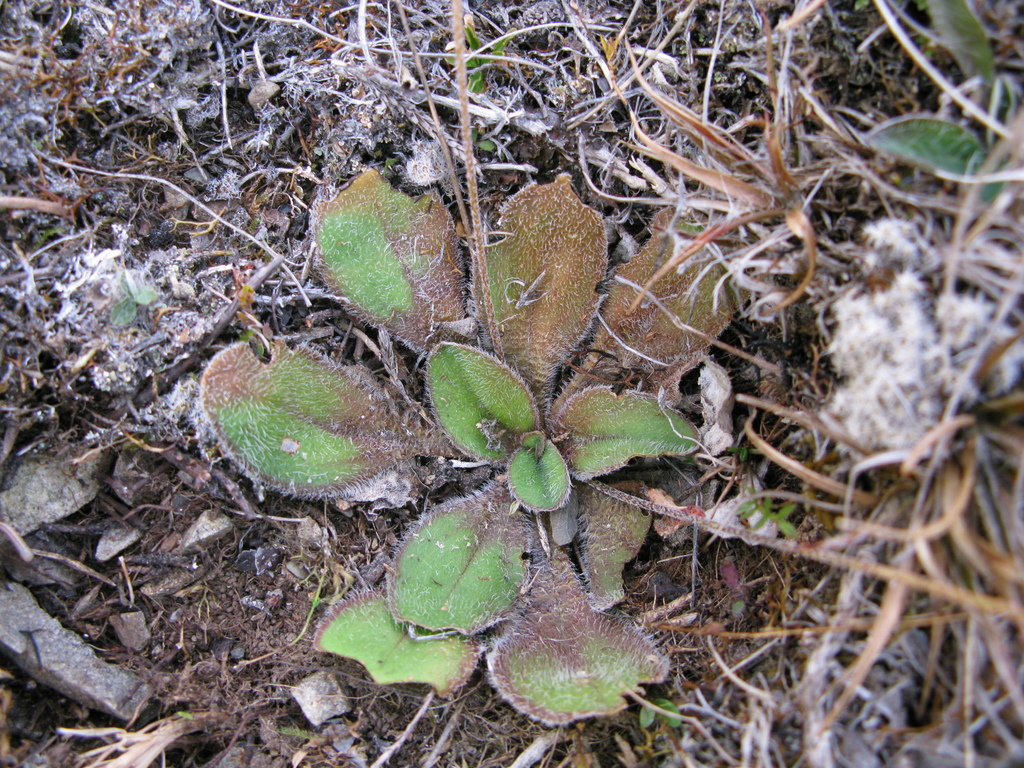
Plantago spathulata
Plantago spathulata (also known as kaupārerarera or pārerarera in te reo Māori) is a species of flowering plant in the family Plantaginaceae that is endemic to New Zealand. Joseph Dalton Hooker described P. spathulata in 1853. Plants of this species of plantain are perennial with a rosette habit, leaves widest above the middle, up to 4 ellipsoid seeds per capsule, bracts with hairs along the edges, and midribs of bracts and sepals hairy. It is listed as Not Threatened.
From the article Plantago spathulata on Wikipedia (CC BY-SA), quoted section by section
Description
Plantago spathulata plants are small rosettes with a primary root up to 13 mm thick, with up to 28 usually narrowly angular-ovate or narrowly obovate leaves, and with visible, short (<10 mm long), rust-coloured leaf axillary hairs in the basal rosette. The leaves have 1–3 veins (rarely up to 5), are 18–118 mm long (including petiole) and up to 29 mm wide, not punctate, with patchy, isolated hairs or sparsely or densely hairy on the upper surface, usually glabrous or with isolated hairs or sparsely hairy on the lower surfaces. The leaf usually has an acute or obtuse apex, and its edges are smooth or wavy or with up to 12 minute teeth, and sparsely or densely hairy especially near the teeth. The petiole is usually distinguishable from the leaf lamina, and up to 27 mm long. Each rosette plant has up to 22 erect inflorescences which can be up to 212 mm (8.3 in) long. The scapes are smooth and sparsely to densely hairy. The spikes are usually linear-ovoid with 3–26 densely crowded flowers. Each flower has 1 small bract that is ovate, broadly ovate or very broadly ovate and with isolated hairs or sparsely hairy along the edges and midrib. The calyx is 2.1–4.0 mm long, 1.4–4.7 mm wide, and sparsely hairy on the lobe edges and midrib. …
Range & habitat
Plantago spathulata is a plantain that is endemic to the North and South Islands of New Zealand. In the North Island it is found in the Southern North Island region, whereas on the South Island it is found in the Western Nelson, Marlborough, Canterbury, Otago and Southland regions. It grows in grasslands, herbfields, on rocky, coastal, exposed, dry or wet areas, on multiple substrates such as limestone, mudstone, clay, sand, gravel or silt, from 0 to 1,070 m (3,510 ft) m above sea level.
Wikipedia: “Distribution and habitat”
Where it lives
Recorded sightings
—
geo-referenced records in GBIF, from museums, herbaria and field observers.
Drag the globe to turn it. Dots are where records exist, not a range map; darker means more records.
In the stacks
Searching the stacks…
Every page naming Plantago spathulata in the Biodiversity Heritage Library →
This page is assembled live from iNaturalist, GBIF, Wikipedia, the Source Library and the Internet Archive. It is not yet part of the hand-edited codex. iNaturalist taxon 404970.