- Plants
- ›Vascular Plants
- ›flowering plants
- ›Dicots
- ›myrtles, evening primroses, and allies
- ›myrtle family
- ›Myrtoideae
- ›Metrosidereae
- ›Metrosideros
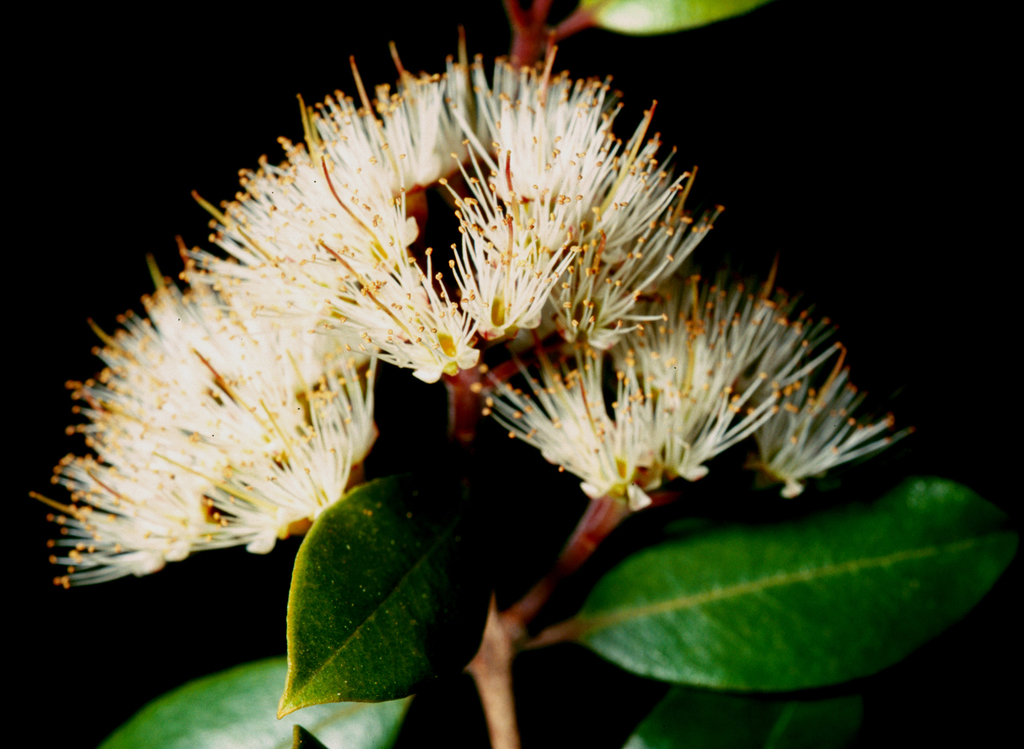
Bartlett's rātā
Metrosideros bartlettii
Metrosideros bartlettii, commonly known as Bartlett's rātā, is a rare species of tree in the family Myrtaceae. It is endemic to the Northland Region in New Zealand's North Island. Bartlett's rātā reaches a height of up to 30 metres (100 feet) with a trunk of 1–1.5 metres (3 ft 3 in – 4 ft 11 in) in diameter. The species is classified in the subgenus Metrosideros and is known for its distinct whitish, paper-like bark and small white-coloured flowers. Bartlett's rātā was first discovered in 1975 by the New Zealand botanist and schoolteacher John Bartlett, who accidentally discovered the species while searching for liverworts near Cape Reinga. It was first described by botanist John Dawson in a 1985 article in the New Zealand Journal of Botany.
Bartlett's rātā's range covers the northern tip of the Aupōuri Peninsula, in three dense forest remnants near Piwhane / Spirits Bay. Bartlett's rātā typically begins life as an epiphyte (growing on another plant); it inhabits lowland forests and is usually found growing near wet areas. A 2018 article by the New Zealand Plant Conservation Network documented 13 adult trees in the wild, a significant decrease from another research article in 2000 that documented 31 wild adult trees. The species has a high chance of becoming extinct in the wild unless immediate conservation measures are taken to stop its ongoing decline, which has been attributed to land use changes following human settlement and the introduction of common brushtail possums, which browse its buds, flowers, and shoots.
From the article Metrosideros bartlettii on Wikipedia (CC BY-SA), quoted section by section
Description
Metrosideros bartlettii (Bartlett's rātā) is a tree in the family Myrtaceae, reaching a height of up to 30 metres (100 feet) with a trunk up to 1–1.5 m in diameter. Its bark is described as "papery" and is pale grey to whitish in colour, shedding freely, and separating into soft flakes. Its young twigs are often coloured dark red. The leaves are chartaceous (paper-like) to coriaceous (leather-like) in character with laminae (leaf blades) that are 30–50 mm long × 15–23 mm wide. Young leaves are palish-green to yellow-green and become dark green as they mature. The leaves' upper surfaces are shiny, and their lower surfaces are glossy. There are 3–4 pairs of cymules (very small flowers) on an inflorescence (flower cluster) with densely spreading white hairs. Compared to other species in the genus Metrosideros, the flowering of Bartlett's rātā is unpredictable, making it unlikely that its small population can regenerate naturally. Bartlett's rātā typically flowers in spring, from October to November; the species produces distinct white-coloured flowers with pedicels up to 3 × 1 mm and a hypanthium of up to 2.5–3 mm high × 2–2.5 mm wide. Its spreading sepals are triangle-shaped and are 1–1.5 × 1–1.5 mm long, and its petals are elliptical to egg-shaped and are 2.5–3 × 1.8–2 mm long. Its peduncles are 9 × 1 mm long. …
Range & habitat
Bartlett's rātā is endemic to the Northland Region in New Zealand's North Island. Its range covers the northern tip of the Aupōuri Peninsula, in three patches of dense forest remnants near Piwhane / Spirits Bay, these being: Kohuronaki Bush, Radar Bush, and Unuwhao Bush. At the time of the original species description in 1985, only seven naturalised adult individuals were known to be located at two of the sites. Later in the mid-1990s, New Zealand's Department of Conservation recorded nineteen adult individuals. Then, a 2000 research article of Bartlett's rātā, published in Molecular Ecology, revealed an additional twelve adult individuals, bringing the known species count of Bartlett's rātā to thirty-one in the year 2000. Before a DNA profiling test of Bartlett's rātā individuals was conducted in 2015, the Department of Conservation was unaware that three of the five genotypes required to grow genetically suitable trees were located within the tribal territories of the Ngāti Kurī and Te Aupōuri iwi. At most, five of the fourteen trees in 2015 possessed the unique genotypes required for the genetic diversity, which is essential to the species' existence. New Zealand botanist and science advisor Peter de Lange stated that without intervention "the future was bleak" for Bartlett's rātā. …
Wikipedia: “Distribution”
What it does
The flowers of Bartlett's rātā are observed to be frequently visited by birds and insects (such as bees and flies), which may help spread pollen to Bartlett's rātā from other nearby Metrosideros individuals. Despite this, it is unclear what the primary pollinators of Bartlett's rātā are. Introduced species are known to visit Metrosideros in a manner similar to native species. This could be due to the inherent vulnerability of biotas on isolated oceanic islands to disruption by introduced species. In 2018, two New Zealand botanists, Carlos Lehnebach and Karin van der Walt, examined the pollination and the flower development of Bartlett's rātā. In their study, published in the New Zealand Plant Conservation Network, they found that Bartlett's rātā is a self-incompatible tree, meaning that its flowers will only seed if it is pollinated by pollen from a genetically distinct tree. In 2021, the New Zealand Journal of Botany published a similar study in which researchers and scientists analysed the ex situ conservation of Bartlett's rātā individuals at Ōtari-Wilton's Bush. Their analyses confirmed the self-incompatibility of Bartlett's rātā, which is consistent with other species within the genus Metrosideros. Although it was speculated that self-incompatibility occurred in Bartlett's rātā, it had never been experimentally confirmed until these two studies. …
Wikipedia: “Ecology”
In human culture
Bartlett's rātā was accidentally discovered in 1975 by the New Zealand botanist and schoolteacher John Bartlett while searching for liverworts near Cape Reinga. He came across the species growing at the base of a large tree in Radar Bush, near Cape Reinga. Bartlett realised it was a new species of rātā but was unable to reach any of the branches, so he instead took fragments of the bark to botanist John Dawson of the Victoria University of Wellington. Dawson thought the find was northern rātā, but Bartlett believed it was a new species, so he later returned to the area where he found the species and was able to collect a branch by shooting one off with his rifle. He then took the branch back to Wellington. Dawson described the new species in a 1985 article in the New Zealand Journal of Botany, noting it had a "distinct whitish, spongy bark and small white flowers" and when flowers of Bartlett's rātā were first collected in 1984, it was clear to him that "a new species was involved". The examined type material for the article was collected in July 1978 by John Bartlett in Radar Bush and the isotype was collected in November 1984 by Nigel Culnie near Spirits Bay Road.
Wikipedia: “History”
Where it lives
Recorded sightings
—
geo-referenced records in GBIF, from museums, herbaria and field observers.
Drag the globe to turn it. Dots are where records exist, not a range map; darker means more records.
In the stacks
Searching the stacks…
Every page naming Metrosideros bartlettii in the Biodiversity Heritage Library →
This page is assembled live from iNaturalist, GBIF, Wikipedia, the Source Library and the Internet Archive. It is not yet part of the hand-edited codex. iNaturalist taxon 403877.