- Plants
- ›Vascular Plants
- ›flowering plants
- ›Dicots
- ›Sunflowers, Bellflowers, Fanflowers, and Allies
- ›bellflower family
- ›Lobelia subfamily
- ›Lobelia
- ›Hypsela
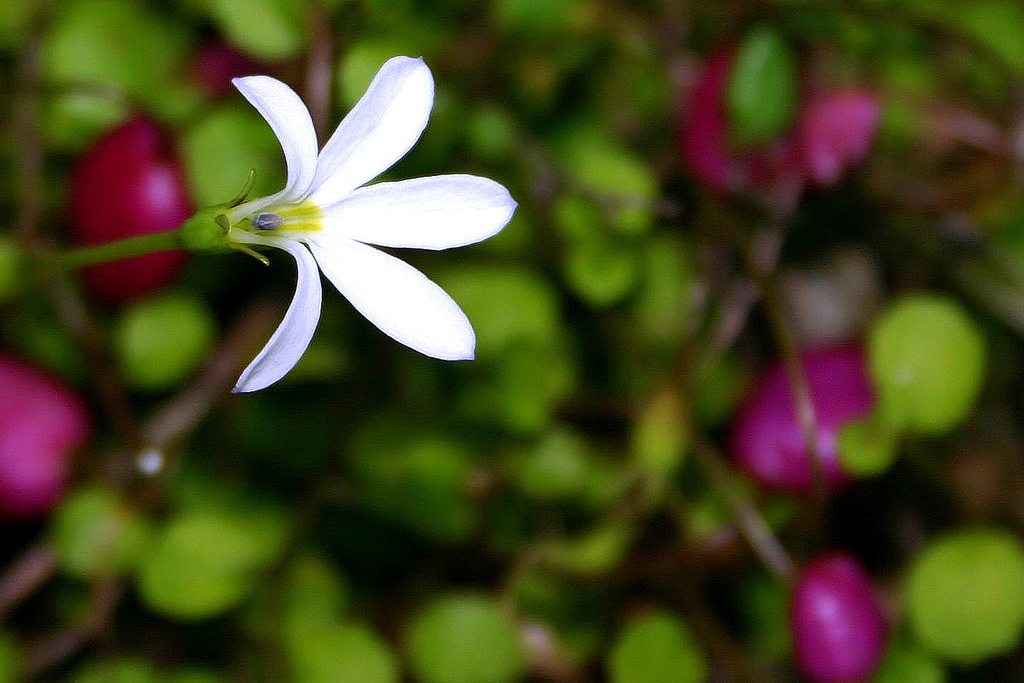
pānakenake
Lobelia angulata
Lobelia angulata, previously known as Pratia angulata, and commonly known as pānakenake, or Lawn Lobelia is a small scrambling herbaceous plant native to New Zealand.
From the article Lobelia angulata on Wikipedia (CC BY-SA), quoted section by section
Range & habitat
Lobelia angulata is naturally endemic to New Zealand and some of its offshore islands. It has also become an established exotic plant in the British Isles. It was first brought to the British Isles for cultivation in 1829 and has become well established in and around the Royal Botanic Garden in Edinburgh. Lobelia angulata has now become quite widespread in the British Isles, especially in areas of England and Scotland, with sightings increasing since the turn of the 21st century.
New Zealand range. Lobelia angulata is widespread and common in damp habitats throughout much of the North, South and Stewart Islands. It is easily the most common and widespread of the New Zealand native Lobelia species. It also occurs on some nearby islands such as Ulva Island off Stewart Island. Interestingly, it also occurs on the subantarctic Auckland Islands (namely Enderby Island) and Campbell Island.
Habitat preferences. Lobelia angulata grows in a variety of moist habitats from lowland to 1,300 metres above sea level in the low alpine zone. It can often be found in habitats such as stream banks, lakes edges, forest edges and tracks, open forest and other types of moist habitats that are well-lit. In alpine regions they may grow in similar moist habitats such as subalpine grasslands, herbfields, closely grazed sites and other non-shaded habitats. …
Wikipedia: “Distribution”
What it does
Lobelia angulata has a long season for flowering and fruiting, with both flowers and ripe fruits often being seen on the plant at the same time. In New Zealand, flowering first commences in late spring around October and lasts until early autumn, typically March and April. The peak of flowering, however, occurs from November through to March. Fruiting typically occurs from late spring to early winter. The most fruiting occurs in autumn during April and May, but fruits are still consistently found throughout much of the winter and spring. Seeds excreted by Weta are known to germinate faster than those extracted from fruit pulp. Lobelia angulata is a perennial plant, and thus lives longer than one year or season, and also has a fast rate of growth. Since this plant roots at the leaf nodes, it could also propagate in new areas via stem fragments that wash away or are carried to new locations. In the British Isles the flowering season is roughly reversed from that of its native New Zealand, with peak flowering occurring from July to September.
Wikipedia: “Life cycle and phenology”
Where it lives
Recorded sightings
—
geo-referenced records in GBIF, from museums, herbaria and field observers.
Drag the globe to turn it. Dots are where records exist, not a range map; darker means more records.
In the stacks
Searching the stacks…
Every page naming Lobelia angulata in the Biodiversity Heritage Library →
This page is assembled live from iNaturalist, GBIF, Wikipedia, the Source Library and the Internet Archive. It is not yet part of the hand-edited codex. iNaturalist taxon 403517.