 NL·0742
Herbarium of the Nature Library
- Name
- Geochelone elegans
- Family
- Testudinidae
- Native to
- Northwestern India and southeastern Pakistan; southeastern India; Sri Lanka
- Habitat
- Scrub, Dry grassland, Thorn forest
Indian star tortoise
Geochelone elegans
Also calledKachhua (Hindi, tortoise) · Nakshatra aamai நட்சத்திர ஆமை (Tamil) · Star tortoise
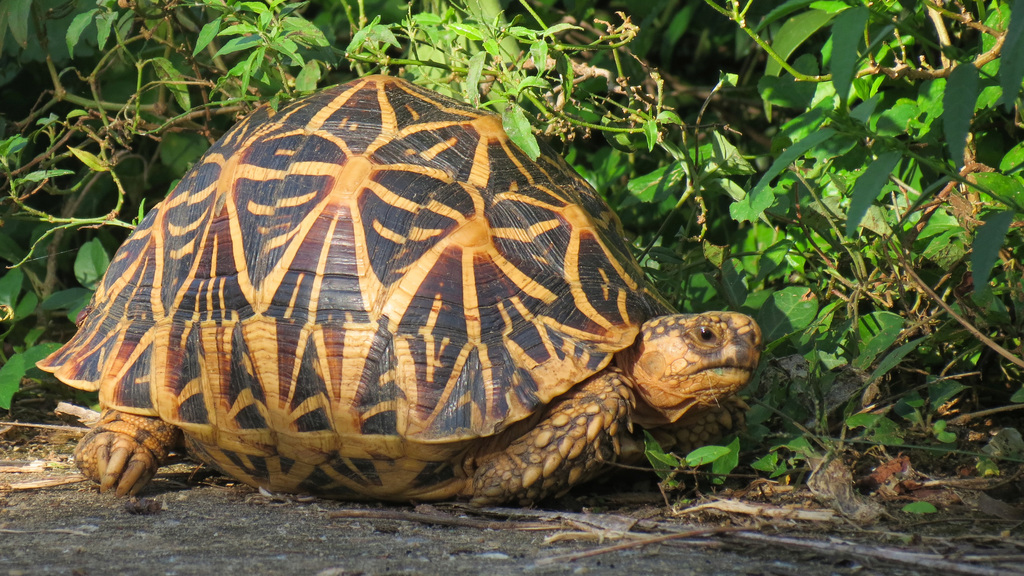
A tortoise of the dry scrub of India, Pakistan and Sri Lanka, with bold yellow star patterns radiating across black, domed shell plates. It is one of the most smuggled tortoises in the world.
The Indian star tortoise is a threatened tortoise species native to India, Pakistan and Sri Lanka where it inhabits dry areas and scrub forest. It has been listed as Vulnerable on the IUCN Red List since 2016, as the population is thought to comprise more than 10,000 individuals, but with a declining trend. It is threatened by habitat loss and poaching for the illegal wildlife trade. It was upgraded to CITES Appendix I in 2019 by full consensus among all member states, giving it the highest level of international protection from commercial trade. Conservation group TRAFFIC found 6,040 were seized globally that were intended to be sold in the pet trade. Currently they are commonly bred in many countries to be sold as pets. Wikipedia
What it can do
- iIts star pattern breaks up its outline among grass and shadows
- iiIts high-domed shell is hard for predators to crack or swallow
- iiiSurvives hot dry seasons by eating succulent plants and being active after rain
In the field
Field marks
- aHigh-domed shell with raised, pyramid-like plates
- bYellow or tan star pattern on each black plate
- cYellow head and limbs
- Not to be confused with
- The Burmese star tortoise (G. platynota) of Myanmar has fewer rays and flatter scutes and is found only in Myanmar.
- Where to see it
- Dry scrub of Gujarat (Kutch, Saurashtra) and Rajasthan; Tamil Nadu and Andhra Pradesh; Sri Lanka's dry zone (Yala, Wilpattu)
- When
- Most active in the monsoon
Life & habits
- Diet
- Grasses, fallen fruit, flowers, succulent leaves
- Habitat
- Dry grassland, scrub forest and semi-desert
- Size
- Shell up to ~25–30 cm
Most active in the early morning and late afternoon, and after monsoon rains.
Where it lives
Recorded sightings
—
geo-referenced records in GBIF, from museums, herbaria and field observers.
Native range
Northwestern India and southeastern Pakistan; southeastern India; Sri Lanka
Drag the globe to turn it. Dots are where records exist, not a range map; darker means more records.
In the stacks
Searching the stacks…
Every page naming Geochelone elegans in the Biodiversity Heritage Library →
Marginalia
Despite being protected under Indian law, thousands are smuggled abroad as pets every year. In 2019 CITES moved it to Appendix I, banning all international commercial trade.
Kinship




Photographs: iNaturalist contributors under the licences shown. Records: GBIF.org. Historical plates: Source Library (CC BY-SA 4.0; originals public domain). Summary text: Nature Library editors and Wikipedia (CC BY-SA). Medicinal and edibility notes are historical and educational, not advice. iNaturalist taxon 40106.