- Plants
- ›Vascular Plants
- ›flowering plants
- ›Dicots
- ›Gentians, Dogbanes, Madders, and Allies
- ›madder family
- ›Rubioideae
- ›Anthospermeae
- ›Coprosminae
- ›Coprosma
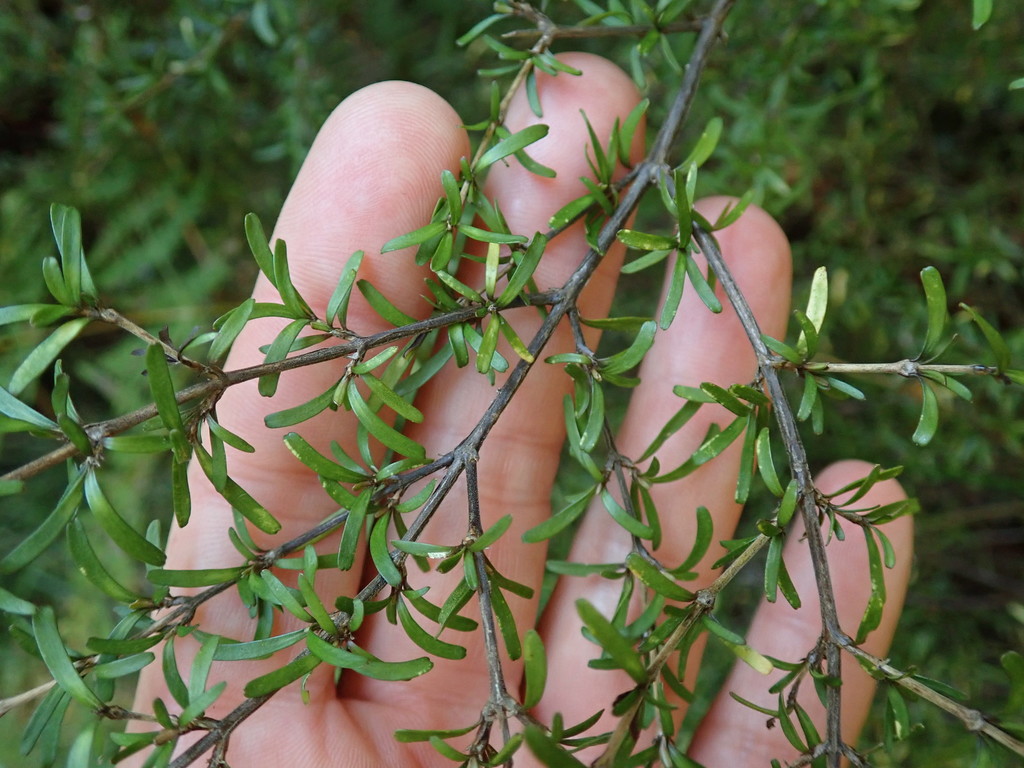
Coprosma cuneata
Coprosma cuneata, is a shrub in the Rubiaceae family, endemic to New Zealand.
From the article Coprosma cuneata on Wikipedia (CC BY-SA), quoted section by section
Description
Coprosma cuneata is a slender shrub up to 1 m tall that may hug the ground on exposed sites. The flexible branchlets are dark to very dark brown with clusters of small dark green narrow leaves. The stipules are oblong to triangular with a tuft of hair at their apex. The leaves are in distant opposite pairs with slender 1-2 mm stalks. The leaves are curved and 10-16 mm by 2 mm. They are widest at the tip. The fruit is red, 3-5 mm in diameter and persists on the shrub.
Range & habitat
Coprosma cuneata is found in the South Island and the southern offshore islands of New Zealand. It is found from lowland to 1,000 metres (3,300 ft) in forest, scrub and shrubland.
Wikipedia: “Distribution and habitat”
In human culture
Coprosma is from the Greek kopros and osme meaning dung smell. Cuneata is from the Latin, meaning wedge-shaped.
Wikipedia: “Taxonomy and etymology”
Where it lives
Recorded sightings
—
geo-referenced records in GBIF, from museums, herbaria and field observers.
Drag the globe to turn it. Dots are where records exist, not a range map; darker means more records.
In the stacks
Searching the stacks…
Every page naming Coprosma cuneata in the Biodiversity Heritage Library →
This page is assembled live from iNaturalist, GBIF, Wikipedia, the Source Library and the Internet Archive. It is not yet part of the hand-edited codex. iNaturalist taxon 401013.