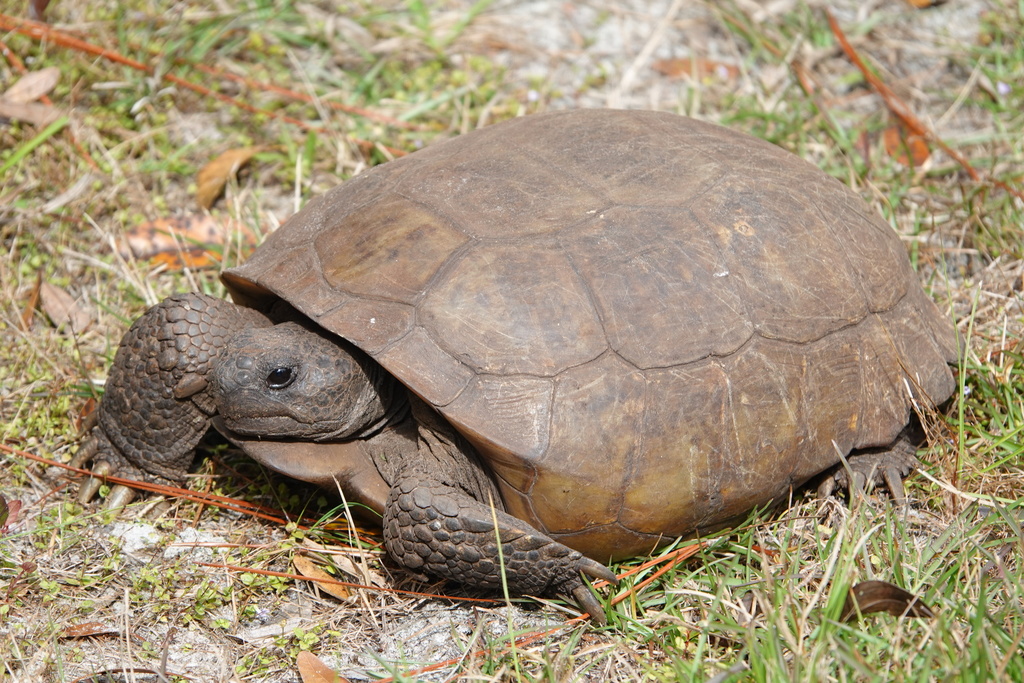
Gopher Tortoise
Gopherus polyphemus
The gopher tortoise (Gopherus polyphemus) is a species of tortoise in the family Testudinidae. The species is native to the Southeastern United States. The gopher tortoise is seen as a keystone species because it digs burrows that provide shelter for at least 360 other animal species. G. polyphemus is threatened by predation and habitat destruction. The IUCN Red List of Threatened Species lists the gopher tortoise as "critically endangered," primarily because of habitat fragmentation and loss, and human exploitation; the animals are considered threatened in some states, while they are endangered in others.
The gopher tortoise is placed in the genus Gopherus, which contains the only tortoises native to North America. The gopher tortoise is the state reptile of Georgia and the state tortoise of Florida.
From the article Gopher tortoise on Wikipedia (CC BY-SA), quoted section by section
Description
The gopher tortoise is a terrestrial reptile that possesses forefeet that are well adapted for burrowing, and elephantine hind feet. These features are common to most tortoises. The front legs have scales to protect the tortoise while burrowing. G. polyphemus is dark brown to gray-black in overall color, with a yellow plastron (bottom shell). A gular projection is evident on the anterior plastron where the head projects from the shell. Sexual dimorphism is evident, with the male gopher tortoise having a concave plastron, while that of the female is flat. In addition, the gular projection of a male plastron is generally longer than that of a female. Straight carapace lengths of adults usually range from 6 to 11 in (15 to 28 cm), with a maximum of 17.32 in (44.0 cm). The carapace is at least twice as long as it is high. Anal width (distance between the extreme posterior points of the anal shields) and anal notch (distance between the posterior end of the plastron at midline and the posterior edge of the carapace) are dimorphic, but does not become distinctly dimorphic until sexual maturity is attained. Body mass averages 4 kg (8.8 lb), with a range of 2–6 kg (4.4–13.2 lb). They are the only extant species of the genus Gopherus found east of the Mississippi River.
Range & habitat
Conversion of gopher tortoise habitat to urban areas, croplands, and pasture, along with adverse forest management practices, has drastically reduced their historic range. They often cross roads, which leads to many fatalities by vehicles. The taking of gopher tortoises for sale or use as food or pets has also had a serious effect on some populations, magnified by the length of time required for tortoises to reach maturity and their low reproductive rate. According to the website of the Brevard Zoo in Melbourne, Florida, current estimates of human predation and road mortality alone are at levels that could offset any annual addition to the population, and sightings of gopher tortoises have become rare in many areas, with the ones sighted being much smaller than in the past. A number of other species also prey upon gopher tortoises; predators of eggs and young include raccoons, coyotes, bobcats, wild boars, striped skunks, eastern spotted skunks, red-tailed hawks, red-shouldered hawks, bald eagles, and a number of snake species, including eastern diamondback rattlesnakes, eastern indigo snakes, coachwhips, eastern racers, common kingsnakes, and Florida cottonmouths. Red imported fire ants destroy many eggs and young tortoises. Adult gopher tortoises are less vulnerable to predation, but they are sometimes killed by coyotes, bobcats, and domestic dogs and cats. …
Wikipedia: “Habitat conversion”
What it does
Gopher tortoises are herbivore scavengers and opportunistic grazers. Thus, their diets contains over 300 species of plants, with the dominant plants within their environment likely making up the bulk of their diet. They consume a very wide range of plants, but mainly eat broad-leaved grass, regular grass, wiregrass, and terrestrial legumes. However, other plant parts, including shoots, stems, leaves, and pine needles are also eaten. They also eat mushrooms, and fruits such as gopher apple, pawpaw, blackberries, and saw palmetto berries. In addition, gopher tortoises eat flowers from the genera Cnidoscolus (nettles), Tillandsia (Spanish and ball moss), Richardia, and Dyschoriste. A very small portion of the tortoises' diet is composed of fungi, lichens, carrion, bones, insects, and feces, eaten more commonly by females before and after nesting time. Juvenile tortoises tend to eat more legumes, which are higher in protein, and fewer grasses and tough, fibrous plants than mature tortoises. As gopher tortoises usually get water from the food they eat, they usually only drink standing water in times of extreme drought. During wetter seasons, gopher tortoises have been known switch to a more frugivorous diet, seeking out fruits when they are more plentiful. …
Wikipedia: “Diet”
In human culture
Tortoises of the genus Gopherus are so named because of some species' habit of digging large, deep burrows like those of gophers. The specific name, polyphemus, refers to the cave-dwelling giant, Polyphemus, of Greek mythology.
Wikipedia: “Etymology”
Where it lives
Recorded sightings
—
geo-referenced records in GBIF, from museums, herbaria and field observers.
Drag the globe to turn it. Dots are where records exist, not a range map; darker means more records.
In the stacks
Searching the stacks…
Every page naming Gopherus polyphemus in the Biodiversity Heritage Library →
This page is assembled live from iNaturalist, GBIF, Wikipedia, the Source Library and the Internet Archive. It is not yet part of the hand-edited codex. iNaturalist taxon 40085.