Impressed Tortoise
Manouria impressa
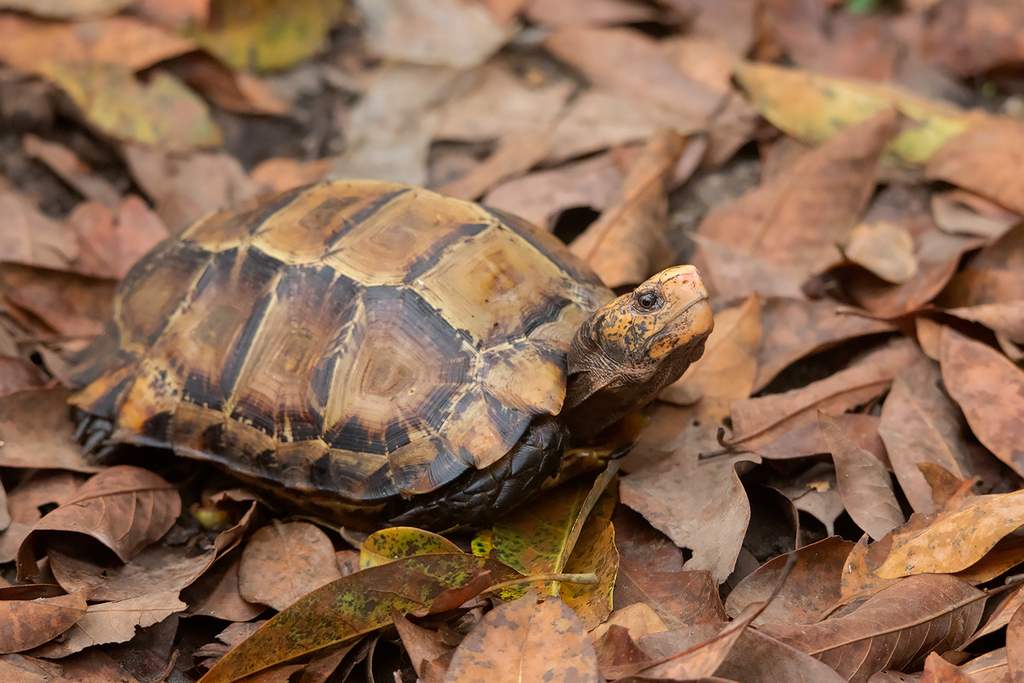
The impressed tortoise (Manouria impressa), occurs in mountainous forest areas in Southeast Asia in Burma, southern China, Thailand, Laos, Vietnam, Cambodia and Malaysia. The species has a golden brown shell and skin. Adults are much smaller than their relatives the Asian forest tortoise (Manouria emys), with a maximum size of 35 cm (14 in) carapace length.
From the article Impressed tortoise on Wikipedia (CC BY-SA), quoted section by section
Description
The tortoise species received its name due to the shape and style of the scutes of the carapace. The scutes are concaved or "impressed", which appear similar to stamps. The species has a golden brown to dark brown shells. Their skin is usually a paler yellow and may have pinkish noses. Adults are much smaller than their relatives the Asian forest tortoise (Manouria emys), with a maximum carapace length of 35 cm (14 in).
Wikipedia: “Morphology”
Range & habitat
The impressed tortoise lives at high elevations, up to 2,000 m (6,600 ft). The non-territorial species have a relatively sedentary lifestyle with space usage and movement heavily influenced by seasonal conditions and resource availability. Despite a stationary life, the tortoises are most active in environments at temperatures between 12-30 degrees Celsius and 60-100% humidity. These animals may also play a vital role in their environment by indirectly spreading fungi spores through defication.
Wikipedia: “Habitat”
What it does
The primary behavior of the impressed tortoise is hiding, with most individuals spending most of their time concealed under leaves or vegetation. Its behavior is little known due to the small known population; diet in the wild has been observed to consist primarily of mushrooms. While mushrooms compose majority of the tortoise's diet, bugs such as beetles and other larvae could be consumed accidentally in the process. Consuming these extra creatures could further provide extra nutrients and protein to the impressed tortoises. Furthermore, feeding occurs primarily in the wet season as mushrooms are more available from May to July. When the species is not hiding, these tortoises can be found basking after period of inactivity. The behavior often helps with raising body temperature as well as digestion.
Wikipedia: “Behavior”
In human culture
The species is known for being difficult to keep alive in captivity because not much is known about it; although its status in the wild is uncertain, it is eaten widely by local people and little captive breeding has occurred. As of 2026, there is only one known successful impressed tortoise breeding group under an AZA-accredited faculty in the United States. The society is called The Turtle Conservancy located in California. Despite efforts to help these tortoises increase population sizes, they are still listed as endangered through the IUCN Red List website.
Wikipedia: “History”
Where it lives
Recorded sightings
—
geo-referenced records in GBIF, from museums, herbaria and field observers.
Drag the globe to turn it. Dots are where records exist, not a range map; darker means more records.
In the stacks
Searching the stacks…
Every page naming Manouria impressa in the Biodiversity Heritage Library →
This page is assembled live from iNaturalist, GBIF, Wikipedia, the Source Library and the Internet Archive. It is not yet part of the hand-edited codex. iNaturalist taxon 40059.