- Plants
- ›Vascular Plants
- ›flowering plants
- ›monocots
- ›grasses, sedges, cattails, and allies
- ›Sedges
- ›Cyperoideae
- ›Cariceae
- ›Carex
- ›Carex
- ›Spirostachyae
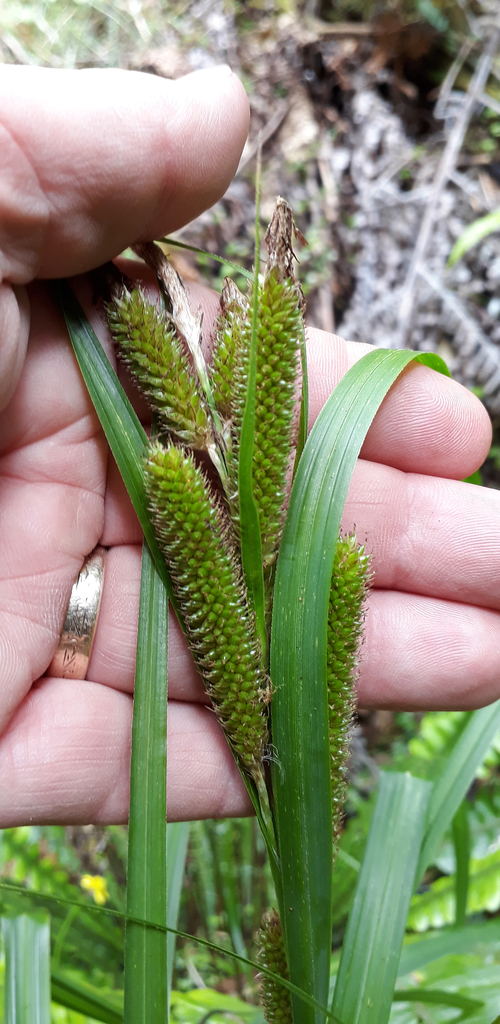
Chatham Island forest sedge
Carex ventosa
Carex ventosa, also known as Chatham Islands forest sedge, is a tussock-forming species of perennial sedge in the family Cyperaceae. It is native to the Chatham Islands.
From the article Carex ventosa on Wikipedia (CC BY-SA), quoted section by section
Description
The sedge has a stout and quite leafy habit with a short and erect rhizome typically with a width of about 20 mm (0.79 in) and is found to grow mostly in well drained soils. It has smooth culms that can be scabrous below the inflorescence. The culms have a triangular cross-section and a length that is usually 0.45 to 1 m (1 ft 6 in to 3 ft 3 in) but can be as long as 1.5 m (4 ft 11 in) and a width of 1 to 4 mm (0.039 to 0.157 in) and are surrounded at the base by drown coloured sheaths. The pale green to light grey-green double folded leaves are usually as long as or slightly longer than the culms and have a width of 5 to 11 mm (0.20 to 0.43 in) and have rough margins. The inflorescences contain 7 to 15 spikes and are 0.2 to 1 mm (0.0079 to 0.0394 in) in length.
Range & habitat
The species is endemic to the Chatham Islands, and is found on Chatham Island, Pitt Island, Mangere Island, Little Mangere Island, Star Keys, Rabbit Island and Rangatira Island. It is widespread throughout the areas of lowland forest on the islands usually associated with areas of coastland forest, tall scrub and dune forest and is rarely found in areas of deep peat.
Wikipedia: “Distribution”
Where it lives
Recorded sightings
—
geo-referenced records in GBIF, from museums, herbaria and field observers.
Drag the globe to turn it. Dots are where records exist, not a range map; darker means more records.
In the stacks
Searching the stacks…
Every page naming Carex ventosa in the Biodiversity Heritage Library →
This page is assembled live from iNaturalist, GBIF, Wikipedia, the Source Library and the Internet Archive. It is not yet part of the hand-edited codex. iNaturalist taxon 400458.