- Plants
- ›Vascular Plants
- ›flowering plants
- ›monocots
- ›Agaves, Orchids, Irises, and Allies
- ›Aloe family
- ›Aloes and allies
- ›Bulbinella
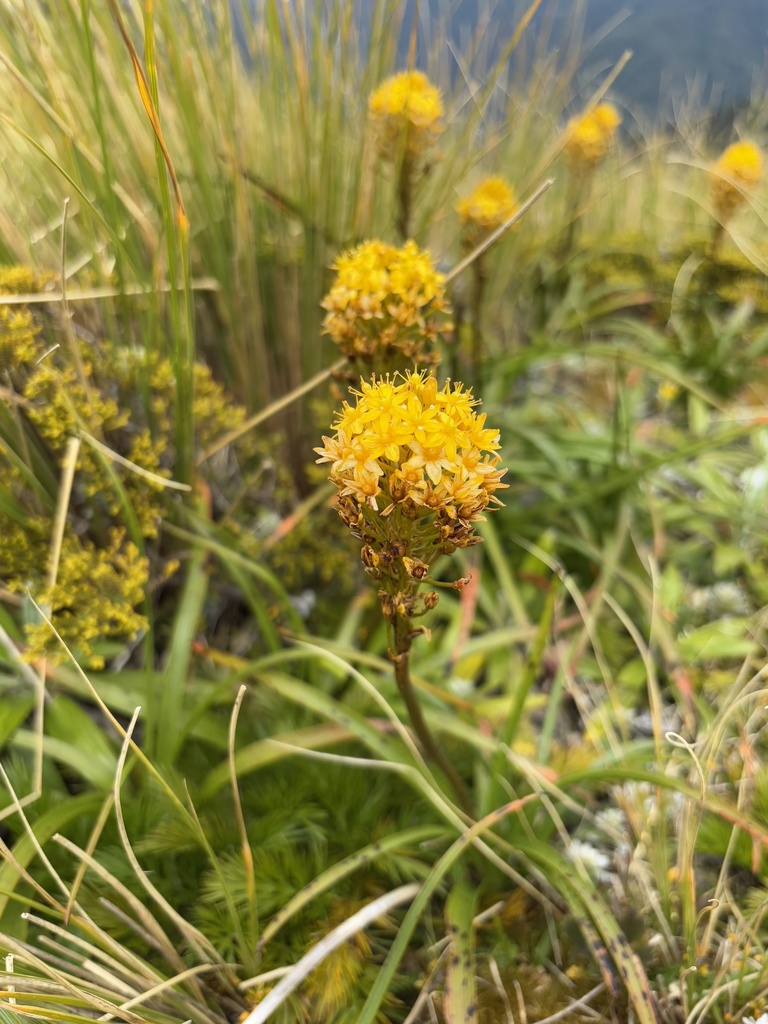
Bulbinella gibbsii
Bulbinella gibbsii, commonly known as Gibbs's Māori onion, is a species of flowering plant in the family Asphodelaceae. It is endemic to New Zealand, primarily found in the South Island. B. gibbsii is typically found in cold habitats in soils with high water content, and typically in tussock grasslands. There are two recognised varieties of B. gibbsii, var. gibbsii and var. balanifera. B. gibbsii, var. gibbsii reaches a height of up to 300 mm tall, while var. balanifera can reach 600 mm tall. B. gibbsii was first described in 1909 by the New Zealand botanist Leonard Cockayne, var. balanifera was described by the botanist Lucy Moore in 1964. It gets its specific epithet, gibbsii, after the New Zealand educationalist Frederick Gibbs.
From the article Bulbinella gibbsii on Wikipedia (CC BY-SA), quoted section by section
Description
Bulbinella gibbsii is a species of subdioecious perennial herb in the family Asphodelaceae and the subfamily Asphodeloideae. It reaches a height of up to 300 mm tall. B gibbsii var. balanifera reaches a height of 600 mm tall, with slightly longer peduncles and pedicels compared to var. gibbsii. Its roots are tuberous. Its leaves are strap-like in character and up to 30 mm wide, reddish-green to dark-green in colour. Its racemes are usually conical in character, sometimes cylindrical, and the central axis is visible between the flowers. Its pedicels are 10–20 mm long. Its flowers are dark-yellow in colour, 10–14 mm in diameter, and typically has six tepals with anthers filled with pollen.
Range & habitat
Bulbinella gibbsii is endemic to New Zealand. Bulbinella gibbsii var. gibbsii's range is restricted to the Stewart Island, however, var. balanifera has a more widespread range covering the North and South Islands. In the North Island, var. balanifera is only found in the Tararua Ranges and the southern portion of the Ruahine Ranges. In the South Island, var. balanifera is more common, occurring from Arthur's Pass south to Fiordland. B. gibbsii var. gibbsii's 2023 assessment in the New Zealand Threat Classification System was "At Risk — Naturally Uncommon". B. gibbsii var. balanifera's assessment was "Not Threatened".
Habitat. New Zealand's Bulbinella species prefer colder habitats and soils with high water content. B. gibbsii var. gibbsii typically occurs in boglands and subalpine areas, occasionally found in ponds and small natural pools. It occurs from near sea level to almost of the summit of Mount Anglem. B. gibbsii var. gibbsii is typically found above 1,600 ft (490 m) in elevation; but it is also abundant near sea level. B. gibbsii var. balanifera occurs in alpine environments, typically in tussock grasslands, occasionally in subalpine scrublands, and likely reaching 4,500 ft (1,400 m) in elevation. It commonly coincides with Chionochloa oreophila and C. pallens.
Wikipedia: “Distribution”
What it does
Despite B. gibbsii being locally abundant in Fiordland, one of the main distribution areas for the flightless and endemic bird, the takahē (Porphyrio hochstetteri), the plant is not a preferred food source for the bird. However, another study found that B. gibbsii was consumed by red deer (Cervus elaphus). B. gibbsii is likely pollinated by insects, such as bees and flies, and its seeds are later dispersed by the wind.
Wikipedia: “Ecology”
At the table
Evidence presented by a 1971 study suggests that the indigenous Māori people wove leaves from B. gibbsii var. balanifera into plaited baskets and floor mats. There are no other recorded uses of Bulbinella species by Māori in academic literature and artefacts.
Wikipedia: “Uses”
In human culture
The etymology (word origin) of B. gibbsii's genus name, Bulbinella, derives from the Greek βολβός, simply meaning 'bulb' (an underground plant storage structure). Both words Bulbine and Bulbinella translate to English as 'little bulb'. The specific epithet (second part of the scientific name), gibbsii, is named after Frederick Gibbs, a New Zealand community leader, businessman, educationalist, and naturalist. The varietal epithet, balanifera, deriving from the Latin balnus, was chosen by Moore due to the resemblance of the variety's fruit to an acorn. The species is commonly known as: Gibbs's Māori onion, Gibbs's lily, Gibbs's onion, or simply Māori onion. In Moore's 1964 revision of the genus, she mentioned that the species in Fiordland was locally known as the golden star lily.
Wikipedia: “Etymology”
Where it lives
Recorded sightings
—
geo-referenced records in GBIF, from museums, herbaria and field observers.
Drag the globe to turn it. Dots are where records exist, not a range map; darker means more records.
In the stacks
Searching the stacks…
Every page naming Bulbinella gibbsii in the Biodiversity Heritage Library →
This page is assembled live from iNaturalist, GBIF, Wikipedia, the Source Library and the Internet Archive. It is not yet part of the hand-edited codex. iNaturalist taxon 400220.