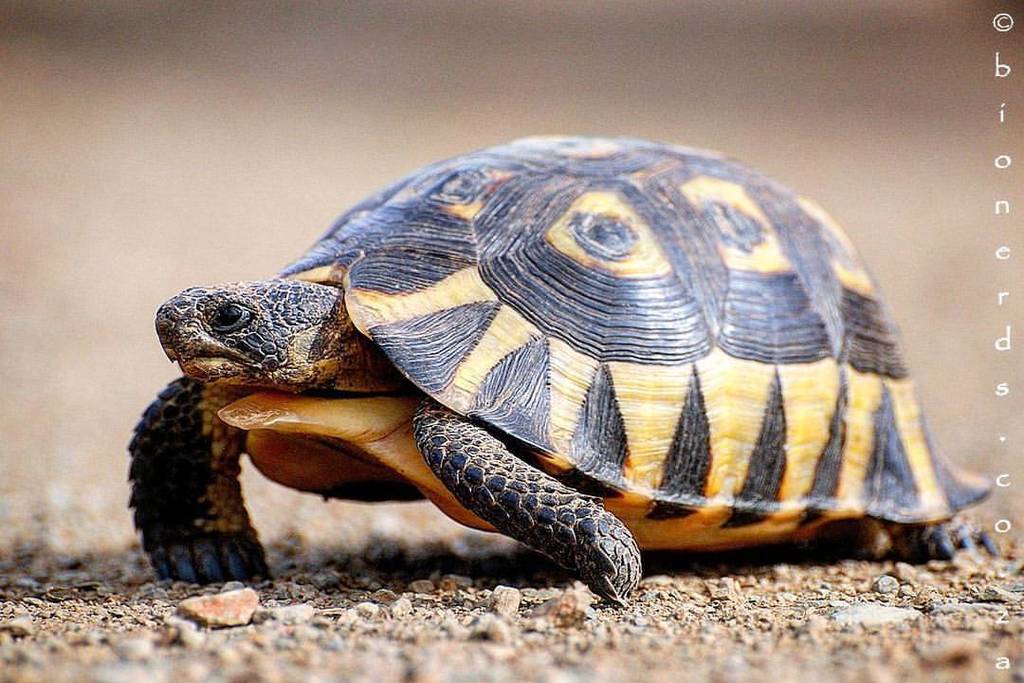
Angulate Tortoise
Chersina angulata
The angulate tortoise (Chersina angulata) or bowsprit tortoise is a species of tortoise found in dry areas and coastal scrub vegetation in South Africa. It is the only living member of the genus Chersina.
From the article Angulate tortoise on Wikipedia (CC BY-SA), quoted section by section
Range & habitat
Their natural habitat is the fynbos, karoo, albany thickets and coastal scrub (strandveld) vegetation of the south-western part of South Africa. This is an area of semi-arid and Mediterranean climate, with winter rainfall. Within this climatic range however, the angulate tortoise is a tough and very adaptable species. Geographically, this natural range extends across the Cape Floristic Region, as far north as the southern part of Namibia. In addition, small colonies have been introduced by tourists to domestic gardens in Swakopmund and Walvis Bay, even further north, in central Namibia. To the east, its range extends along the Cape's southern coast as far as East London. There is also an especially dense colony on Dassen Island, off the South African coast. Throughout its range, this tortoise usually occurs in the greatest numbers near the coast. Inland it occurs at lesser densities, though smaller populations are even found in parts of the Karoo.
Wikipedia: “Distribution and habitat”
What it does
Within its natural range, the natural predators of the species include mongoose, jackals, badgers, baboons and predatory birds which attack the infants. Perhaps the largest killers of this species in its natural habitat are the periodic wildfires, which can kill hundreds of thousands at a time.
Diet. Herbs and grasses are the most important foods in the diet of angulate tortoises. However, angulate tortoises are food generalists, and will consume a wide variety of angiosperms, as well as mosses, mushrooms, insects, snail shells, and animal feces. Their diet changes seasonally based on the availability of food sources. On Dassen Island, rabbit feces can contribute nearly 30% of their diet in summer and fall. This may be a result of the low diversity of vegetation and shortage of food plants during the dry season on the island. Alongside nutrition, coprophagy is hypothesized to aid the digestion of cellulose by supplementing gut microflora. Dassen Island tortoises also eat sand, perhaps to supplement minerals or to aid in digestion.
Wikipedia: “Ecology”
In human culture
Internationally it is known by the two names of "angulate" and "bowsprit" tortoise. Locally in southern Africa however, it is uniformly known as the "angulate" tortoise in English, and as the rooipens skilpad ("red-belly tortoise") in Afrikaans.
Wikipedia: “Etymology”
Where it lives
Recorded sightings
—
geo-referenced records in GBIF, from museums, herbaria and field observers.
Drag the globe to turn it. Dots are where records exist, not a range map; darker means more records.
In the stacks
Searching the stacks…
Every page naming Chersina angulata in the Biodiversity Heritage Library →
This page is assembled live from iNaturalist, GBIF, Wikipedia, the Source Library and the Internet Archive. It is not yet part of the hand-edited codex. iNaturalist taxon 40021.