- Plants
- ›Vascular Plants
- ›flowering plants
- ›Dicots
- ›carrots, ivies, and allies
- ›carrot family
- ›Apioideae
- ›Aciphylleae
- ›Anisotome
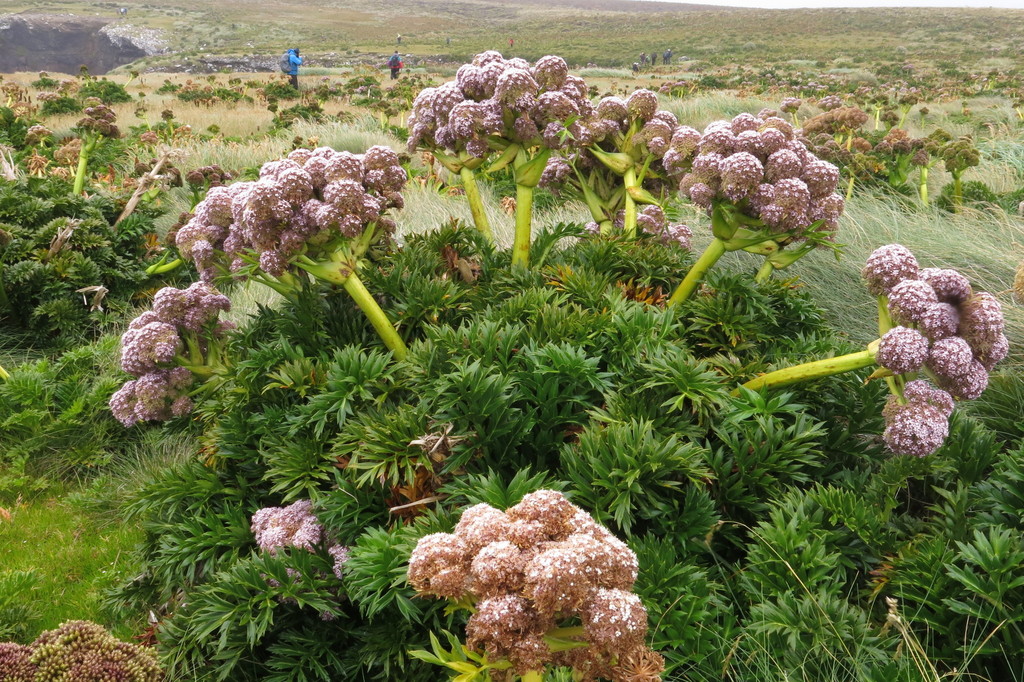
Campbell Island carrot
Anisotome latifolia
Anisotome latifolia, commonly known as the Campbell Island carrot, is a species of plant in the genus Anisotome of the carrot family (Apiaceae). It is native to the Auckland and Campbell Islands in the subantarctic regions of the South Pacific.
From the article Anisotome latifolia on Wikipedia (CC BY-SA), quoted section by section
Description
Anisotome latifolia is a large and robust perennial herb, growing up to 2 m (6 ft 7 in) in height. The leathery basal leaves are 300–600 mm (12–24 in) long and 100–200 mm (3.9–7.9 in) wide, 2-pinnate with 5-7 pairs of dark to yellow-green leaflets. The inflorescence axis grows up to 2 m (6 ft 7 in), with a 10–15 mm (0.39–0.59 in) diameter at the first node. The flowers vary from off-white to a creamy pink in colour. The plant flowers from October to February and fruits from January to March.
Range & habitat
The plant is endemic to New Zealand's subantarctic Auckland and Campbell Islands, where it is a striking component of the megaherb community. It occurs from the coast up to the tops of the island ranges on peaty ground among tussocks and other megaherbs, though more rarely under low forest. It is most abundant at lower altitudes and where the vegetation is not subject to browsing by introduced animals.
Wikipedia: “Distribution and habitat”
How it is grown
The plant is easy to grow from fresh seed in deep, peaty, permanently moist soil, though it does not tolerate hot weather.
== References ==
Wikipedia: “Cultivation”
Where it lives
Recorded sightings
—
geo-referenced records in GBIF, from museums, herbaria and field observers.
Drag the globe to turn it. Dots are where records exist, not a range map; darker means more records.
In the stacks
Searching the stacks…
Every page naming Anisotome latifolia in the Biodiversity Heritage Library →
This page is assembled live from iNaturalist, GBIF, Wikipedia, the Source Library and the Internet Archive. It is not yet part of the hand-edited codex. iNaturalist taxon 399593.