- Animals
- ›Chordates
- ›Vertebrates
- ›Reptiles
- ›Turtles and Tortoises
- ›Eurasian Pond, River, and Neotropical Wood Turtles
- ›Geoemydinae
- ›Mauremys
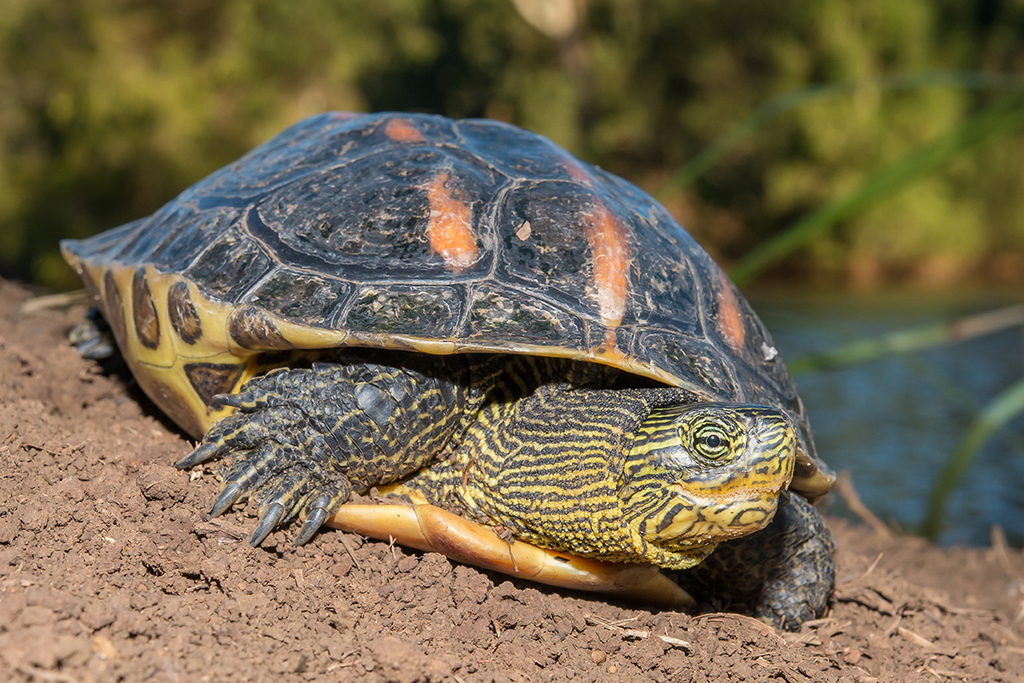
Chinese Stripe-necked Turtle
Mauremys sinensis
The Chinese stripe-necked turtle (Mauremys sinensis) or golden thread turtle, is a species of turtle in the family Geoemydidae. They are widely distributed in the subtropical regions of Taiwan.
Like many other Geoemydidae, this species hybridizes vigorously with related and not-so-closely related members of its family.
From the article Chinese stripe-necked turtle on Wikipedia (CC BY-SA), quoted section by section
Description
Chinese-stripe-necked turtles have a green body. As a juvenile, its carapace is grayish green and there are three distinctive ridges. As an adult, the color fades to a brown color and the two ridges gradually disappear. The plastron is ivory in color with small black spots. The male's tail is more coarse and long, while adult females will be larger than the males(body length: male~20 cm, female~26 cm). Its diet are small animals (small shrimp, small fish, aquatic snail, mosquito larval...) and aquatic plant (duckweed, water spinach,...)
Range & habitat
Chinese stripe-necked turtles prefer lowland waters such as ponds, canals, and slow-moving rivers. Climate is very important when sustaining a risk of invasion, since the turtles become naturalized in areas with a suitable climate.
Wikipedia: “Habitat”
What it does
After mating, the female turtle may lay 5-20 eggs that hatch about 60 days when needed.
Wikipedia: “Reproduction”
Where it lives
Recorded sightings
—
geo-referenced records in GBIF, from museums, herbaria and field observers.
Drag the globe to turn it. Dots are where records exist, not a range map; darker means more records.
In the stacks
Searching the stacks…
Every page naming Mauremys sinensis in the Biodiversity Heritage Library →
This page is assembled live from iNaturalist, GBIF, Wikipedia, the Source Library and the Internet Archive. It is not yet part of the hand-edited codex. iNaturalist taxon 39950.