- Animals
- ›Chordates
- ›Vertebrates
- ›Reptiles
- ›Turtles and Tortoises
- ›Eurasian Pond, River, and Neotropical Wood Turtles
- ›Geoemydinae
- ›Orlitia
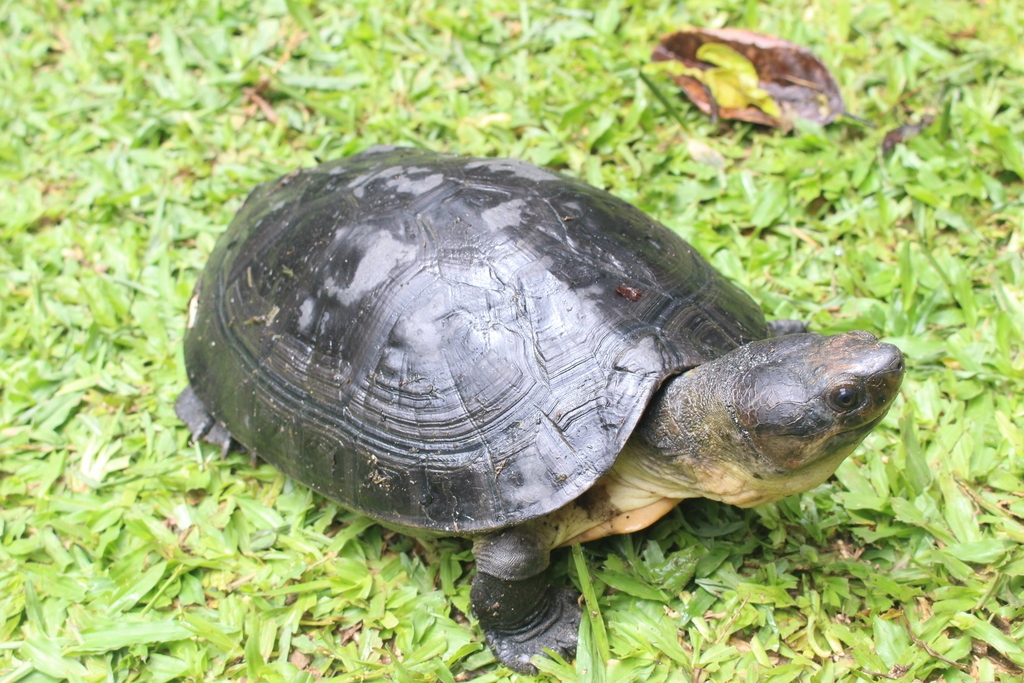
Malayan Giant Turtle
Orlitia borneensis
The Malaysian giant turtle or also known as the Bornean river turtle (Orlitia borneensis) is a freshwater species of turtle in the family Bataguridae. It is monotypic within the genus Orlitia. It is found in Indonesia and Malaysia. In recent surveys it has been narrowed down to a small region in Southern Thailand, Singapore, Sumatra, and Borneo. The Malaysian giant turtle is currently not a protected species in its natural habitat.
From the article Malaysian giant turtle on Wikipedia (CC BY-SA), quoted section by section
Description
The Malaysian giant turtle is the largest freshwater turtle in Southeast Asia, reaching a maximum length of 80 cm (31 inches) and a maximum weight of up to 50 kg (110 pounds). This species has a dark brown or black carapace which is smooth and oval in shape and a pale yellow-brown to off white plastron. The head is wedge shaped, with strong jaws and a slightly projecting snout, and the heads of adults are uniformly colored dark brown to black whereas juveniles are dark mottled with a pale line extending from the mouth to the back of the head. Endoscopy shows that the Malaysian giant turtle, similar to the loggerhead sea turtle, has esophageal papillae lining the inside of the throat. The papillae are coated in a thin layer of mucus down the entire esophagus.
Skeletal structure. Fossil evidence supports taxonomic certainty with the Malaysian giant turtle with matching skeletal structures. These structures include a distinct concavity on the sutural connected to the plastral portion on the auxiliary buttress, the carapace portion does not connect with the first two ribs and mushroom-shaped second vertebral scute. The anteromedial part of the first costal is covered by a wide first vertebral covering and elongated first neural covering. …
Range & habitat
The Malaysian giant turtle inhabits large lakes, swamps, and slow-flowing rivers within the countries it resides in. In the middle to late Pleistocene fossil evidence suggests that the distribution of the Malaysian giant turtle extended further south reaching Java. The Malaysian giant turtle is mainly piscivorous however it occasionally takes fallen fruit and may consume and other available vertebrate.
Wikipedia: “Distribution and habitat”
Where it lives
Recorded sightings
—
geo-referenced records in GBIF, from museums, herbaria and field observers.
Drag the globe to turn it. Dots are where records exist, not a range map; darker means more records.
In the stacks
Searching the stacks…
Every page naming Orlitia borneensis in the Biodiversity Heritage Library →
This page is assembled live from iNaturalist, GBIF, Wikipedia, the Source Library and the Internet Archive. It is not yet part of the hand-edited codex. iNaturalist taxon 39947.