- Animals
- ›Chordates
- ›Vertebrates
- ›Reptiles
- ›Turtles and Tortoises
- ›Eurasian Pond, River, and Neotropical Wood Turtles
- ›Geoemydinae
- ›Mauremys
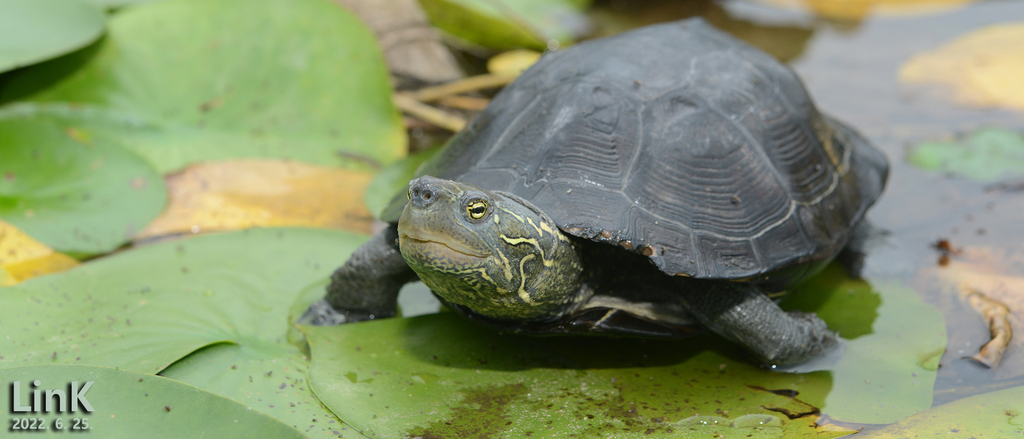
Chinese Pond Turtle
Mauremys reevesii
Mauremys reevesii, commonly known as the Chinese pond turtle, the Chinese three-keeled pond turtle, or Reeves' turtle, is a species of turtle in the family Geoemydidae, a family which was formerly called Bataguridae. The species is native to East Asia.
Alongside the Chinese softshell turtle, it is one of the two most commonly found species used for divination that have been recovered from Shang dynasty sites.
From the article Chinese pond turtle on Wikipedia (CC BY-SA), quoted section by section
Description
While the species typically appears to have a brown shell, dark grey skin, with yellow markings on the neck and yellow irises, melanism is well documented in males, where the entirety of the animal including the eyes becomes completely black and the yellow markings are lost. Melanism only occurs in mature males over 7 years old. Old females may sometimes also develop darker shells and fewer markings.
Certain populations of Reeve's turtles may exhibit megacephaly. Megacephalic turtles have much larger and broader heads, and hypertrophied jaws muscles. In at least one other species of turtle, it appears that megacephaly may not be genetically linked, instead developing in individuals as a response to a heavily durophagous diet.
Range & habitat
Mauremys reevesii is native to China and Korea, and is thought to have been introduced to Japan and Taiwan in historic times; it was previously thought to be native to both these regions. The species is thought to have been introduced to Japan from the Korean Peninsula near the end of the 18th century. Introduced populations of M. reevesii may serve as a threat to the native turtles of these regions due to its propensity for hybridization.
East Timor. During surveys in East Timor (Timor-Leste), a small but well-established population of M. reevesii was found living in marshes near the city of Dili. The species is not native to the island and was possibly introduced by locals of Chinese origin. East Timor is home to the Roti Island snake-necked turtle (Chelodina mccordi), more specifically the subspecies C. m. timorensis (sometimes considered a species of its own). Although the introduced population of M. reevesii is not known to present a risk to the native turtles per se, they could indirectly present a threat to the natives if confused. M. reevesii from the introduced population are sometimes captured to be sold to people of Chinese origin and this may cause problems if extended to the native turtles. A potential solution is to remove the introduced M. reevesii (thereby restricting the trade to captive farmed M. reevesii).
Wikipedia: “Geographic range”
What it does
M. reevesii is semiaquatic, and basks in the sun on rocks or logs and can often be found leaving water to do so. They can usually be found in marshes, relatively shallow ponds, streams, and canals with muddy or sandy bottoms.
Wikipedia: “Habitat and behaviour”
Where it lives
Recorded sightings
—
geo-referenced records in GBIF, from museums, herbaria and field observers.
Drag the globe to turn it. Dots are where records exist, not a range map; darker means more records.
In the stacks
Searching the stacks…
Every page naming Mauremys reevesii in the Biodiversity Heritage Library →
This page is assembled live from iNaturalist, GBIF, Wikipedia, the Source Library and the Internet Archive. It is not yet part of the hand-edited codex. iNaturalist taxon 39913.