- Animals
- ›Chordates
- ›Vertebrates
- ›Reptiles
- ›Turtles and Tortoises
- ›Eurasian Pond, River, and Neotropical Wood Turtles
- ›Geoemydinae
- ›Cuora
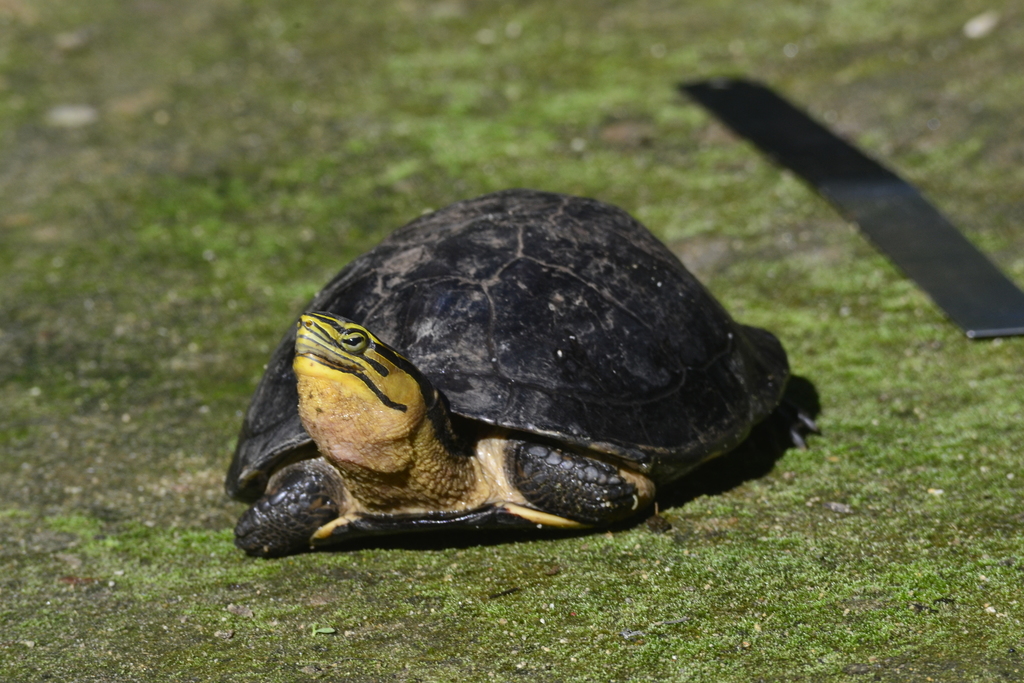
Amboina Box Turtle
Cuora amboinensis
The Amboina box turtle or Southeast Asian box turtle (Cuora amboinensis) is a species of Asian box turtle widely distributed across Southeast Asia. It is native to the Asian mainland from northeast India, through Bangladesh, Burma and Thailand, across Laos, Cambodia, Vietnam, and Malaysia. It is also found on the archipelagos of Indonesia and the Philippines.
The type locality is "Amboine" (or "Amboina") Island, today Ambon Island in Indonesia.
From the article Amboina box turtle on Wikipedia (CC BY-SA), quoted section by section
Description
These turtles have blackish-brown to olive-brown shells that are not as ornate as many other box turtles. All have a blackish olive head with three yellow stripes on the side. They are relatively small turtles, ranging in length between 200-250mm depending on subspecies and sex. Females are slightly larger than males. The male can be identified by the slightly concave shape to its plastron. There is no specific pattern to what the underbellies may look like, for either sex. Life expectancy is 25–30 years. The only true way of telling age is to guess by the texture of the shell, as growth rings form irregularly.
Range & habitat
The Amboina box turtle is widely distributed across Southeast Asia. Its range extends on the Asian mainland from northeast India, through Bangladesh, Burma and Thailand, across Laos, Cambodia, Vietnam, and Malaysia. It is also found on the archipelagos of Indonesia and the Philippines. The Amboina prefers lowland freshwater habitats from sea level up to about 500 meters and can be found in both natural and human-modified landscapes. It prefers still or slow-moving waters with a soft bottom including ponds, creeks, marshes, rice paddies, irrigation canals and drainage ditches. They are semi-aquatic and tend to spend more time on land at night; the young are more aquatic than adults. Amboina turtles do not migrate but individuals may wander substantial distances during their lifetime.
Wikipedia: “Distribution and habitat”
What it does
The Amboina is omnivorous but tends toward a more vegetarian diet. On land it eats plants, fruits, seeds, fungi and worms; in the water it consumes plants, insects and mollusks. The species has been observed to contribute to seed dispersal for fig trees and other tropical plants. Mating takes place between November and April after a brief courtship ritual. Typically, the female will lay three small clutches of two eggs each year and incubation may take anywhere from 70 to 100 days. Eggs are elongate, brittle and hard-shelled. The variability in clutch size, egg size and egg-laying season relate to geographic variability and climate.
Wikipedia: “Ecology and behavior”
Where it lives
Recorded sightings
—
geo-referenced records in GBIF, from museums, herbaria and field observers.
Drag the globe to turn it. Dots are where records exist, not a range map; darker means more records.
In the stacks
Searching the stacks…
Every page naming Cuora amboinensis in the Biodiversity Heritage Library →
This page is assembled live from iNaturalist, GBIF, Wikipedia, the Source Library and the Internet Archive. It is not yet part of the hand-edited codex. iNaturalist taxon 39893.