- Animals
- ›Chordates
- ›Vertebrates
- ›Reptiles
- ›Turtles and Tortoises
- ›Pond and Box Turtles
- ›Emydine Turtles
- ›Glyptemys
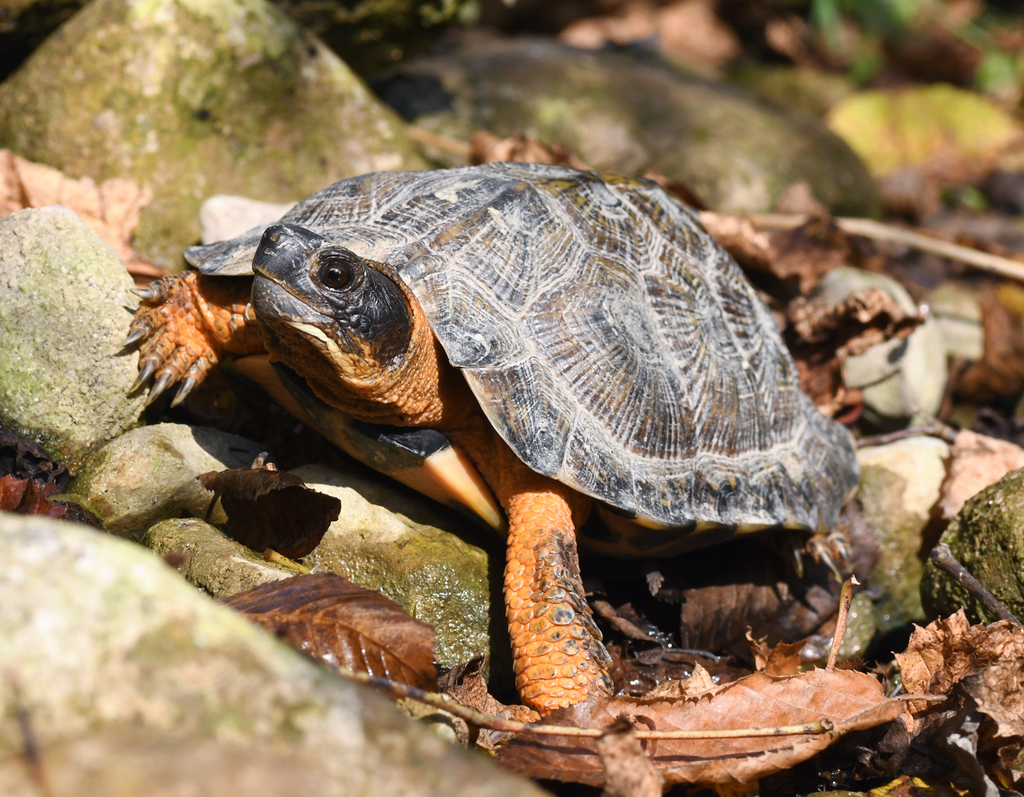
Wood Turtle
Glyptemys insculpta
The wood turtle (Glyptemys insculpta) is a semi-aquatic turtle species in the family Emydidae. The species inhabits the northeastern United States and Canada. The wood turtle exists in a broad geographic range extending from Nova Scotia in the north (and east) across the Great Lakes region to Minnesota in the west, and Virginia in the south. In the past, it was forced south by encroaching glaciers: skeletal remains have been found as far south as Georgia.
The genus Glyptemys contains only one other species of turtle: the bog turtle (Glyptemys muhlenbergii). The specific name, insculpta, refers to the rough, sculptured surface of the carapace.
From the article Wood turtle on Wikipedia (CC BY-SA), quoted section by section
Description
The wood turtle usually grows to between 14 and 20 centimeters (5.5 and 7.9 in) in straight carapace length, but may reach a maximum of 23.4 centimeters (9.2 in). It has a rough carapace that is a tan, grayish brown or brown in color, with a central ridge (called a keel) made up of a pyramidal pattern of ridges and grooves. Older turtles typically display an abraded or worn carapace. Fully grown, it weighs 1 kilogram (2.2 lb). The wood turtle's karyotype consists of 50 chromosomes. The larger scutes display a pattern of black or yellow lines. The wood turtle's plastron (ventral shell) is yellowish in color and has dark patches. The posterior margin of the plastron terminates in a V-shaped notch. Although sometimes speckled with yellowish spots, the upper surface of the head is often a dark gray to solid black. The ventral surfaces of the neck, chin, and legs are orange to red with faint yellow stripes along the lower jaw of some individuals. Seasonal variation in color vibrancy is known to occur. At maturity, males, which reach a maximum straight carapace length of 23.4 centimeters (9.2 in), are larger than females, which have been recorded to reach 20.4 centimeters (8.0 in). Males also have larger claws, a larger head, a concave plastron, a more dome-like carapace, and a longer tail than females. …
Range & habitat
The wood turtle is found in most New England states, Nova Scotia, west to Michigan, northern Indiana and Minnesota, and south to Virginia. Overall, the distribution is disjunct with populations often being small and isolated. Roughly 30% of its total population is in Canada. It prefers slow-moving streams containing a sandy bottom and heavily vegetated banks. The soft bottoms and muddy shores of these streams are ideal for overwintering. Also, the areas bordering the streams (usually with open canopies ) are used for nesting. Spring to summer is spent in open areas including forests, fields, bogs, wet meadows, and beaver ponds. The rest of the year is spent in the aforementioned waterways. The densities of wood turtle populations have also been studied. In the northern portion of its range (Quebec and other areas of Canada), populations are fairly dilute, containing an average of 0.44 individuals per 1 hectare (2.5 acres), while in the south, over the same area, the densities varied largely from 6 to 90 turtles. In addition to this, it has been found that colonies often have more females than males. In the western portion of its range, wood turtles are more aquatic. In the east, wood turtles are decidedly more terrestrial, especially during the summer. During this time, they can be found in wooded areas with wide open canopies. …
Wikipedia: “Distribution and habitat”
What it does
The wood turtle is oviparous. It produces offspring by laying eggs, and does not provide parental care outside of nest-building. Thus, the location and quality of nesting sites determine the offspring survival and fitness; so females invest significant time and energy into nest site selection and construction. Females select nest sites based on soil temperature (preferring warmer temperature nest sites), but not soil composition. Average nest size is four inches wide and three inches deep. Also, females build nests in elevated areas in order to avoid flooding and predation. After laying eggs, female wood turtles will cover the nest with leaves or dirt in order to hide the unhatched eggs from predators, and then the female will leave the nest location until the next mating season. Nesting sites can be used by the same female for multiple years. Because nest building occurs along rivers, females tend to spend more time along river areas, compared to male turtles.
Wikipedia: “Nesting behavior”
Where it lives
Recorded sightings
—
geo-referenced records in GBIF, from museums, herbaria and field observers.
Drag the globe to turn it. Dots are where records exist, not a range map; darker means more records.
In the stacks
Searching the stacks…
Every page naming Glyptemys insculpta in the Biodiversity Heritage Library →
This page is assembled live from iNaturalist, GBIF, Wikipedia, the Source Library and the Internet Archive. It is not yet part of the hand-edited codex. iNaturalist taxon 39865.