- Animals
- ›Chordates
- ›Vertebrates
- ›Reptiles
- ›Turtles and Tortoises
- ›Pond and Box Turtles
- ›Deirochelyine Turtles
- ›Trachemys
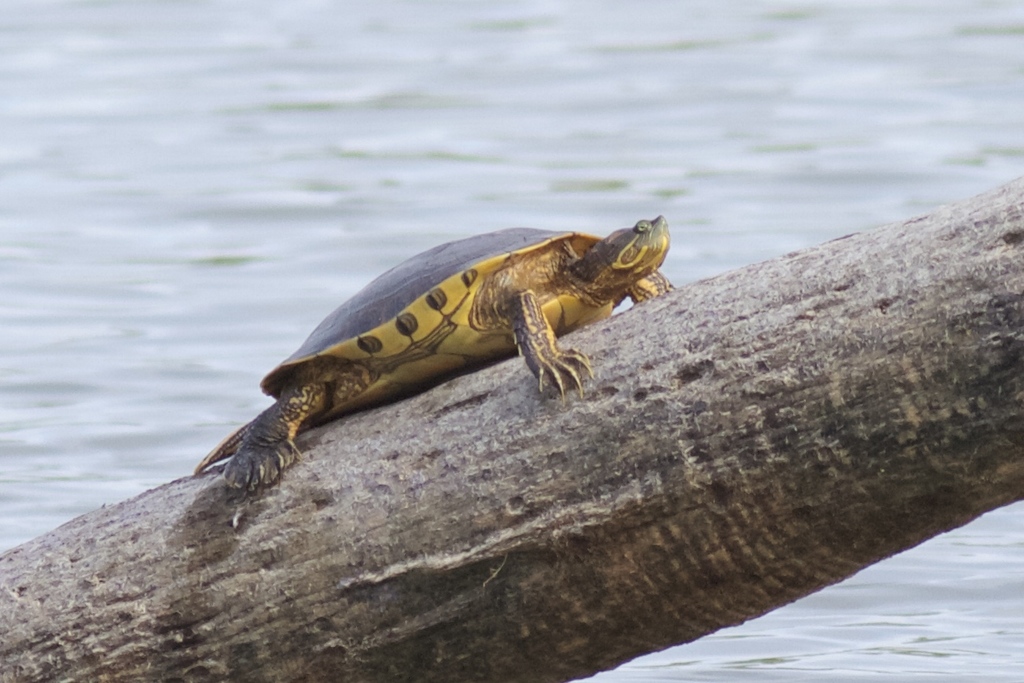
Baja California Slider
Trachemys nebulosa
The Baja California slider (Trachemys nebulosa), also known as the black-bellied slider, is turtle in the family Emydidae. It is native to Baja California, Sinaloa and Sonora in Mexico.
From the article Baja California slider on Wikipedia (CC BY-SA), quoted section by section
Description
The Baja California slider is a medium-sized turtle and identified for their clawed digits, non-elephantine hind limbs and a wide-colored suborbital patch. They have smooth shells, rounded posteriorly and straight interiorly. These shells are longer than they are wide, have a low later profile and can reach up to 37 cm (14.5 inches) in length. On the ventral side of the shell is yellow with symmetrical black markings. Dorsally the shell is dark in color with the vertebral, costal and marginal scutes having dark black spots surrounded by lighter margins. The Baja California slider has a large, triangular shaped head which is covered by smooth skin. They have protruding non-hooked snouts where the nostrils are located decently high and large eyes. The top of the head is olive colored with indistinct pale lines while the chin and throat are lighter with central yellow markings; there is a pair of yellow stripes that extend anteriorly across the local jaw and onto the upper jaw. Their tails are moderately long while male's tails being longer than females. The bodies are covered with multiple yellow stripes including the forelimbs, not the hind limbs.
Range & habitat
The Baja California slider has an exceedingly limited geographic range, currently found from San Ignacio southward into Baja California Sur. They were endemic only to the Río San José basin in the greater Cabo San Lucas area (where they are now exceedingly rare due to over fishing) but as early as the late 1700s they were transported northwards by natives to provide a continuing food source. They prefer larger bodies of water with muddy bottoms, often seen basking on emerged rocks or floating logs. Most activity takes place between mid-March and October as well as the winter months by burying themselves into the mud.
Wikipedia: “Distribution and habitat”
Where it lives
Recorded sightings
—
geo-referenced records in GBIF, from museums, herbaria and field observers.
Drag the globe to turn it. Dots are where records exist, not a range map; darker means more records.
In the stacks
Searching the stacks…
Every page naming Trachemys nebulosa in the Biodiversity Heritage Library →
This page is assembled live from iNaturalist, GBIF, Wikipedia, the Source Library and the Internet Archive. It is not yet part of the hand-edited codex. iNaturalist taxon 39798.