- Animals
- ›Chordates
- ›Vertebrates
- ›Reptiles
- ›Turtles and Tortoises
- ›Pond and Box Turtles
- ›Deirochelyine Turtles
- ›Chrysemys
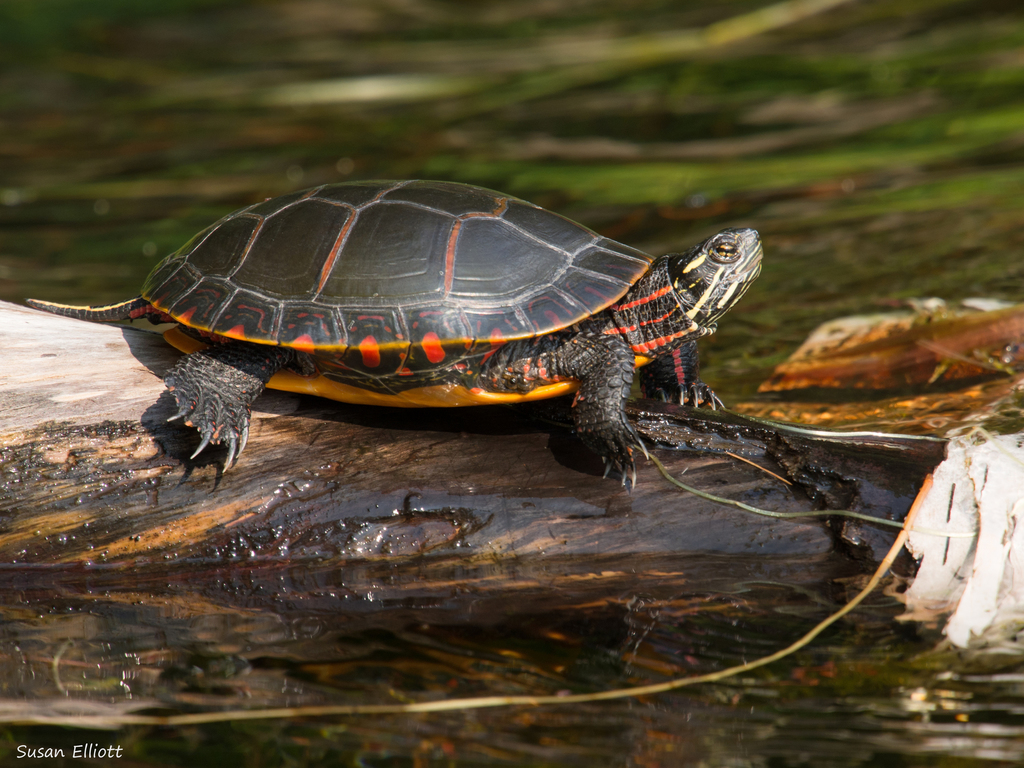
Painted Turtle
Chrysemys picta
The painted turtle (Chrysemys picta) is North America's most widespread native turtle, with a rich evolutionary history that stretches back 15 million years. As resilient survivors belonging to the pond turtle family Emydidae, these turtles adapted creatively to the planet's changing climate. During the last Ice Age, they split into distinct groups and evolved into three regionally unique subspecies: the Eastern painted turtle (found along the Atlantic coast), the Midland painted turtle (living around the Great Lakes), and the Western painted turtle (the largest group, spanning the west coast and Canada). Scientists still debate whether a fourth group, the Southern painted turtle, is its own separate species or another subspecies. Because they are highly adaptable and widely distributed across fresh waters from Canada to Mexico, their conservation status is listed as Least Concern, meaning they are currently thriving in the wild.
It lives in relatively slow-moving fresh waters, from southern Canada to northern Mexico, and from the Atlantic to the Pacific. They have been shown to prefer large wetlands with long periods of inundation and emergent vegetation.
From the article Painted turtle on Wikipedia (CC BY-SA), quoted section by section
Description
Adult painted turtles can grow to 13–25 cm (5–10 in) long, with males being smaller. The shell is oval, smooth with little grooves where the large scale-like plates overlap, and flat-bottomed. The color of the top shell (carapace) varies from olive to black. Darker specimens are more common where the bottom of the water body is darker. The bottom shell (plastron) is yellow, sometimes red, sometimes with dark markings in the center. Similar to the top shell, the turtle's skin is olive to black, but with red and yellow stripes on its neck, legs, and tail. As with other pond turtles, such as the bog turtle, the painted turtle's feet are webbed to aid swimming. The head of the turtle is distinctive. The face has only yellow stripes, with a large yellow spot and streak behind each eye, and on the chin two wide yellow stripes that meet at the tip of the jaw. The turtle's upper jaw is shaped into an inverted "V" (philtrum), with a downward-facing, tooth-like projection on each side. The hatchling has a proportionally larger head, eyes, and tail, and a more circular shell than the adult. The adult female is generally longer than the male, 10–25 cm (4–10 in) versus 7–15 cm (3–6 in). For a given length, the female has a higher (more rounded, less flat) top shell. The female weighs around 500 g (18 oz) on average, against the males' average adult weight of roughly 300 g (11 oz). …
Range & habitat
The most widespread North American turtle, the painted turtle is the only turtle whose native range extends from the Atlantic to the Pacific. It is native to eight of Canada's ten provinces, forty-five of the fifty United States, and one of Mexico's thirty-one states. On the East Coast, it lives from the Canadian Maritimes to the U.S. state of Georgia. On the West Coast, it lives in British Columbia, Washington, and Oregon and offshore on southeast Vancouver Island. The northernmost American turtle, its range includes much of southern Canada. To the south, its range reaches the U.S. Gulf Coast in Louisiana and Alabama. In the southwestern United States there are only dispersed populations. It is found in one river in extreme northern Mexico. It is absent in a part of southwestern Virginia and the adjacent states as well as in north-central Alabama. There is a harsher divide between midland and eastern painted turtles in the southeast because they are separated by the Appalachian mountains, but the two subspecies tend to mix in the northeast.
The borders between the four subspecies are not sharp, because the subspecies interbreed. Many studies have been performed in the border regions to assess the intermediate turtles, usually by comparing the anatomical features of hybrids that result from intergradation of the classical subspecies. …
Wikipedia: “Range”
What it does
The painted turtle is a bottom-dwelling hunter. It quickly juts its head into and out of vegetation to stir potential victims out into the open water, where they are pursued. Large prey is ripped apart with the forefeet as the turtle holds it in its mouth. It also consumes plants and skims the surface of the water with its mouth open to catch small particles of food. Although all subspecies of painted turtle eat both plants and animals (in the form of leaves, algae, fish, crustaceans, aquatic insects and carrion), their specific diets vary. Young painted turtles are mostly carnivorous and as they mature they become more herbivorous. Painted turtles obtain coloration from carotenoids in their natural diet by eating algae and a variety of aquatic plants from their environment. Stripes and spots increase red and yellow chroma and decrease UV chroma and brightness in turtles with large amounts of carotenoids in their diet compared to the stripes and spots of turtles with only moderate amounts of carotenoids in their diet. In addition, painted turtles with increased carotenoid chromas have a corresponding increase in bactericidal capacity, resulting in a higher bacteria killing capacity.
The eastern painted turtle's diet is the least studied. It prefers to eat in the water, but has been observed eating on land. The fish it consumes are typically dead or injured. …
Wikipedia: “Diet”
At the table
According to a trade data study, painted turtles were the second most popular pet turtles after red-eared sliders in the early 1990s. As of 2010, most U.S. states allow, but discourage, painted turtle pets, although Oregon forbids keeping them as pets, and Indiana prohibits their sale. U.S. federal law prohibits sale or transport of any turtle less than 10 cm (4 in), to limit human contact to salmonella. However, a loophole for scientific samples allows some small turtles to be sold, and illegal trafficking also occurs. Painted turtle pet-keeping requirements are similar to those of the red-eared slider. Keepers are urged to provide them with adequate space and a basking site, and water that is regularly filtered and changed. Aquatic turtles are generally unsuitable pets for children, as they do not enjoy being held. Hobbyists have maintained turtles in captivity for decades. Painted turtles are long-lived pets, and have a lifespan of up to 40 years in captivity. The painted turtle is sometimes eaten but is not highly regarded as food, as even the largest subspecies, the western painted turtle, is inconveniently small and larger turtles are available. Schools frequently dissect painted turtles, which are sold by biological supply companies; specimens often come from the wild but may be captive-bred. In the Midwest, turtle racing is popular at summer fairs.
Wikipedia: “Pets and other uses”
In human culture
Native American tribes were familiar with the painted turtle—young braves were trained to recognize its splashing into water as an alarm—and incorporated it in folklore. A Potawatomi myth describes how the talking turtles, "Painted Turtle" and allies "Snapping Turtle" and "Box Turtle", outwit the village women. Painted Turtle is the star of the legend and uses his distinctive markings to trick a woman into holding him so he can bite her. An Illini myth recounts how Painted Turtle put his paint on to entice a chief's daughter into the water. As of 2010, four U.S. states designated the painted turtle as official reptile. Vermont honored the reptile in 1994, following the suggestion of Cornwall Elementary School students. In 1995, Michigan followed, based on the recommendation of Niles fifth graders, who discovered the state lacked an official reptile. On February 2, 2005, Representative Bob Biggins introduced a bill to make the tiger salamander the official state amphibian of Illinois and to make the painted turtle the official state reptile. The bill was signed into law by Governor Rod Blagojevich on July 19, 2005. Colorado chose the western painted turtle in 2008, following the efforts of two succeeding years of Jay Biachi's fourth grade classes. …
Wikipedia: “Culture”
Where it lives
Recorded sightings
—
geo-referenced records in GBIF, from museums, herbaria and field observers.
Drag the globe to turn it. Dots are where records exist, not a range map; darker means more records.
In the stacks
Searching the stacks…
Every page naming Chrysemys picta in the Biodiversity Heritage Library →
This page is assembled live from iNaturalist, GBIF, Wikipedia, the Source Library and the Internet Archive. It is not yet part of the hand-edited codex. iNaturalist taxon 39771.