- Animals
- ›Chordates
- ›Vertebrates
- ›Reptiles
- ›Turtles and Tortoises
- ›American Mud and Musk Turtles
- ›Kinosternine Turtles
- ›Kinosternon
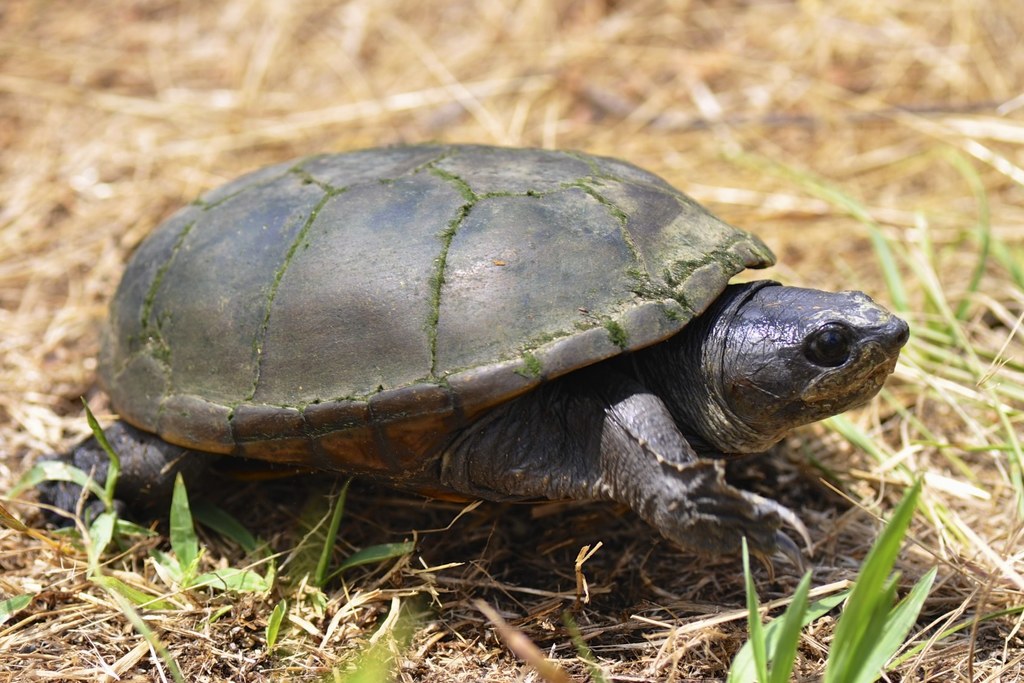
Yellow Mud Turtle
Kinosternon flavescens
The yellow mud turtle (Kinosternon flavescens), also commonly known as the yellow-necked mud turtle, is a species of mud turtle in the family Kinosternidae. The species is endemic to the Central United States and Mexico.
From the article Yellow mud turtle on Wikipedia (CC BY-SA), quoted section by section
Description
The yellow mud turtle is a small, olive-colored turtle. Both the common name, yellow mud turtle, and the specific name, flavescens (Latin: yellow), refer to the yellow-colored areas on the throat, head, and sides of the neck. The bottom shell (plastron) is yellow to brown with two hinges, allowing the turtle to close each end separately. The male's tail has a blunt spine on the end, but the female's tail does not.
Range & habitat
Northeastern Mexico: Chihuahua, Coahuila, Nuevo León, and Tamaulipas. Midwestern and Southwestern United States: Arizona, Colorado, Illinois, Iowa, Kansas, Missouri, Nebraska, New Mexico, Oklahoma, and Texas. Its current presence is uncertain in Veracruz (Mexico) and Arkansas (United States).
Wikipedia: “Distribution”
What it does
Yellow mud turtles are omnivorous. Their diet includes worms, crayfish, frogs, snails, fish, fairy shrimp, slugs, leeches, tadpoles, and other aquatic insects and invertebrates. They also eat vegetation and dead and decaying matter. Yellow mud turtles forage on land and water for food. In early spring their main diet is fairy shrimp they find in the shallows of their ponds. While they are burrowing, they will eat earthworms or grubs they encounter. Some studies show these turtles will eat earthworms that pass in front of them while hibernating. They also consume fish and other aquatic organisms.
Wikipedia: “Diet”
Where it lives
Recorded sightings
—
geo-referenced records in GBIF, from museums, herbaria and field observers.
Drag the globe to turn it. Dots are where records exist, not a range map; darker means more records.
In the stacks
Searching the stacks…
Every page naming Kinosternon flavescens in the Biodiversity Heritage Library →
This page is assembled live from iNaturalist, GBIF, Wikipedia, the Source Library and the Internet Archive. It is not yet part of the hand-edited codex. iNaturalist taxon 39742.