- Animals
- ›Chordates
- ›Vertebrates
- ›Reptiles
- ›Turtles and Tortoises
- ›American Mud and Musk Turtles
- ›Kinosternine Turtles
- ›Sternotherus
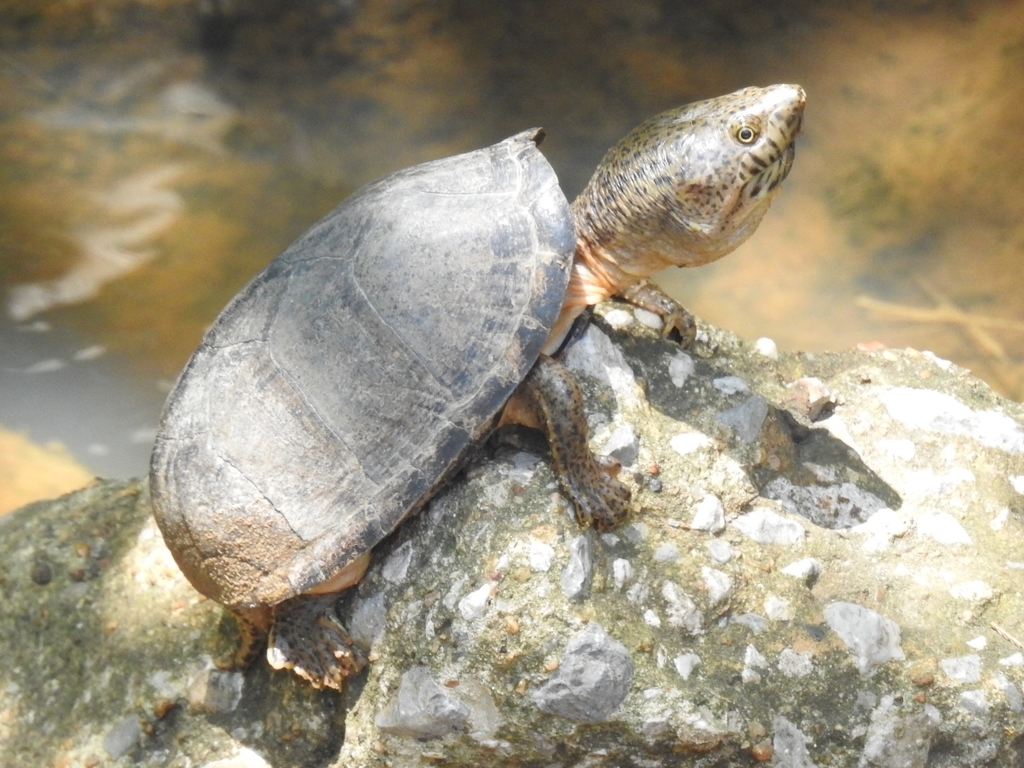
Razor-backed Musk Turtle
Sternotherus carinatus
The razor-backed musk turtle (Sternotherus carinatus) is a species of turtle in the family Kinosternidae. The species is native to the southern United States. There are no subspecies that are recognized as being valid.
The musk turtle is also known as the Mississippi musk turtle. It was first found in Alabama in 1994, but was mainly claimed in Mississippi, hence the second name.
From the article Razor-backed musk turtle on Wikipedia (CC BY-SA), quoted section by section
Description
The razor-backed musk turtle grows to a straight carapace length of about 15 cm (5.9 in). It has a brown-colored carapace, with black markings at the edges of each scute. The carapace has a distinct, sharp keel down the center of its length, giving the species its common name. The body is typically grey-brown in color, with black spotting, as is the head, which tends to have a bulbous shape to it. It has a long neck, short legs, and a sharp beak. Males can usually be distinguished from females by their longer tails. The plastron is small, with only one hinge which is located anteriorly. There is no gular scute. Barbels are present on the chin only. As the name suggests, they do have a smell. They use this as a defense mechanism, produced through the musk glands. However, the razor-backed musk turtle is known to not produce as much of a smell, especially the captive turtles.
Range & habitat
S. carinatus is found in the states of Alabama, Arkansas, Louisiana, Mississippi, Oklahoma, Florida, and Texas. However, it is only found in certain parts of those states except Louisiana. It is found in southeastern Oklahoma, southern and eastern Texas, southern Arkansas, south-central Mississippi, and extreme southwestern Alabama.
Wikipedia: “Geographic range”
What it does
S. carinatus is almost entirely aquatic, spending most of its time in shallow, heavily vegetated, slow-moving creeks, ponds, streams, and swamps. The only time it typically ventures onto land is when the female lays eggs. However, both sexes bask often. This species is mainly aquatic, but the turtles often like to take advantage of emergent deadwood to bask and has been observed to occasionally climb trees above the water and drop back into the water when threatened. This species enjoys basking more than other species in the same family. This helps the turtles stay in safe areas away from other turtles, lowering competition.
Wikipedia: “Behavior”
Where it lives
Recorded sightings
—
geo-referenced records in GBIF, from museums, herbaria and field observers.
Drag the globe to turn it. Dots are where records exist, not a range map; darker means more records.
In the stacks
Searching the stacks…
Every page naming Sternotherus carinatus in the Biodiversity Heritage Library →
This page is assembled live from iNaturalist, GBIF, Wikipedia, the Source Library and the Internet Archive. It is not yet part of the hand-edited codex. iNaturalist taxon 39708.