- Animals
- ›Chordates
- ›Vertebrates
- ›Reptiles
- ›Turtles and Tortoises
- ›American Mud and Musk Turtles
- ›Kinosternine Turtles
- ›Sternotherus
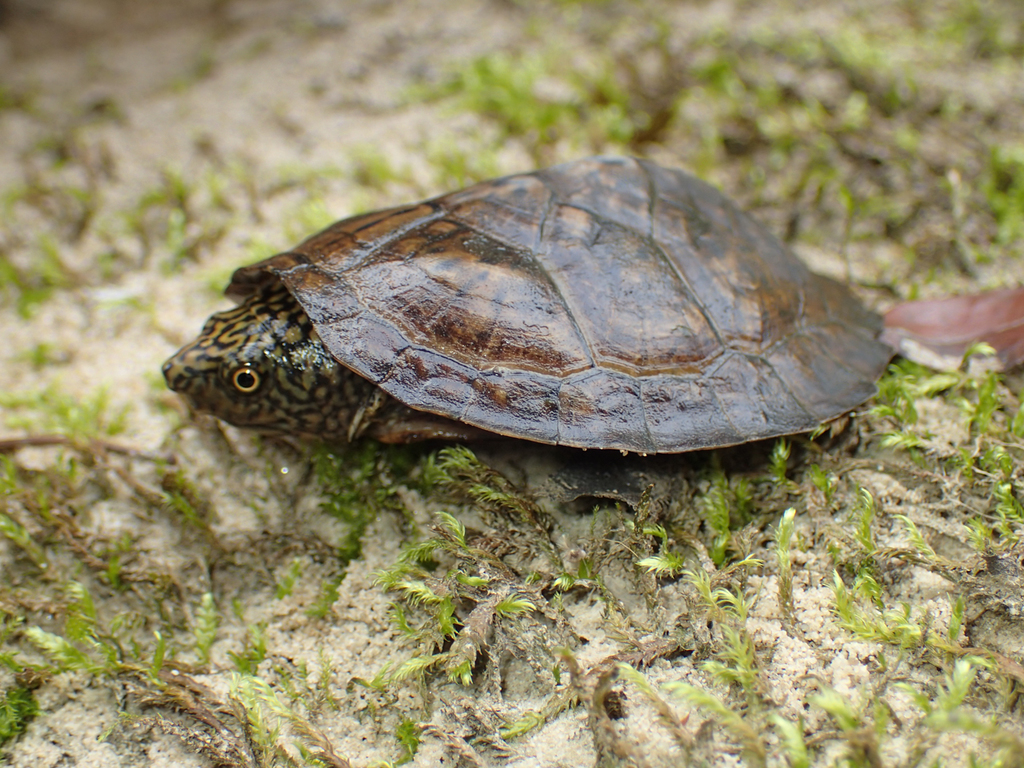
Flattened Musk Turtle
Sternotherus depressus
The flattened musk turtle (Sternotherus depressus) is a critically endangered species of freshwater turtle in the family Kinosternidae. The species is endemic to north-central Alabama.
From the article Flattened musk turtle on Wikipedia (CC BY-SA), quoted section by section
Description
A small turtle, S. depressus can have a straight carapace length of 7.5–10 cm (3.0–3.9 in) as an adult, with a record length of 11.4 cm (4+1⁄2 in). Both the common name and specific name refer to the fact that the species' carapace (upper shell) is much lower and flatter than those of the other members of the genus Sternotherus. In fact the flattened musk turtle looks as if someone had accidentally stepped on it, hence the common name.
Range & habitat
S. depressus is an endemic with a restricted range, historically inhabiting the Black Warrior River drainage of north central Alabama. Serious declines have been observed throughout its range, and it has likely been extirpated from greater than 70% of its historic range, especially in much of the Mulberry Fork and the Locust Fork of the upper Black Warrior River Basin. Sipsey Fork populations have fared significantly better due to protection offered by the Bankhead National Forest.
Wikipedia: “Geographic range”
What it does
S. depressus are omnivorous and mostly rely on gastropods (snails) and pelecypods (mussels) as a large part of their diet. Crayfish, insects, and seeds are also consumed by S. depressus, but are not a main food item. A greater portion of snails were detected in the feces of denser populations of S. depressus.
Wikipedia: “Diet”
At the table
The flattened musk turtle is primarily threatened by habitat alteration and habitat destruction. Strip mining for coal has increased the amount of silt and particulates in the waters of the Warrior River drainage system. S. depressus relies on rock crevices to escape predation, which are easily filled in from silt and sediment. Increased siltation in the streams also decreases the food availability for S. depressus as mollusk populations decrease. Sewage and other forms of pollution from urban areas near the Warrior Basin have also had an effect on stream biota. Secondary threats to the flattened musk turtle are illegal collection for the pet trade and disease. Habitat fragmentation also poses a significant threat to S. depressus. Isolated populations have the potential to lose genetic viability and threaten normal population structure. Smaller isolated populations also have less resilience to human caused disturbance, and thus are more vulnerable.
Wikipedia: “Threats and causes of decline”
Where it lives
Recorded sightings
—
geo-referenced records in GBIF, from museums, herbaria and field observers.
Drag the globe to turn it. Dots are where records exist, not a range map; darker means more records.
In the stacks
Searching the stacks…
Every page naming Sternotherus depressus in the Biodiversity Heritage Library →
This page is assembled live from iNaturalist, GBIF, Wikipedia, the Source Library and the Internet Archive. It is not yet part of the hand-edited codex. iNaturalist taxon 39704.