- Animals
- ›Chordates
- ›Vertebrates
- ›Reptiles
- ›Turtles and Tortoises
- ›Side‑necked turtles
- ›Austro-American Side-necked Turtles
- ›South American Snake-necked Turtles
- ›Hydromedusa
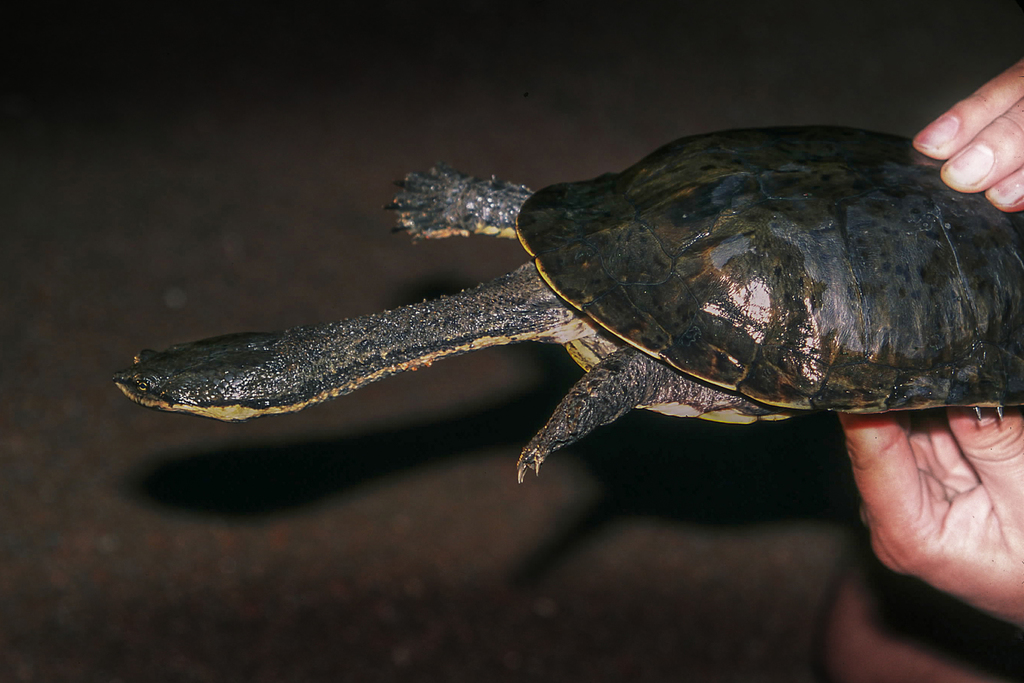
South-American Snake-headed Turtle
Hydromedusa tectifera
The Argentine snake-necked turtle (Hydromedusa tectifera), also known commonly as the South American snake-necked turtle is a species of turtle in the family Chelidae. The species is known for the long neck to which its common names refer. Despite appearances, the Argentine snake-necked turtle is probably more closely related to the mata mata (Chelus fimbriatus) than to the Australian snake-necked turtles in the genus Chelodina. H. tectifera is found in northern Argentina, Uruguay, Paraguay, and southern Brazil. Not much is known about it, as it has not been extensively researched. It is a popular pet in the exotic pet trade.
From the article Argentine snake-necked turtle on Wikipedia (CC BY-SA), quoted section by section
Description
H. tectifera can reach up to 28 centimeters (11 inches) in straight carapace length. Its carapace is strongly keeled, and it can also be distinguished by black and yellowish markings along its head and neck. Generally, the females are larger than the males which often have larger tails.
Wikipedia: “Anatomy and morphology”
In human culture
The Argentine snake-necked turtle lives in slow-moving ponds, rivers, streams, and marshes, preferably with aquatic vegetation. In coastal areas, it will enter brackish water, and it may hibernate in colder areas of its distribution. It is carnivorous and eats snails, aquatic insects, fish, and amphibians. It attacks its prey with a combination of matamata-like vacuum suction and the stabbing neck motions of other snake-necked turtles. Courtship and mating has not been extensively observed in this species, although it is known that nesting occurs in the spring at the riverbanks. The eggs are 34 mm × 22 mm (1.34 in × 0.87 in), white, and brittle-shelled. Hatchlings have a straight carapace length of about 34 mm (1.3 in), and have a carapace which is more wrinkled than that of an adult.
Wikipedia: “Natural history”
Where it lives
Recorded sightings
—
geo-referenced records in GBIF, from museums, herbaria and field observers.
Drag the globe to turn it. Dots are where records exist, not a range map; darker means more records.
In the stacks
Searching the stacks…
Every page naming Hydromedusa tectifera in the Biodiversity Heritage Library →
This page is assembled live from iNaturalist, GBIF, Wikipedia, the Source Library and the Internet Archive. It is not yet part of the hand-edited codex. iNaturalist taxon 39633.