- Animals
- ›Chordates
- ›Vertebrates
- ›Reptiles
- ›Turtles and Tortoises
- ›Side‑necked turtles
- ›Austro-American Side-necked Turtles
- ›Australasian Side-necked Turtles
- ›Chelodina
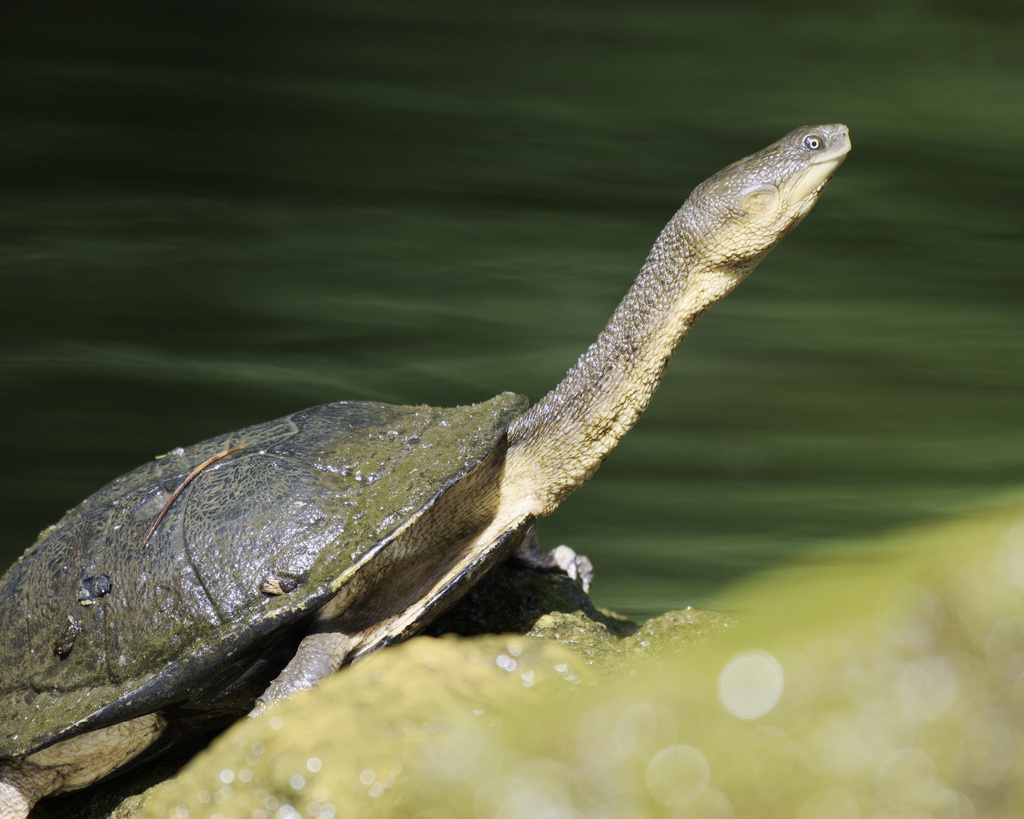
Eastern Snake-necked Turtle
Chelodina longicollis
The eastern long-necked turtle (Chelodina longicollis), also known commonly as the common long-necked turtle and the common snake-necked turtle, is an eastern Australian species of freshwater snake-necked turtle in the family Chelidae. The species inhabits a wide variety of water bodies and is an opportunistic feeder. It is a side-necked turtle (Pleurodira), meaning that it bends its head sideways into its shell rather than pulling it directly back.
From the article Eastern long-necked turtle on Wikipedia (CC BY-SA), quoted section by section
Description
The carapace of Chelodina longicollis is generally black in colour, though some may be brown. It is broad and flattened with a deep medial groove. The scutes are edged in black in those individuals with a lighter background colour. The plastron is also very broad and is cream to yellow in colour with sutures edged in black. The neck is long and narrow, typical of the subgenus Chelodina, and reaches a length of approximately 60% of the carapace length. The neck has numerous small pointed tubercles and is grey to black in colour dorsally, cream below, as is the narrow head. Females tend to grow to larger sizes and have deeper bodies. The maximum sizes recorded for females and males vary throughout the geographic range; in river environments of the Murray River it has a straight-line carapace length of 28.2 cm (11.1 in) and 24.9 cm (9.8 in) respectively, whereas in the Latrobe Valley it is 21.6 cm (8.5 in) and 18.8 cm (7.4 in) respectively. It is thought this is linked to productivity of the local environment. When it feels threatened, this turtle will emit an offensive-smelling fluid from its musk glands. This trait gives the turtle one of its other common names, "stinker".
Range & habitat
Chelodina longicollis is found throughout southeastern Australia, where it is found west of Adelaide (South Australia) eastwards throughout Victoria, the Northern Territory, and New South Wales, and northwards to the Fitzroy River of Queensland. Where Chelodina longicollis comes in contact with Chelodina canni the two species freely hybridise, exhibiting hybrid vigour in the Styx River Drainage of Queensland. C. longicollis has been introduced to Tasmania, likely via the pet trade. Chelodina longicollis has also been introduced to the Perth and Albany metropolitan areas of southwestern Australia, where it is known to hybridise with the local oblong turtle (Chelodina oblonga). This is again likely due to long-lived pets being released into wetlands or lakes, where the non-local species is able to survive. The wide distribution of the eastern long-necked turtle has allowed it to tolerate climates that are far colder than those that most other pleurodire turtles occur in, including southerly and high-altitude temperate climates. In 2023, a high-altitude long-necked turtle from the New England Tablelands was found brumating in a pool that had completely frozen for 15 days during the winter, marking the first documented case of a pleurodire turtle overwintering under ice.
Wikipedia: “Geographic distribution”
What it does
The eastern long-necked turtle is carnivorous, eating a variety of animals. This includes insects, worms, tadpoles, frogs, small fish, crustaceans, molluscs, plankton, and carrion.
Wikipedia: “Diet”
Where it lives
Recorded sightings
—
geo-referenced records in GBIF, from museums, herbaria and field observers.
Drag the globe to turn it. Dots are where records exist, not a range map; darker means more records.
In the stacks
Searching the stacks…
Every page naming Chelodina longicollis in the Biodiversity Heritage Library →
This page is assembled live from iNaturalist, GBIF, Wikipedia, the Source Library and the Internet Archive. It is not yet part of the hand-edited codex. iNaturalist taxon 39598.