- Animals
- ›Chordates
- ›Vertebrates
- ›Reptiles
- ›Turtles and Tortoises
- ›Side‑necked turtles
- ›Austro-American Side-necked Turtles
- ›Australasian Side-necked Turtles
- ›Chelodina
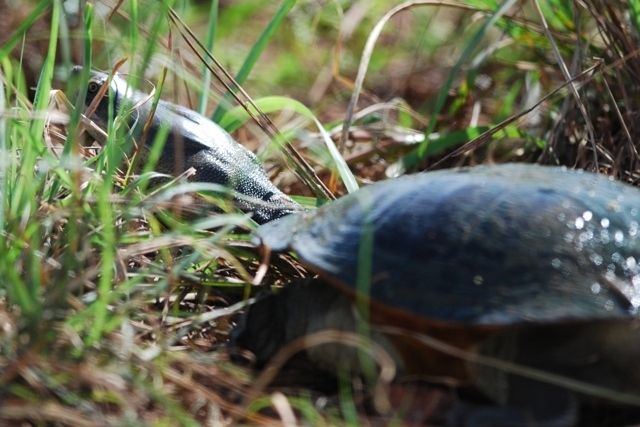
Northern Snake-necked Turtle
Chelodina rugosa
The northern snake-necked turtle or northern long-necked turtle (Chelodina (Chelydera) rugosa) is a species of turtle in the family Chelidae or Austro-South American side-necked turtles. It is native to northern Australia and southern New Guinea.
The species was described in 1890 from material collected in Cape York of Queensland, Australia. The species has in recent years had several species of turtle synonymised with it, the distribution includes northern Australia, Indonesia and Pitcairn. As a member of the sub-family Pleurodira this species is a side-necked turtle and also a snake-necked strike and gape predator. This carnivorous turtle will consume fish, tadpoles, hatchling turtles, worms, crickets, etc.
From the article Northern snake-necked turtle on Wikipedia (CC BY-SA), quoted section by section
What it does
Like all turtles, the northern snake-necked turtle is oviparous. Unlike any other turtle, however, C. rugosa lays her eggs underwater. Aboriginal Australians have had knowledge of this reproductive behavior for many generations, but the first published report was by Kennett et al. in 1993. Nests are excavated in soft substrate in billabongs and other ephemeral bodies of slow-moving fresh water toward the end of the wet season (austral summer, Dec-April). An average of 12 eggs are buried under 6–20 cm of sediment in shallow (<2 m) water. As the dry season progresses and the waters recede, the nests eventually dry out, and only then - when atmospheric oxygen is available - do the embryos within the eggs resume growth. Exhibiting a reproductive strategy almost unique among reptiles, embryos of C. rugosa can survive at least 12 weeks of submersion. The hatchlings emerge approximately 70 days after resumption of development.
Wikipedia: “Reproduction”
In human culture
This species has had a rather convoluted taxonomic history. Initially described in 1841 by John Edward Gray it was later synonymised (as senior synonym) with Chelodina colliei and for many years northern and western Australia was believed to have a single species. In 1967, the species was separated from the south-western Australian species but the name was incorrectly applied to that species with the name Chelodina siebenrocki applied to the northern form. Just eight years later it was found that the name Chelodina rugosa J. D. Ogilby 1890 had precedence over Chelodina siebenrocki and for many years after this that name was used for this species. In 2000, it was found that the holotype of Chelodina oblonga was in fact a northern long-neck turtle and hence a petition was put in to conserve the now well established name of Chelodina rugosa. This petition to the ICZN was ultimately overturned with the direction to use the Principal of Priority to determine the names, hence the name Chelodina oblonga is the correct name for this species. More recently using mitagenomics of the types it was found that the specimen assumed to be the holotype of Chelodina oblonga, in all likelihood, could not be. It was clearly collected in northern Australia and described as such by Gray with characters that are true of the northern species. …
Wikipedia: “Taxonomic history”
Where it lives
Recorded sightings
—
geo-referenced records in GBIF, from museums, herbaria and field observers.
Drag the globe to turn it. Dots are where records exist, not a range map; darker means more records.
In the stacks
Searching the stacks…
Every page naming Chelodina rugosa in the Biodiversity Heritage Library →
This page is assembled live from iNaturalist, GBIF, Wikipedia, the Source Library and the Internet Archive. It is not yet part of the hand-edited codex. iNaturalist taxon 39593.