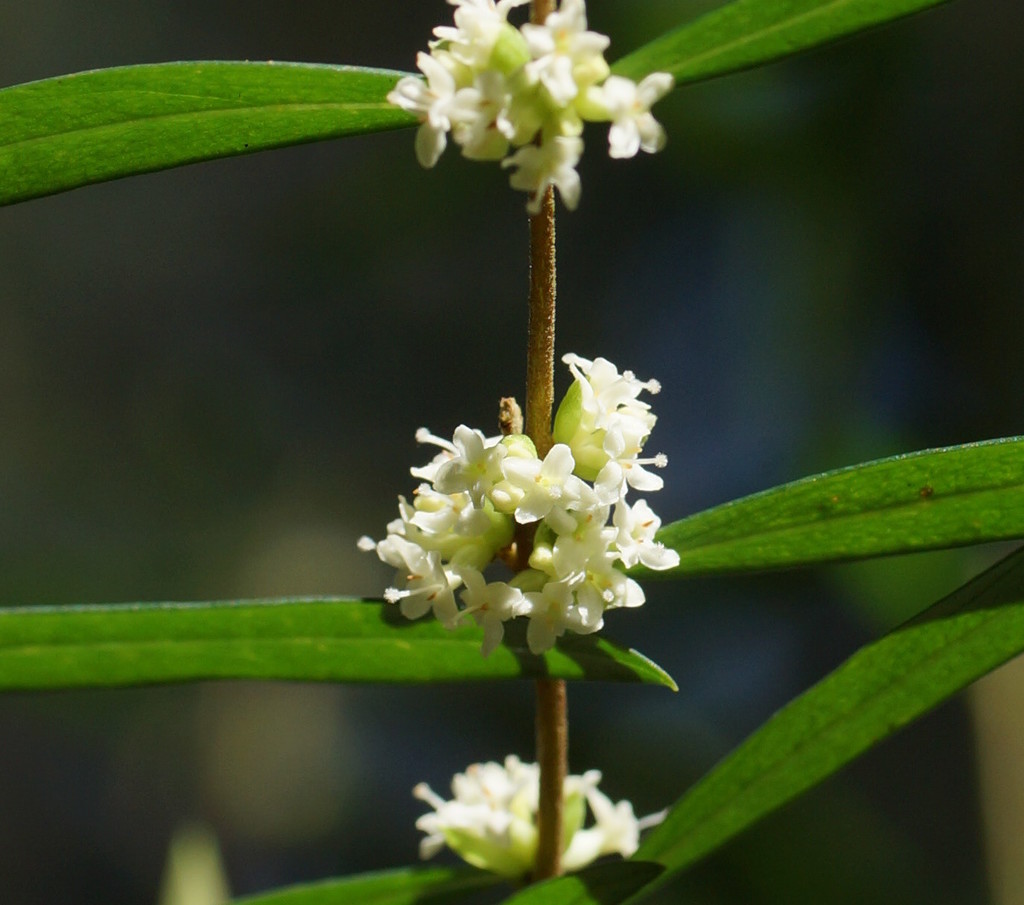
Tough Rice-flower
Pimelea axiflora
Pimelea axiflora, commonly known as bootlace bush, is a small shrub in the family Thymelaeaceae and is endemic to Australia. It is a small shrub with whitish flowers on mostly smooth stems.
From the article Pimelea axiflora on Wikipedia (CC BY-SA), quoted section by section
Description
Pimelea axiflora is a small dioecious shrub 0.2–3 m (8 in – 9 ft 10 in) high with smooth stems or occasionally hairy. The leaves are arranged in opposite pairs are mostly linear or narrowly elliptic, upper surface mid-green, underside paler, 5–60 mm (0.20–2.36 in) long, 2–10 mm (0.079–0.394 in) wide on a petiole 3 mm (0.12 in) long. The leaves are green, smooth and leaf margins mostly recurved. The inflorescence consists of a cluster of 2-10 white flowers in leaf axils with little or no stalk. The male flowers are larger, 5–9 mm (0.20–0.35 in) long and female 3–6 mm (0.12–0.24 in) long. The 2-4 flower bracts are usually oval shaped and 1.5–7 mm (0.059–0.276 in) long and 1–2.5 mm (0.039–0.098 in) wide. The green fruit are 3–4 mm (0.12–0.16 in) long.
Range & habitat
Bootlace bush is found at higher altitudes on the Grampians extending to the east coast in Victoria, in south-eastern New South Wales and on King Island, Tasmania.
Wikipedia: “Distribution”
Where it lives
Recorded sightings
—
geo-referenced records in GBIF, from museums, herbaria and field observers.
Drag the globe to turn it. Dots are where records exist, not a range map; darker means more records.
In the stacks
Searching the stacks…
Every page naming Pimelea axiflora in the Biodiversity Heritage Library →
This page is assembled live from iNaturalist, GBIF, Wikipedia, the Source Library and the Internet Archive. It is not yet part of the hand-edited codex. iNaturalist taxon 370129.