- Plants
- ›Vascular Plants
- ›flowering plants
- ›Dicots
- ›pinks, cactuses, and allies
- ›Amaranth family
- ›Gomphrenoideae
- ›Alternanthera
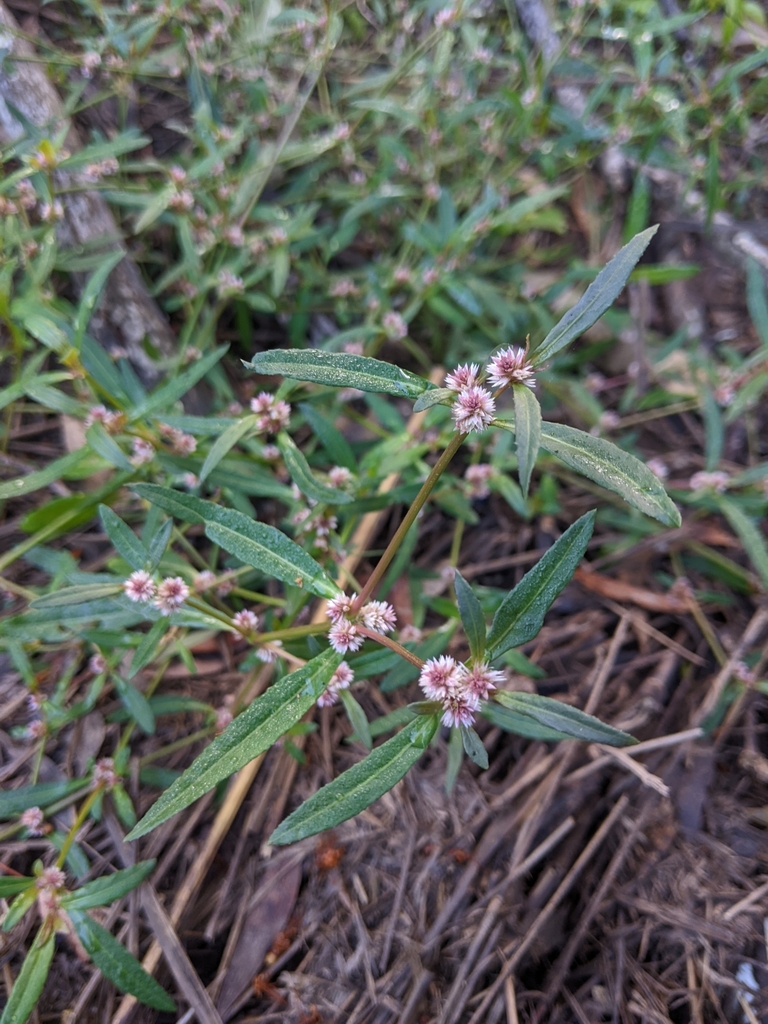
Lesser Joyweed
Alternanthera denticulata
Alternanthera denticulata (common name lesser joyweed) is a small prostrate white-flowering herb in the Amaranthaceae family. It is native to all states and territories of Australia, New Guinea, and the North Island of New Zealand. It is also one of the food plants of the varied eggfly, Hypolimnas bolina nerina.
The species was first described in 1810 by Robert Brown.
From the article Alternanthera denticulata on Wikipedia (CC BY-SA), quoted section by section
Description
Alternanthera denticulata is a prostrate to erect perennial herb, whose stems root at the nodes. The stems are green flushed pink, and sparsely hairy to being without a covering. The nodes are tomentose (that is, covered with dense intertwined hairs). The leaves are (20-)30-80 by 6–12 mm, and a light green, yellow green or flushed pink, with both the midrib and lateral veins being pink. The leaf margins are finely toothed, or entire.
Range & habitat
In Western Australia, it grows on both sand and clay soils, on the banks of creeks, rivers and swamps, flowering from April to August. On the North Island of New Zealand, it is found on coastal and lowland wetlands, lake margins and other damp ground, flowering from January to December.
Wikipedia: “Habitat and flowering”
Where it lives
Recorded sightings
—
geo-referenced records in GBIF, from museums, herbaria and field observers.
Drag the globe to turn it. Dots are where records exist, not a range map; darker means more records.
In the stacks
Searching the stacks…
Every page naming Alternanthera denticulata in the Biodiversity Heritage Library →
This page is assembled live from iNaturalist, GBIF, Wikipedia, the Source Library and the Internet Archive. It is not yet part of the hand-edited codex. iNaturalist taxon 369665.