- Plants
- ›Vascular Plants
- ›flowering plants
- ›monocots
- ›Agaves, Orchids, Irises, and Allies
- ›agave and allies
- ›cabbage tree subfamily
- ›Cordyline
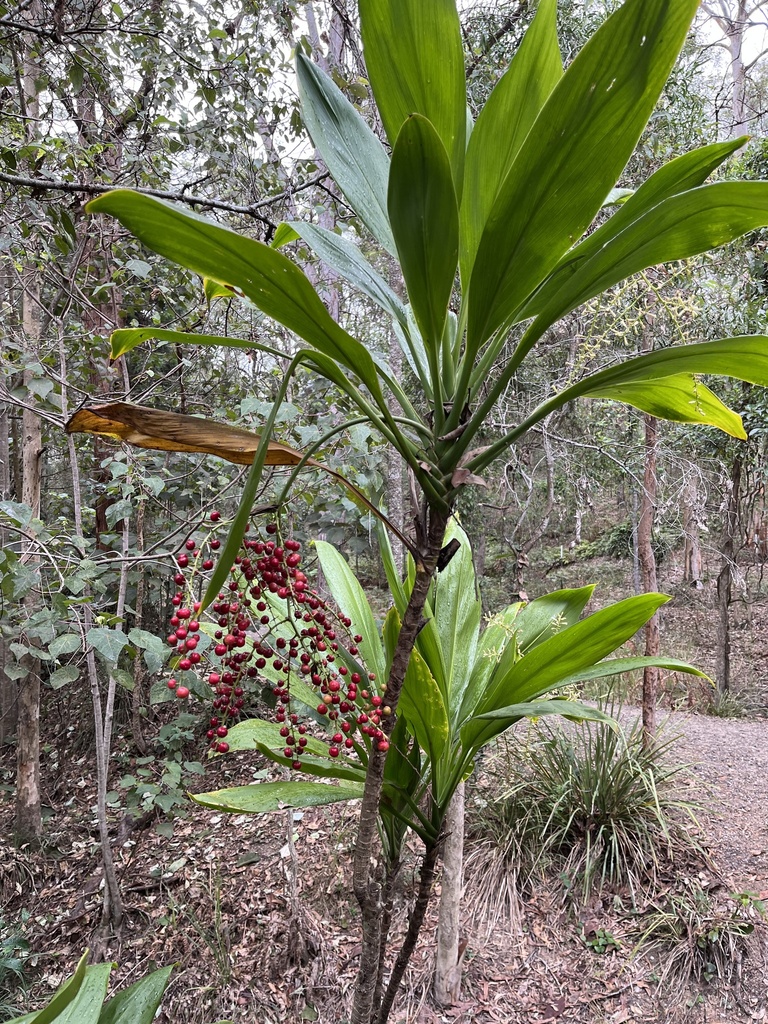
Giant palm-lily
Cordyline manners-suttoniae
Cordyline manners-suttoniae, known as the Broad Leafed Palm Lily or Swamp Palm Lily is an evergreen Australian plant. A shrub to 5 metres tall. Found only in Queensland, in swampy places, often in rainforests.
From the article Cordyline manners-suttoniae on Wikipedia (CC BY-SA), quoted section by section
Description
Cordyline manners-suttoniae is an erect shrub growing to about 4 or 5 m (13 or 16 ft) tall, and may be single stemmed or branched. The large simple leaves are crowded at the ends of the branches. They may reach 65 cm (26 in) long and 12 cm (4.7 in) wide, and are arranged spirally around the stem. Lateral veins run more or less parallel to each other with numerous secondary veins between them. The fleshy petiole may be 30 cm (12 in) long, is "U" shaped in cross-section, and the base widens into a sheath clasping the stem. The inflorescences are panicles measuring up to 25 cm (9.8 in) long, produced either terminally or from the leaf axils. The bisexual flowers are about 12 mm (0.47 in) long with 3 white or cream petals; they are held on pedicels about 10 mm (0.39 in) long. There are six stamens, the ovary is 3-lobed with 2-16 ovules per locule. The fruit is a bright red glossy berry (in botanical terms) measuring about 8–15 mm (0.31–0.59 in) diameter, containing up to eight small black seeds.
Range & habitat
The giant palm lily is found in eastern Queensland from about Cooktown southwards to about Rockhampton. It inhabits rainforest in very wet areas, near swamps and areas with poorly drained soils. The altitudinal range is from near sea level to about 700 m (2,300 ft).
Wikipedia: “Distribution and habitat”
What it does
The fruit of this species are eaten by birds, including the figbird (Sphecotheres vieilloti).
Wikipedia: “Ecology”
In human culture
The genus name Cordyline is from the Greek kordyle meaning "club", a reference to the swollen roots of some species. The species epithet manners-suttoniae was given by Mueller in honour of the wife of the Victorian Governor John Henry Manners-Sutton.
Wikipedia: “Etymology”
Where it lives
Recorded sightings
—
geo-referenced records in GBIF, from museums, herbaria and field observers.
Drag the globe to turn it. Dots are where records exist, not a range map; darker means more records.
In the stacks
Searching the stacks…
Every page naming Cordyline manners-suttoniae in the Biodiversity Heritage Library →
This page is assembled live from iNaturalist, GBIF, Wikipedia, the Source Library and the Internet Archive. It is not yet part of the hand-edited codex. iNaturalist taxon 369583.