- Plants
- ›Vascular Plants
- ›flowering plants
- ›Dicots
- ›Mints, Plantains, Olives, and Allies
- ›olive family
- ›Olea
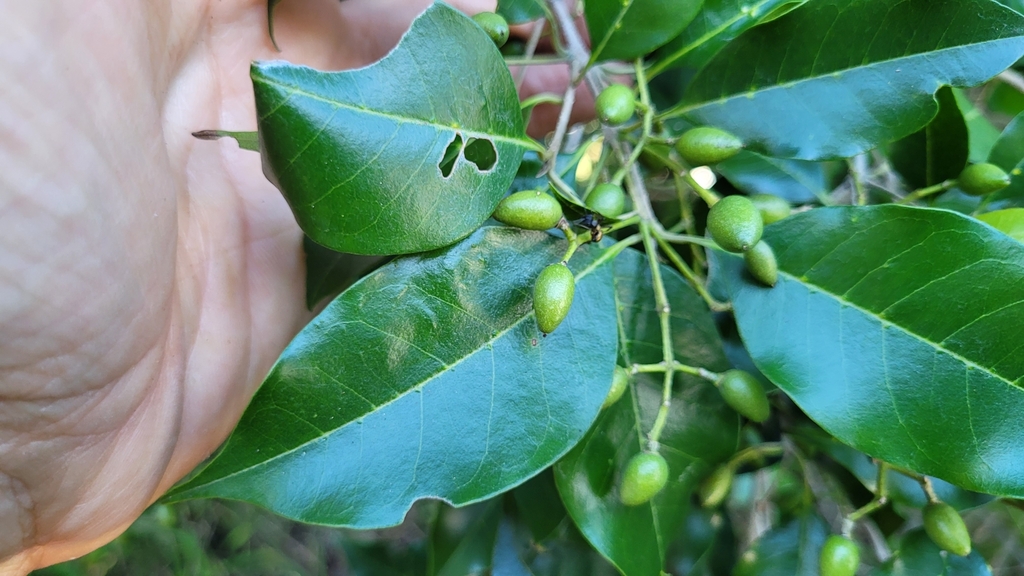
Australian Olive
Olea paniculata
Olea paniculata, commonly known as the native olive, is a plant of the genus Olea and a relative of the olive. It grows natively in Pakistan, India and southwestern China (Yunnan) through tropical Southeast Asia to Australia (Queensland and New South Wales) and the Pacific islands of New Caledonia, Vanuatu and Lord Howe Island.
From the article Olea paniculata on Wikipedia (CC BY-SA), quoted section by section
Description
It grows as a bushy tree to 30 m (98 ft), often with a sparse canopy. The trunk has smooth grey-brown bark and reaches a maximum diameter of 90 cm (35 in) with some buttressing. The shiny green ovate to elliptical leaves measure 5–10 cm (2.0–3.9 in) in length, and 1.5–6 cm (0.59–2.36 in) in width, and have a pointed (acuminate) end. The blue-black fruit are oval and measure 0.8–1.2 (0.3–0.5 in) cm long. They are ripe from May to September. It resembles the introduced and weedy African olive Olea europaea subsp. cuspidata, but the latter lacks O. paniculata's small depressions between the main and secondary veins on the back of the leaf. The introduced species is found in disturbed areas such as roadsides and waterways.
Range & habitat
Olea paniculata is found from North East Queensland to the vicinity of the Hunter Region in New South Wales. In Australia it is found near watercourses in dry rainforests. Outside Australia it is found in Yunnan province in southwestern China, where it occurs in sheltered wetter valleys 1,200–2,400 m (3,900–7,900 ft) in altitude, as well as India, Indonesia, Kashmir, Malaysia, Nepal, New Guinea, Pakistan, and Sri Lanka. On Lord Howe Island it is widespread below around 500 m (1,600 ft) elevation. It is also found on New Caledonia and Vanuatu.
Wikipedia: “Distribution and habitat”
What it does
The fruit are consumed by the Australian king parrot, brown cuckoo-dove, topknot pigeon, rose-crowned fruit-dove, wompoo fruit-dove, white-headed pigeon, green catbird and regent bowerbird in Australia.
Wikipedia: “Ecology”
At the table
It is a fast pioneer species on sunny protected sites, but needs well drained soil for good growth. It is a butterfly host plant whose black fruit attracts birds. The fruit was traditionally eaten by Aboriginal Australians.
== References ==
Wikipedia: “Uses”
Where it lives
Recorded sightings
—
geo-referenced records in GBIF, from museums, herbaria and field observers.
Drag the globe to turn it. Dots are where records exist, not a range map; darker means more records.
In the stacks
Searching the stacks…
Every page naming Olea paniculata in the Biodiversity Heritage Library →
This page is assembled live from iNaturalist, GBIF, Wikipedia, the Source Library and the Internet Archive. It is not yet part of the hand-edited codex. iNaturalist taxon 369380.