- Plants
- ›Vascular Plants
- ›flowering plants
- ›Dicots
- ›Mallows, Rock Roses, and Allies
- ›Stringbarks
- ›Wikstroemia
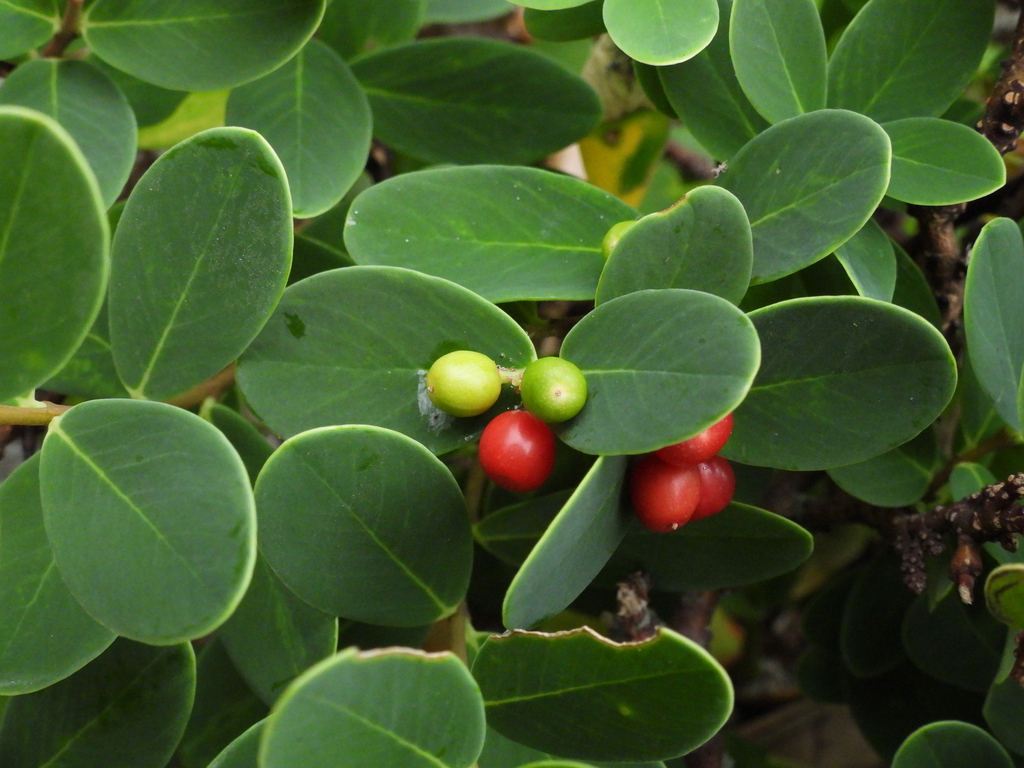
Bootlace Plant
Wikstroemia indica
Wikstroemia indica, also known as tie bush, Indian stringbush, bootlace bush, or small-leaf salago (Chinese: 了哥王; pinyin: liǎo gē wáng; Vietnamese: dó liệt) is a small shrub with glossy leaves, small greenish-yellow flowers and toxic red fruits. It grows in forests and on rocky, shrubby slopes in central and southeastern China, Vietnam, India, Australia and the Philippines.
From the article Wikstroemia indica on Wikipedia (CC BY-SA), quoted section by section
At the table
It is one of the 50 fundamental herbs used in traditional Chinese medicine. As a traditional Chinese herb, this plant has long been employed as an antipyretic, detoxicant, expectorant, vermifuge, and abortifacient in clinical practice in China. In Vinh, paper made by hand from the phloem fibers of W. indica is used for packaging freshly caught fish. To make the paper, peeled bark of W. indica is harvested in Quỳnh Lưu and shipped in dehydrated bales to Nghi Lộc, where the fibers are rehydrated, scraped, cooked, beaten into pulp, bleached, rinsed, suspended in water, and cast into sheets using large moulds made of mosquito netting and rebar, which are then left in the sun. Once dry, the resulting sheets are peeled from their moulds, folded in quarters, and sold to fishermen in Vinh. The paper helps to keep fish fresh, and prevents it from drying out during cooking.
Wikipedia: “Uses”
Toxicity
W. indica is toxic and the poisoning caused by W. indica leads to dizziness, blurred vision, nausea, vomiting, abdominal distension, abdominal pain and diarrhea.
Where it lives
Recorded sightings
—
geo-referenced records in GBIF, from museums, herbaria and field observers.
Drag the globe to turn it. Dots are where records exist, not a range map; darker means more records.
In the stacks
Searching the stacks…
Every page naming Wikstroemia indica in the Biodiversity Heritage Library →
This page is assembled live from iNaturalist, GBIF, Wikipedia, the Source Library and the Internet Archive. It is not yet part of the hand-edited codex. iNaturalist taxon 369310.