- Animals
- ›Molluscs
- ›Bivalves
- ›Autobranchia
- ›Pteriomorphia
- ›Ark Shells and Allies
- ›Arks, Bittersweet Clams and allies
- ›Ark Clams
- ›Tegillarca
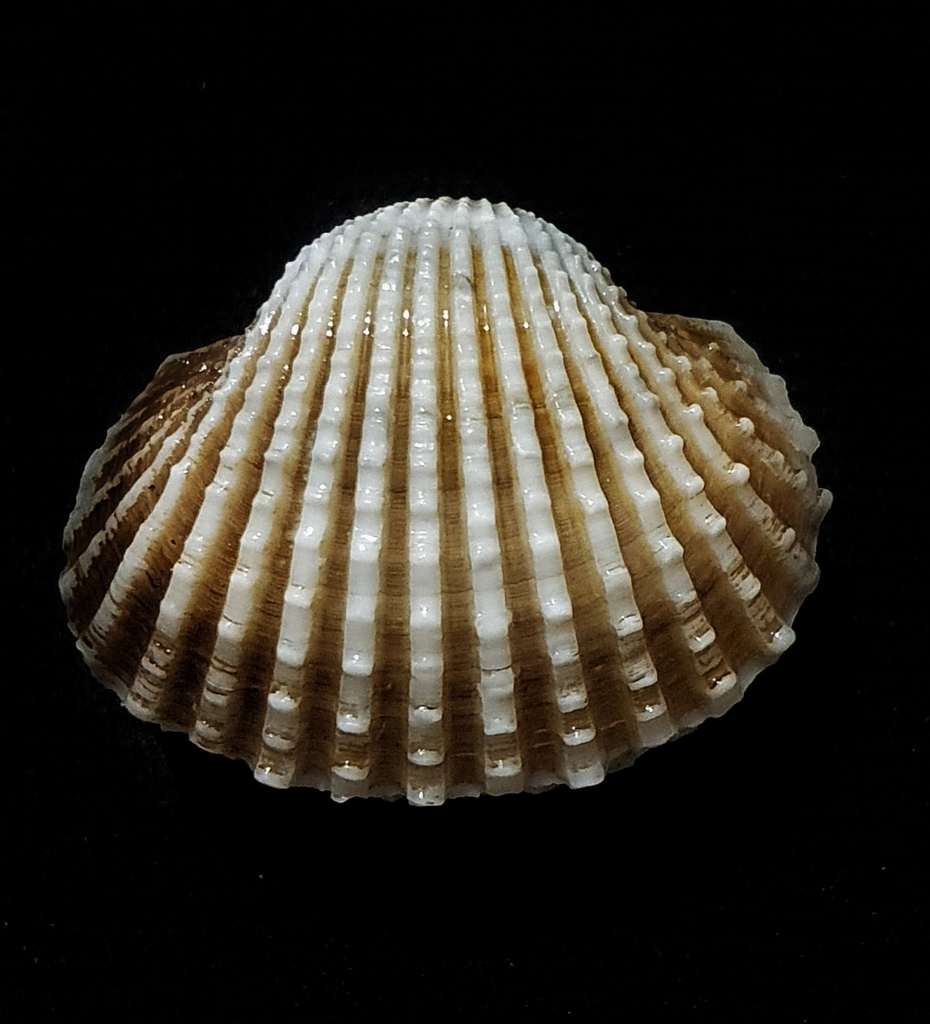
Granular Mud Ark
Tegillarca granosa
Tegillarca granosa (also known as Anadara granosa) is a species of ark clam commonly known as the blood cockle or blood clam due to the red haemoglobin liquid inside the soft tissues. It is found throughout the Indo-Pacific region from the eastern coast of South Africa northwards and eastwards to Southeast Asia, Australia, Polynesia, and up to northern Japan. It lives mainly in the intertidal zone at one to two metres water depth, burrowed down into sand or mud. Adult size is about 5 to 6 cm long and 4 to 5 cm wide.
From the article Tegillarca granosa on Wikipedia (CC BY-SA), quoted section by section
Description
The shell of the blood cockle is adapted for its burrowing lifestyle.
Shape and Size: The shell is equivalved (both valves are the same size), thick, solid, and strongly inflated, giving it a rounded, ovate shape. Adults typically reach 5-6 cm in length . Ornamentation: A key identifying feature is the presence of 15 to 20 broad, radial ribs on each valve. These ribs are often covered with distinct, small knobs or beads (giving it the common name "blood cockle" in some regions) . Coloration: The shell is covered by a dark brown or blackish periostracum (the organic outer layer). A characteristic feature is a diamond-shaped, dark brown or black patch located just below the umbones (the beak-like projections). The inside of the shell is white, sometimes with a purple hue. Hinge and Margin: The hinge area (where the two valves meet) is long and straight, containing a row of numerous small, interlocking "teeth" (taxodont dentition). T. granosa can have about 35 of these small teeth. The inner margin of the shell has small crenulations or notches (around 18) that correspond with the external radial ribs.
Wikipedia: “Anatomy”
At the table
China Blood cockles are commonly consumed in coastal China particularly in the Yangtze River region.
Korea In Korea, blood cockles are called kkomak (꼬막) and are cooked and seasoned with soy sauce, chili powder, and sesame oil.
Indonesia In Indonesia, blood cockles (local: kerang darah) are quite popular food and are served as various dishes including boiled, deep fried or sauteed. Thailand In Thailand, they are known as hoi kraeng (Thai: หอยแครง), presumably a corruption of the common Indonesian name. In Thai cuisine, they are usually boiled and eaten with a spicy and sour dipping sauce like other types of seafood.
Safety. Some sources of blood cockle may not undergo the depuration process. Therefore, certain styles of preparation, such as the poaching commonly carried out in Shanghai, can leave many pathogens present. A 2014 study found that blood cockles collected from the Sabang River in Asajaya, Sarawak, Malaysia, contained cadmium and lead levels exceeding Malaysian food safety regulations, indicating potential health risks from long-term consumption.
Wikipedia: “Culinary use”
In human culture
It has a high economic value as food, and it is aquacultured. On the coast of Zhejiang Province alone, blood cockle plantations occupy around 145,000 mu (about 100 km2) of mudflats. These clams are raised in the river estuaries of the neighboring Fujian Province as well.
Wikipedia: “Aquaculture”
Where it lives
Recorded sightings
—
geo-referenced records in GBIF, from museums, herbaria and field observers.
Drag the globe to turn it. Dots are where records exist, not a range map; darker means more records.
In the stacks
Searching the stacks…
Every page naming Tegillarca granosa in the Biodiversity Heritage Library →
This page is assembled live from iNaturalist, GBIF, Wikipedia, the Source Library and the Internet Archive. It is not yet part of the hand-edited codex. iNaturalist taxon 368448.