- Plants
- ›Vascular Plants
- ›flowering plants
- ›Dicots
- ›beeches, oaks, walnuts, and allies
- ›walnut family
- ›Juglans
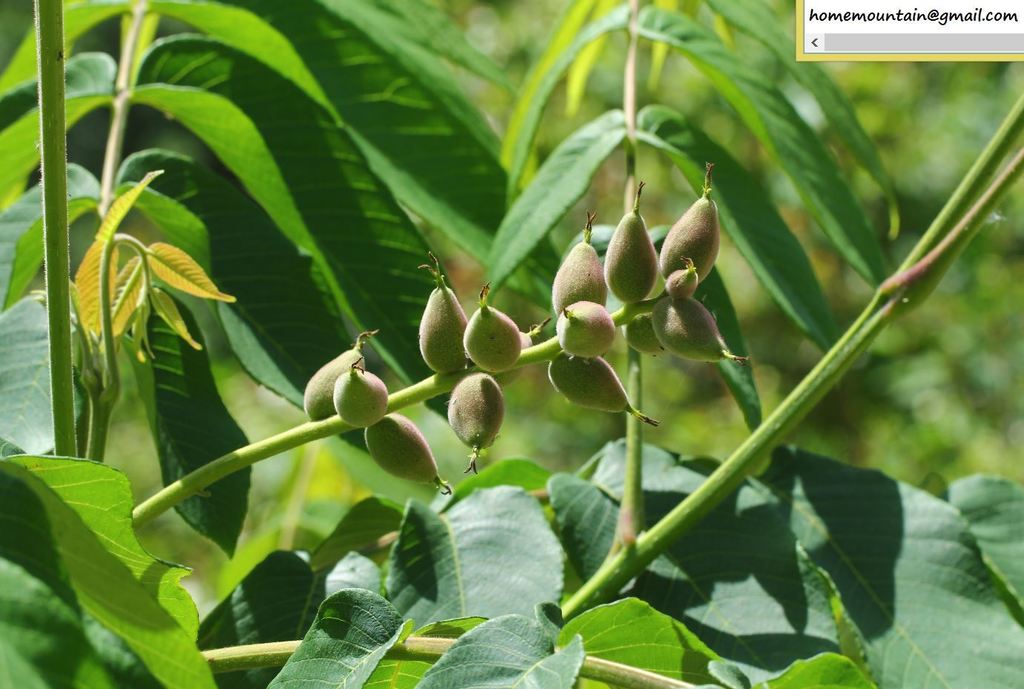
Manchurian walnut
Juglans mandshurica
Juglans mandshurica, the Manchurian walnut, is a deciduous tree of the genus Juglans (section Cardiocaryon), native to the Eastern Asiatic Region (China, Russian Far East, North Korea and South Korea). It grows to about 25 m.
From the article Juglans mandshurica on Wikipedia (CC BY-SA), quoted section by section
Description
The tree grows to about 25 metres (82 ft). The leaves are alternate, 40–90 centimetres (15+1⁄2–35+1⁄2 in) long, odd-pinnate, with 7–19 leaflets, 6–17 cm (2+1⁄2–6+1⁄2 in) long and 2–7.5 cm (3⁄4–3 in) broad (margin serrate or serrulate, apex acuminate). The male flowers are in drooping catkins 9–40 cm (3+1⁄2–15+1⁄2 in) long, the wind-pollinated female flowers (April–May) are terminal, in spikes of 4 to 10, ripening in August–October into nuts, 3–7.5 by 3–5 cm (1–3 by 1–2 in), with densely glandular pubescent green husk and very thick shell. The Manchurian walnut contains and exudes much lesser quantities of allelopathic compounds (such as juglone) than other popular Juglans species and usually causes few significant allelopathic effects in cultivation.
Range & habitat
The species is native to the Eastern Asiatic Region (China, Russian Far East, North Korea and South Korea). The tree is exceptionally hardy (down to at least −45 °C), has a relatively short vegetation period compared to other walnuts, grows rapidly and is cultivated as an ornamental in colder temperate regions all over the Northern Hemisphere. For example, it has been found to grow satisfactorily in Edmonton, Alberta, Canada.
Wikipedia: “Distribution and habitat”
At the table
The kernels of the nuts are edible, but small and difficult to extract. The timber is in use, but less valuable than that of English walnut or black walnut.
Wikipedia: “Uses”
Where it lives
Recorded sightings
—
geo-referenced records in GBIF, from museums, herbaria and field observers.
Drag the globe to turn it. Dots are where records exist, not a range map; darker means more records.
In the stacks
Searching the stacks…
Every page naming Juglans mandshurica in the Biodiversity Heritage Library →
This page is assembled live from iNaturalist, GBIF, Wikipedia, the Source Library and the Internet Archive. It is not yet part of the hand-edited codex. iNaturalist taxon 366815.