Porcupine Shrub
Melicytus alpinus
Melicytus alpinus, the mahoe porcupine shrub, is a small shrub of the family Violaceae endemic to New Zealand.
From the article Melicytus alpinus on Wikipedia (CC BY-SA), quoted section by section
Description
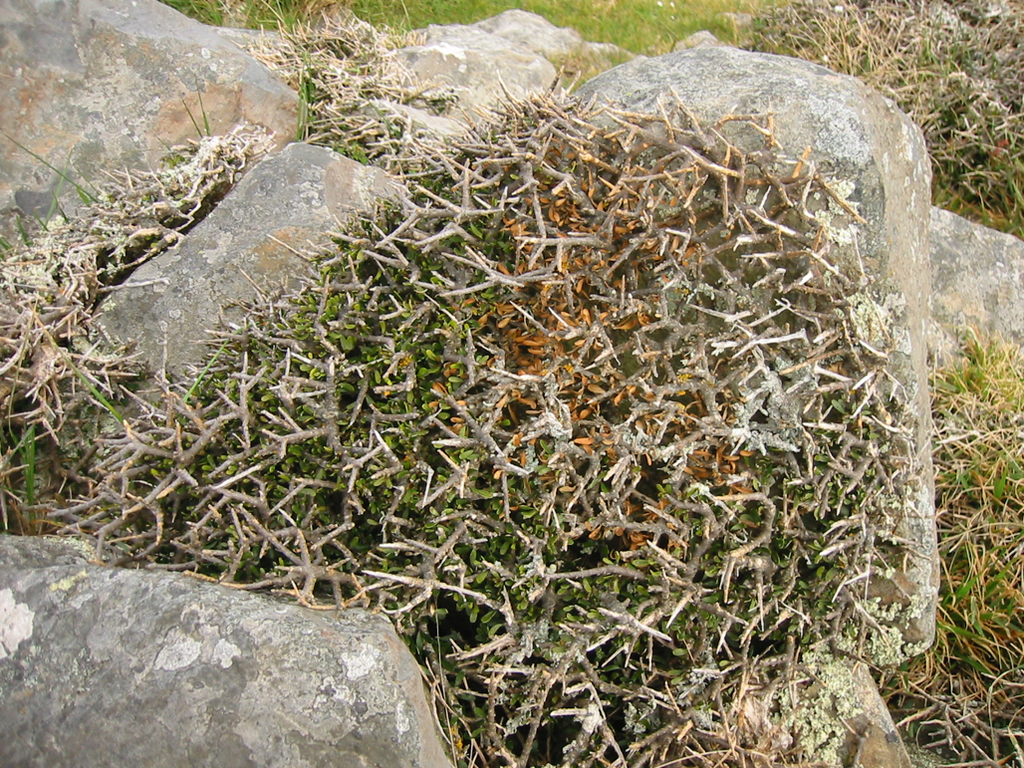
Melicytus alpinus get their common name, porcupine shrub, from the long, almost leafless, spindly branches which resemble the quills of a porcupine. Its leaves are narrow and generally have smooth margins with a few exceptions with serrated edges, however, they do only have a small amount of leaves and they are only approximately 1 cm long. Hard and dense, slow-growing in coastal or alpine areas of southern North Island and the South Island. It looks almost leafless but most of the leaves are sheltered between the stiff interlacing stems as an adaptation to the harsh environment where the plant grows. Leaves are variable, leathery and about 1 cm long.
Range & habitat
Melicytus alpinus is endemic to New Zealand. There, it can be found in both the North and South Islands in coastal and/or dry alpine areas. It is most common in the South Island high country.
Wikipedia: “Distribution”
What it does
In spring and early summer, small white flowers turn into tasty fragrant white, blue-specked fruit. Seeds for the porcupine shrub are dispersed by lizards. The shrub flowers in spring to early summer. The flowers are then insect pollinated and produce small white berries eaten by many native New Zealand lizards, thus starting the cycle again.
Wikipedia: “Life cycle and phenology”
Where it lives
Recorded sightings
—
geo-referenced records in GBIF, from museums, herbaria and field observers.
Drag the globe to turn it. Dots are where records exist, not a range map; darker means more records.
In the stacks
Searching the stacks…
Every page naming Melicytus alpinus in the Biodiversity Heritage Library →
This page is assembled live from iNaturalist, GBIF, Wikipedia, the Source Library and the Internet Archive. It is not yet part of the hand-edited codex. iNaturalist taxon 366688.