- Plants
- ›Vascular Plants
- ›flowering plants
- ›Dicots
- ›Woodsorrels, Quandongs, and Allies
- ›quandong family
- ›Aristotelia
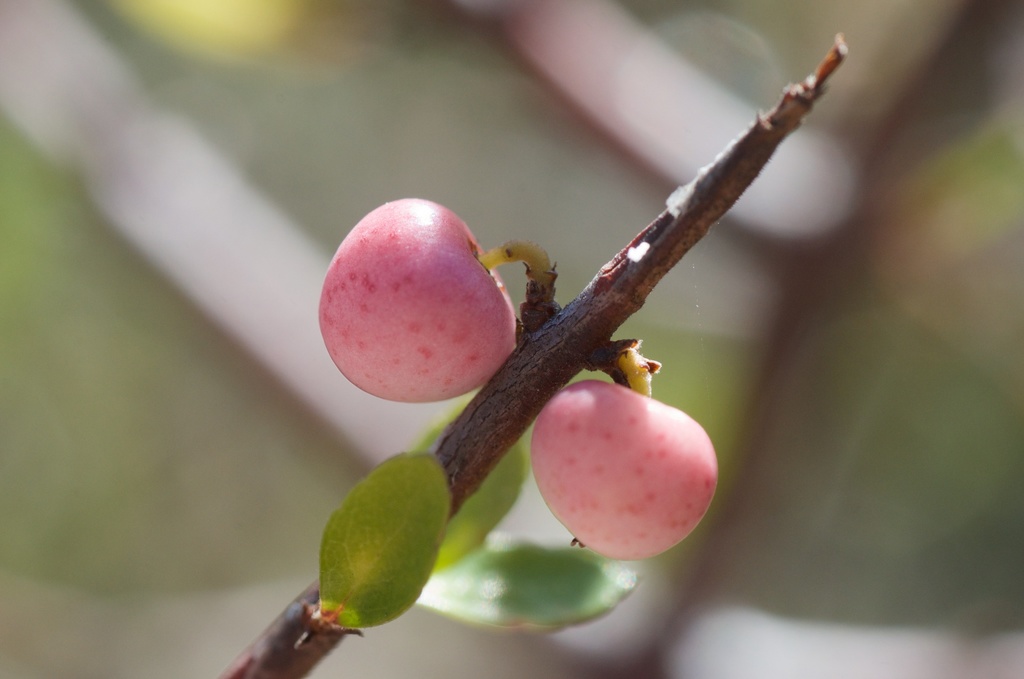
Mountain Wineberry
Aristotelia fruticosa
Aristotelia fruticosa, commonly known as the mountain wineberry or shrubby wineberry, is a species of tree or shrub endemic to New Zealand. It grows up to 2 metres (6 feet 7 inches) tall in a densely branching and divaricating form.
From the article Aristotelia fruticosa on Wikipedia (CC BY-SA), quoted section by section
Description
Aristotelia fruticosa is a divaricating upright shrub that grows up to 2 metres in height. This unique species is known to be heteroblastic, meaning that it changes its leaf shape as it matures. As a juvenile, this twiggy shrub produces various leaf shapes and sizes in opposing pairs or clusters, which can be displayed simultaneously on one plant, or have one leaf shape per individual. These can be narrow, lance-like (9–15 mm long), egg-shaped (5–7 mm long), or an amalgamation of the two. They mature into an obcordate shape (heart-like, tapered end attached to the stem) along their reddish-brown stems, averaging 12 mm long and 4 mm wide. The thin, leathery leaves are a shiny dark green on the surface with a contrasting light green underside showing a visible display of their veins. Being dioecious, the flowers between the sexes look similar, but have different features. Both sexes have flowers that grow a few millimeters in diameter with colours ranging from cream-white to pink and red. Like the leaves, the petals have 1–4 rounded teeth at the tip of the petal with 4 sepals and grow in clusters. The male develops 4–6 pollen-producing stamens, whereas the female grows a two-lobed stamen which, when pollinated, develops into small clusters of berries up to 5 mm in diameter between March to April. …
Range & habitat
Aristotelia fruticosa is endemic to New Zealand, meaning it is only found from 37°30’S midway down the North Island and throughout the South Island and Stewart Island. It is distributed throughout the southern and western side of Mt Ruapehu and its volcanic plateaus, on Tongariro tephera, across the North Island dividing range, along the eastern side of the Southern Alps, throughout Northwestern Fiordland, in South Otago and in central Stewart Island.
Wikipedia: “Distribution”
What it does
Showy clusters of brightly coloured flowers bloom between October and December. Interestingly, this shrub will produce flowers as a juvenile and continue to do so for the remainder of its life. The fruiting season is between January to April, after which its fleshy berries are dispersed by frugivory including by birds and other browsers. Its seeds have a low germination rate, but will begin to grow one year after dispersal.
Wikipedia: “Life cycle and phenology”
How it is grown
Aristotelia fruticosa thrives in colder climates and ideally prefers neither dry nor wet conditions, with shade to moderate sunlight. However, being an extremely hardy and adaptive shrub, it can live in various conditions and is tolerant of strong winds, snow and nutritionally poor and dry soils. Due to its deep root system, it can thrive in a variety of both nutritionally rich and deficient soils including soils rich in peat, raw humus, pumice, clayey loam, and stony soils mixed with clay and sand.
Wikipedia: “Growing conditions”
Where it lives
Recorded sightings
—
geo-referenced records in GBIF, from museums, herbaria and field observers.
Drag the globe to turn it. Dots are where records exist, not a range map; darker means more records.
In the stacks
Searching the stacks…
Every page naming Aristotelia fruticosa in the Biodiversity Heritage Library →
This page is assembled live from iNaturalist, GBIF, Wikipedia, the Source Library and the Internet Archive. It is not yet part of the hand-edited codex. iNaturalist taxon 366640.