- Animals
- ›Cnidarians
- ›Sea Anemones and Corals
- ›Hexacorallians
- ›Sea Anemones
- ›Enthemonae
- ›Actinioidea
- ›Actiniid Sea Anemones
- ›Dofleinia
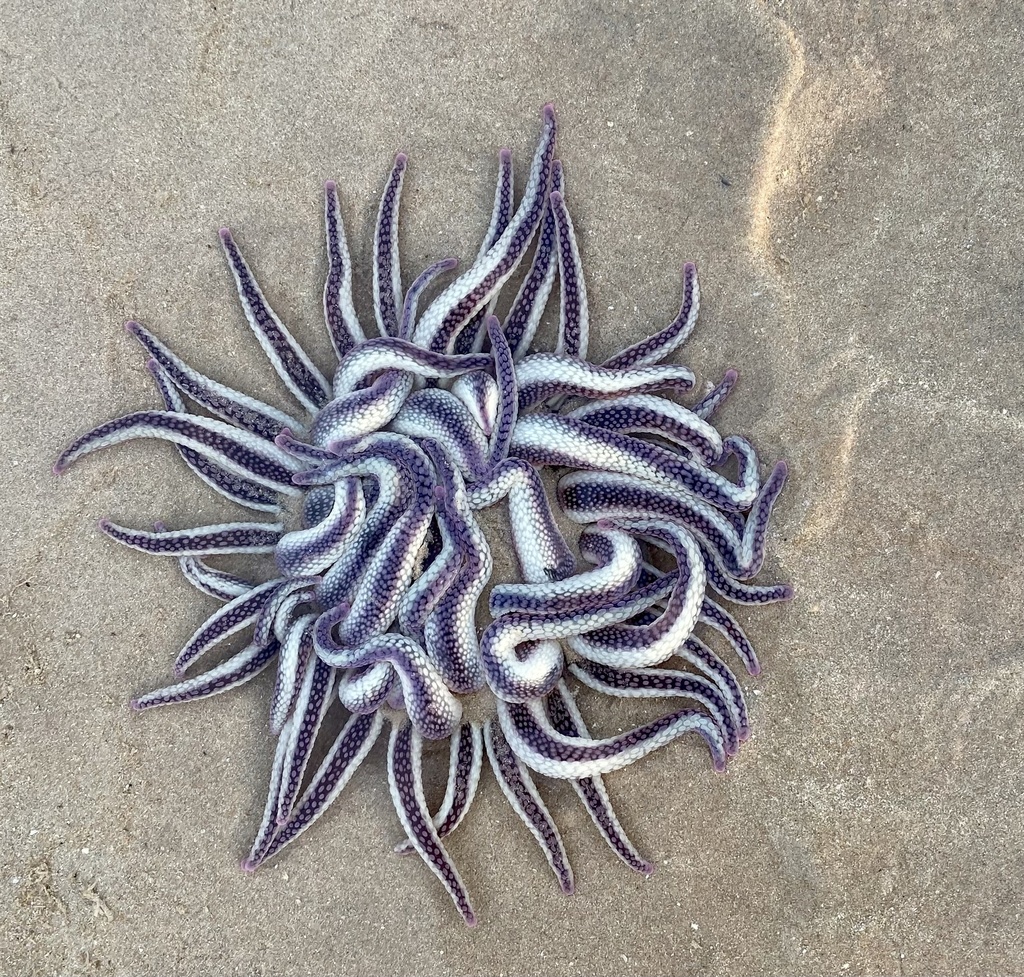
Dofleinia armata
Dofleinia armata, commonly known as the striped anemone or armed anemone, is a species of sea anemone in the family Actiniidae. It is the only species in the genus Dofleinia.
From the article Dofleinia on Wikipedia (CC BY-SA), quoted section by section
Description
Dofleinia armata is one of Australia's largest species of anemone. It can grow to 20 cm in diameter, with tentacles up to 50 cm long. The base of this species is broad, the column smooth, with a broad, flat oral disc. It has long inner tentacles which are a minimum of double the size of the outer tentacles. The tentacles have visible papillae on the surface. These contain nematocysts that are very large. The oral disc has papillae as well, but weaker. These also contain nematocysts. The surface of the tentacles end in a tip that is somewhat swollen. The tentacles are either cream, brown, or plain, and are striped. They have a surface that is scale-like and are often observed curling into ball shapes that hide the mouth. It is able to expand its body and tentacles due to a well-developed hydrostatic system.
Range & habitat
This species is known to live in the tropical waters of Australia as far south as Perth, Western Australia. It is also known to occur in the Philippines and Indonesia.
Wikipedia: “Distribution”
Toxicity
The sting of Dofleinia armata presents a danger to humans. Injuries resulting from contact with this species are considered very painful, and can take several months to heal.
Wikipedia: “Danger to humans”
Where it lives
Recorded sightings
—
geo-referenced records in GBIF, from museums, herbaria and field observers.
Drag the globe to turn it. Dots are where records exist, not a range map; darker means more records.
In the stacks
Searching the stacks…
Every page naming Dofleinia armata in the Biodiversity Heritage Library →
This page is assembled live from iNaturalist, GBIF, Wikipedia, the Source Library and the Internet Archive. It is not yet part of the hand-edited codex. iNaturalist taxon 361259.