- Plants
- ›Vascular Plants
- ›Ferns
- ›Leptosporangiate Ferns
- ›Polypod Ferns
- ›eupolypods I
- ›shieldfern family
- ›Dryopteridoideae
- ›Dryopteris
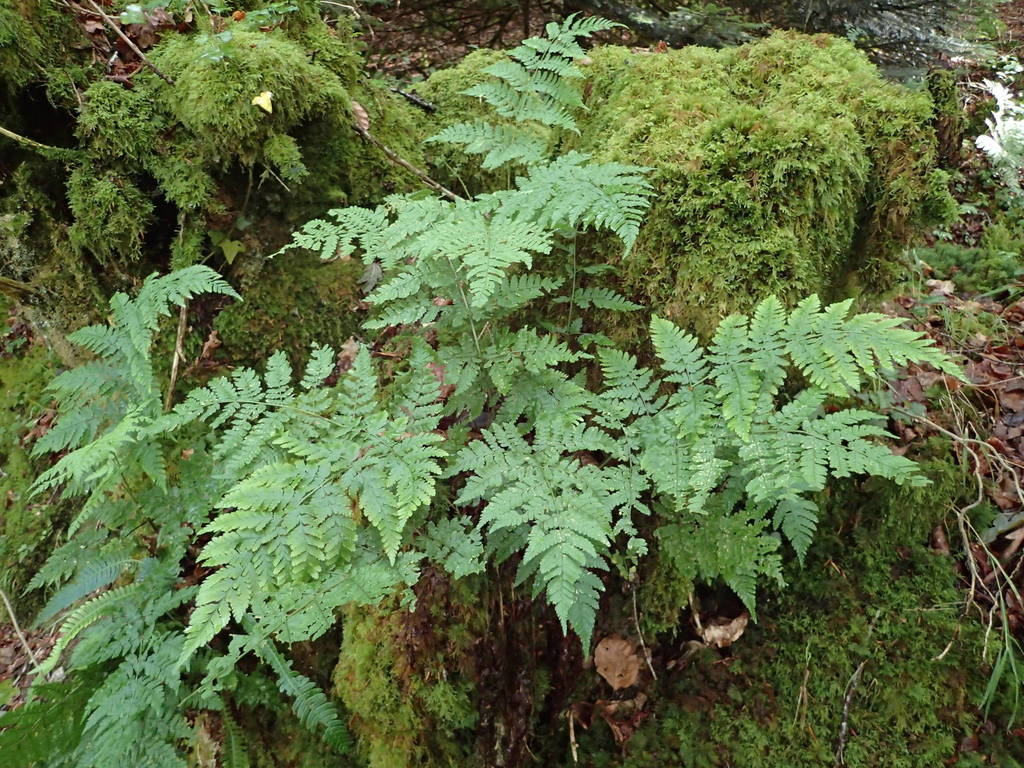
hay-scented buckler-fern
Dryopteris aemula
Dryopteris aemula, the hay-scented buckler-fern or hay-scented fern, is a species of perennial leptosporangiate fern.
From the article Dryopteris aemula on Wikipedia (CC BY-SA), quoted section by section
Description
Dryopteris aemula grows as a crown of fronds arising from a short ascending rhizome. The rachis is dark purple-brown with red-brown lanceolate scales. Leaves are tri-pinnate, triangular-ovate or triangular-lanceolate, 15–60 cm (5.9–23.6 in) long, often arching, semi-evergreen and pale yellow-green. Scattered small sessile glands grow on the underside or both surfaces of the fronds. Pinnae are slightly concave giving the frond a characteristic crisped appearance. The plant is hay-scented. Sori or spore-producing organs occur in a row down each side of the midrib. The indusium of the sorus is irregularly toothed and edged with sessile glands. The plant does not reproduce vegetatively and relies upon spores to generate new individuals.
Range & habitat
Dryopteris aemula is confined to the atlantic coastal areas of western Europe and Macaronesia. D. aemula is highly oceanic in its distribution occurring mostly in the Köppen climate type Cfb (oceanic climates). Even within Great Britain, it is restricted to western districts and has just a few outlying eastern localities such as The Weald. D. aemula reaches the northern limit of its distribution in Britain. 20% of the world population of D. aemula is in the United Kingdom.
Wikipedia: “Distribution”
Where it lives
Recorded sightings
—
geo-referenced records in GBIF, from museums, herbaria and field observers.
Drag the globe to turn it. Dots are where records exist, not a range map; darker means more records.
In the stacks
Searching the stacks…
Every page naming Dryopteris aemula in the Biodiversity Heritage Library →
This page is assembled live from iNaturalist, GBIF, Wikipedia, the Source Library and the Internet Archive. It is not yet part of the hand-edited codex. iNaturalist taxon 359750.